Fiber-Optic Automatic Gain Control Systems and Methods

a fiber optic and automatic gain control technology, applied in the field of methods and systems to receive and process optical signals, can solve the problems of introducing disruptive intensity fluctuations, attenuation effects of fso communication links, and/or optical turbulence, so as to reduce costs and/or losses

Active Publication Date: 2013-01-03
THE JOHN HOPKINS UNIV SCHOOL OF MEDICINE
View PDF3 Cites 16 Cited by
  • Summary
  • Abstract
  • Description
  • Claims
  • Application Information

AI Technical Summary

Benefits of technology

This patent is about controlling the power of optical components to prevent damage. It also discusses using hybrid components to reduce costs and losses.

Problems solved by technology

Free space optical (FSO) links are inherently different than fiber optic links, in that a FSO communication link may suffer from attenuation effects, line-of-sight limitations, and / or optical turbulence along a beam path.
In addition to inducing beam spread above a diffraction limit, turbulence may introduce disruptive intensity fluctuations at a receive terminal, where large power swings may occur in millisecond scales.
Attenuation changes may lead to excessive errors with intensity-modulated direct detection data communications, both when amplitude variations occur over a time scale comparable to the bandwidth of the decision circuits designed to determine the presence of a mark or a space, when variations couple through the decision electronics affecting the decision threshold, or when the undesirable amplitude modulation exceeds an amplitude range of decision circuits.
There is also a possibility of damage to sensitive optical detectors in cases where the upper limit of the power variations exceeds the damage threshold of the optical detector.
For example, commercially available high-sensitivity receivers, such as avalanche photodiodes, have relatively limited dynamic ranges and suffer from saturation and damage from large power variations.
Attenuation devices, by design, decrease the optical signal level to the receiver, even at minimum attenuation, and may thus reduce the optical signal-to-noise ratio (OSNR), of the received signal from which data is extracted, and may reduce the power of a received signal at a receiver input below an optimal level.
Forward-propagating ASE may co-propagate with the amplified input signal and may thus degrade amplifier performance.

Method used

the structure of the environmentally friendly knitted fabric provided by the present invention; figure 2 Flow chart of the yarn wrapping machine for environmentally friendly knitted fabrics and storage devices; image 3 Is the parameter map of the yarn covering machine
View more

Image

Smart Image Click on the blue labels to locate them in the text.
Viewing Examples
Smart Image
  • Fiber-Optic Automatic Gain Control Systems and Methods
  • Fiber-Optic Automatic Gain Control Systems and Methods
  • Fiber-Optic Automatic Gain Control Systems and Methods

Examples

Experimental program
Comparison scheme
Effect test

Embodiment Construction

[0001]This invention was made with U.S. Government support under contract number FA8650-04-D-2413-D0006. The U.S. Government has certain rights in the invention.

BACKGROUND

[0002]1. Technical Field

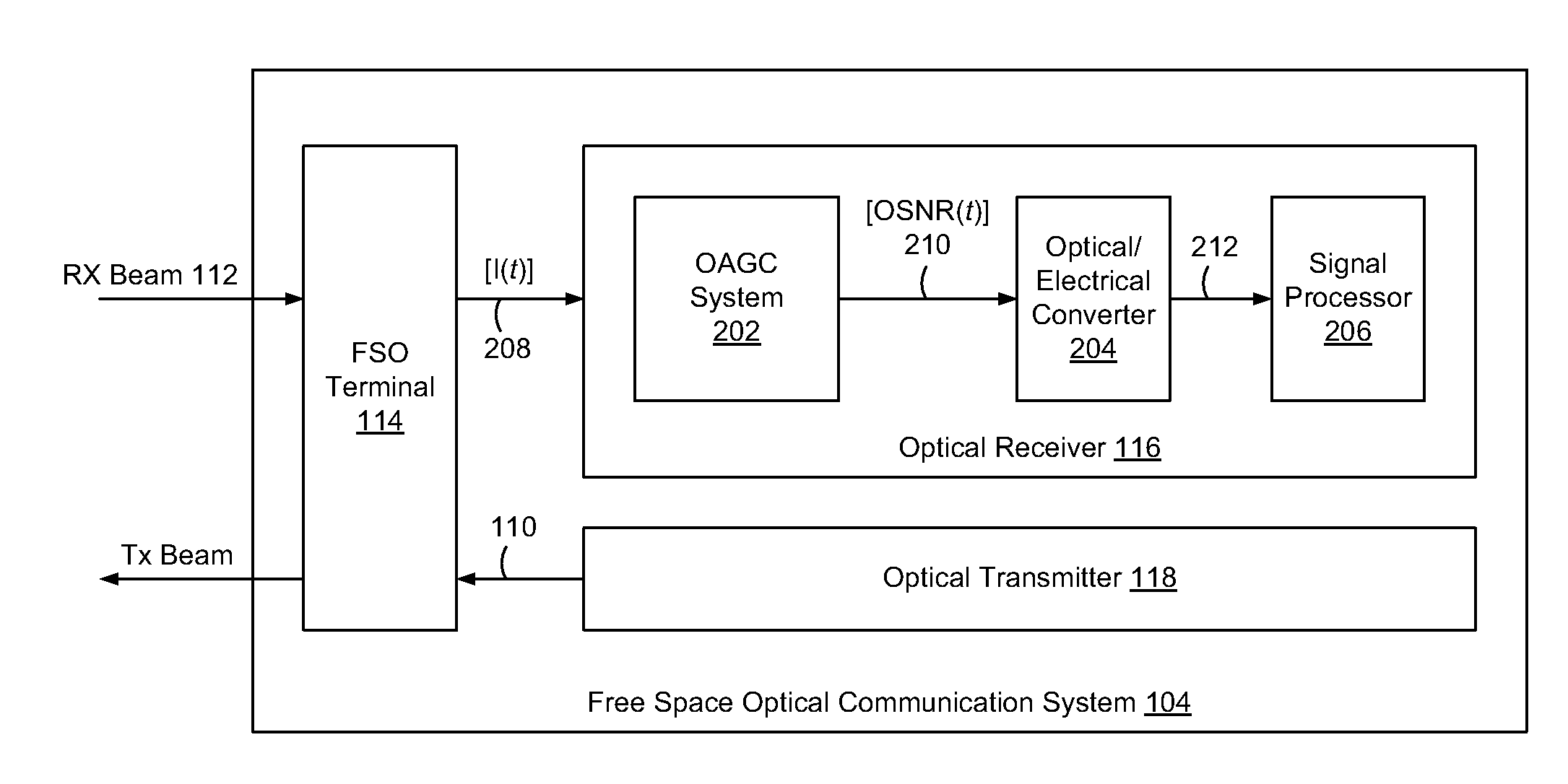
[0003]Disclosed herein are methods and systems to receive and process optical signals, including free-space optical (FSO) signals, including methods and systems to control a gain applied to an optical signal in response to time-varying intensity fluctuations, to translate the optical signal to a substantially constant-intensity optical signal.

[0004]2. Related Art

[0005]Free Space Optics (FSO) systems are used for line-of-sight communications, and may be used over distances of several kilometers (km).

[0006]There is a move towards designing free space optical communications systems to couple received light into a single-mode fiber. This may permit relatively large optical bandwidths to be accessed using elements developed and utilized in terrestrial and sub-sea optical fiber networks, such as h...

the structure of the environmentally friendly knitted fabric provided by the present invention; figure 2 Flow chart of the yarn wrapping machine for environmentally friendly knitted fabrics and storage devices; image 3 Is the parameter map of the yarn covering machine
Login to View More

PUM

No PUM Login to View More

Abstract

Methods and systems to control a gain applied to a free-space optical (FSO) signal to reduce time-varying intensity fluctuations. An optical pre-amplifier may provide a first, relatively moderate gain with low noise factor (NF). A second optical amplifier may provide a second gain. Amplification may include doped fiber amplification (DFA), such as erbium-doped fiber amplification (EDFA) and / or Raman amplification. A variable optical attenuator (VOA) may be controllable with a relatively fast response time to reduce the time-varying intensity fluctuations. The VOA may effectively control an overall system gain. The gain of the first and / or second optical amplifier may also be controllable to reduce the time-varying intensity fluctuations. Optical intensities may be detected at one or more locations to support one or more feed-forward and / or feedback control loops. A clamp may be applied when an optical power reaches a threshold.

Description

STATEMENT OF GOVERNMENTAL INTEREST[0001]This invention was made with U.S. Government support under contract number FA8650-04-D-2413-D0006. The U.S. Government has certain rights in the invention.BACKGROUND[0002]1. Technical Field[0003]Disclosed herein are methods and systems to receive and process optical signals, including free-space optical (FSO) signals, including methods and systems to control a gain applied to an optical signal in response to time-varying intensity fluctuations, to translate the optical signal to a substantially constant-intensity optical signal.[0004]2. Related Art[0005]Free Space Optics (FSO) systems are used for line-of-sight communications, and may be used over distances of several kilometers (km).[0006]There is a move towards designing free space optical communications systems to couple received light into a single-mode fiber. This may permit relatively large optical bandwidths to be accessed using elements developed and utilized in terrestrial and sub-sea...

Claims

the structure of the environmentally friendly knitted fabric provided by the present invention; figure 2 Flow chart of the yarn wrapping machine for environmentally friendly knitted fabrics and storage devices; image 3 Is the parameter map of the yarn covering machine
Login to View More

Application Information

Patent Timeline
no application Login to View More
IPC IPC(8): G02F2/00H04B10/06
CPCH04B10/1121
InventorJUAREZ, JUAN C.YOUNG, DAVID W.SLUZ, JOSEPH E.
OwnerTHE JOHN HOPKINS UNIV SCHOOL OF MEDICINE