Locking connector

a technology of locking connectors and connectors, applied in the direction of coupling device connections, mechanical equipment, engagement/disengagement of coupling parts, etc., can solve the problems of post turning and loosening its own mounting, affecting the service life of the connector, etc., to achieve the effect of easy adaptability to other connector types or families

US20130072048A1Active Publication Date: 2013-03-21MICRO COAX
19 Cites 36 Cited by

Patent Information

Authority / Receiving Office
US · United States
Patent Type
Applications(United States)
Current Assignee / Owner
Publication Date
2013-03-21

Smart Images

  • Figure 1
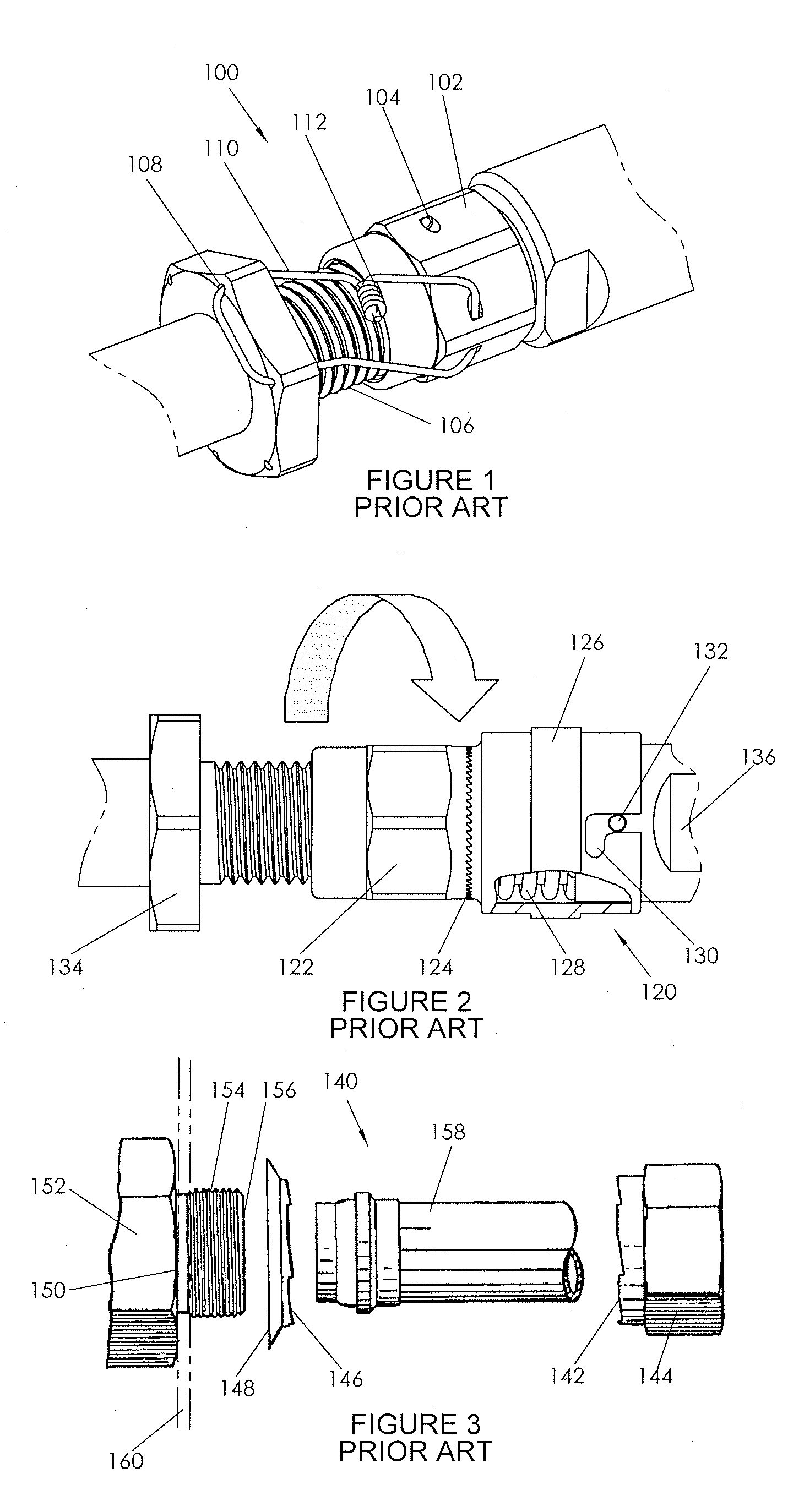
    Figure 1
  • Figure 2
    Figure 2
  • Figure 3
    Figure 3
Patent Text Reader

Abstract

A self-locking connector system has a connector member having an external thread and an axially extending keyway, and a connecting interface at a distal end. A connector body has a distal end with a connecting interface that mates with the connecting interface of the connector member. An internally threaded nut is captive on the distal end of the connector body encircling the connecting interface and is configured to screw onto the externally threaded connector member. A locking collar is dimensioned to encircle the externally threaded connector member, has at least one key dimensioned to engage in the keyway, and is movable axially on the nut between a first position in which the nut is rotatable relative to the collar and a second position in which the nut is not rotatable relative to the collar.
Need to check novelty before this filing date? Find Prior Art

Description

FIELD OF THE INVENTION

[0001] The invention pertains to a connector to interconnect the mating ends of connector bodies, and for holding coaxial cables and other conduits for material or data coupled together, including connecting an end of a cable or other flexible conduit to a post or other connector mounted to a solid object.BACKGROUND OF THE INVENTION

[0002] It is well known to connect coaxial cables, hosepipes, and other conduits for material or data end-to-end by providing a connector member with an external screw thread on one conduit end, and an internally threaded nut rotatable but captive on a connector body at the other conduit end.

[0003] It is well known that connectors used on satellites, military aircraft, and missile systems experience several Gs of shock and high amplitudes of vibration, which can cause the nuts to loosen, which degrades signal performance. The risk of loosening in use can be reduced by screwing up the nut very tightly. However, the externally threaded me...

Examples

Embodiment Construction

[0036]A better understanding of various features and advantages of the present invention will be obtained by reference to the following detailed description of embodiments of the invention and accompanying drawings, which set forth illustrative embodiments that utilize particular principles of the invention.

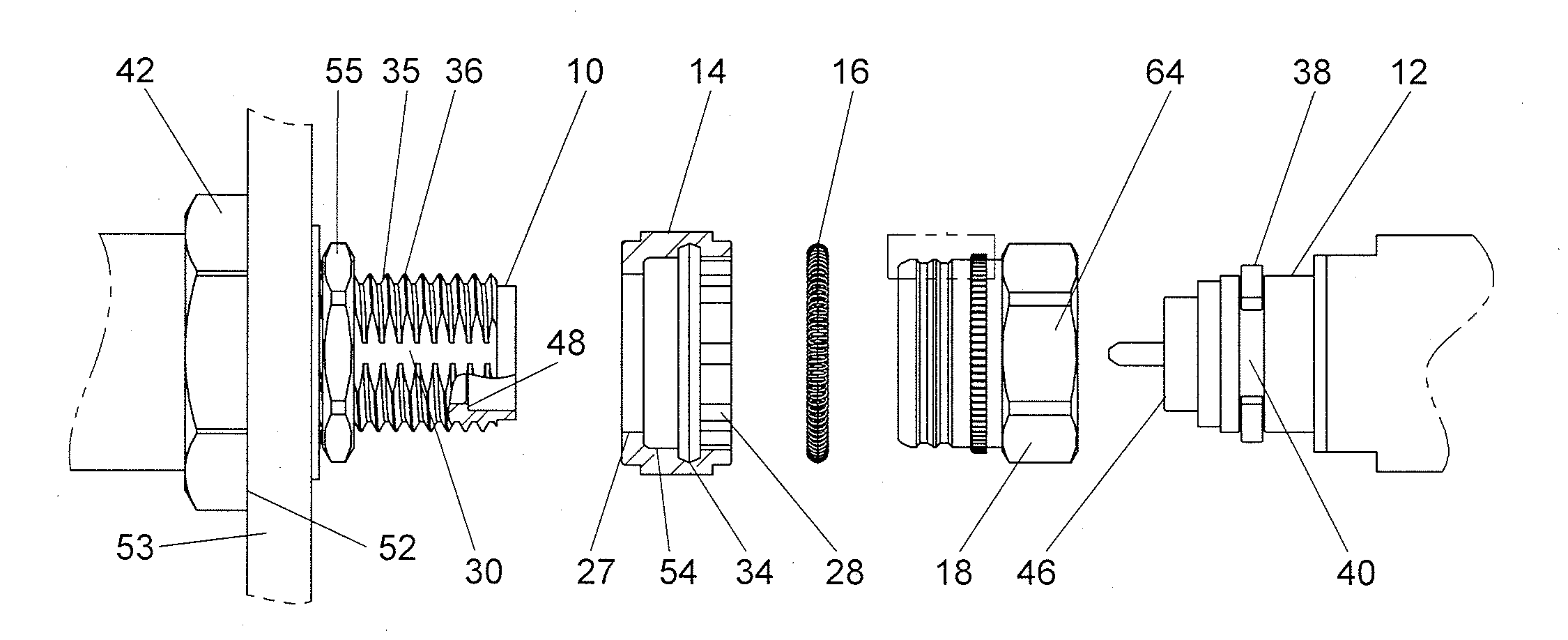
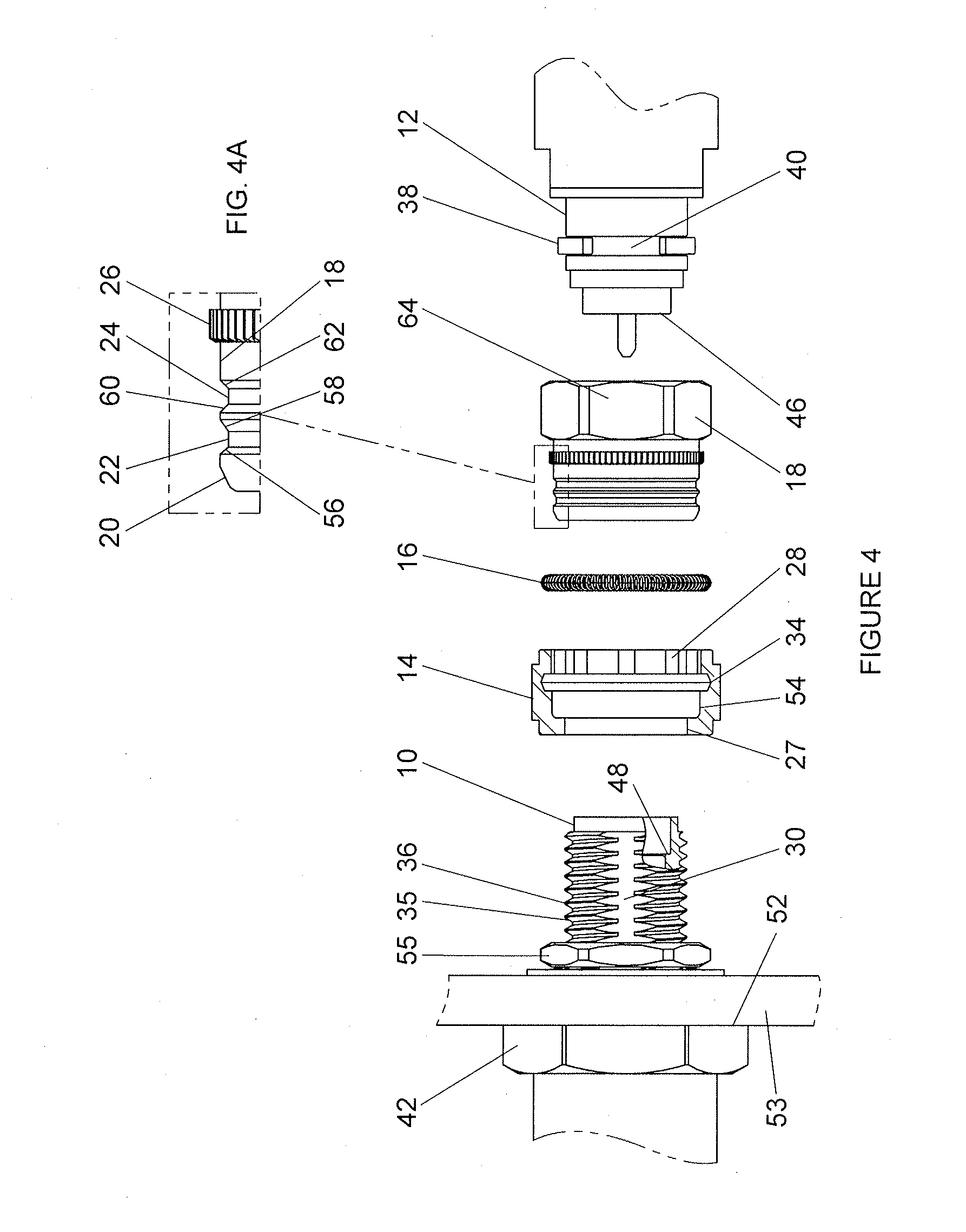
[0037]Referring to FIGS. 4 to 7A, and initially to FIG. 4, one embodiment of a connector for a coaxial cable according to an embodiment of the invention comprises a first body or connector member 10 having a threaded distal end 35 with at least one keyway in the form of a D-flat 30 axially along the threads 36. An annular sealing surface 48 is provided in the open end of the distal end 35 of connector member 10. Connector member 10 is also provided with a hexagonal structure 42 that can be grasped by a wrench for tightening. The distal face of hexagonal structure 42 defines a shoulder 52 that abuts the rear face of a panel 53 for mounting. Connector member 10 may be secured to pa...