
Nucleic acid probe with single fluorophore label bound to internal cytosine for use in loop mediated isothermal amplification
a nucleic acid and fluorophore technology, applied in the field of nucleic acid probes, can solve the problems of difficult to distinguish between specific and unspecific dna products generated under isothermal conditions, and the commonly used probes such as taqman® probes are not compatible with lamp technology, so as to achieve specificity of dna products amplified in isothermal reaction
- Summary
- Abstract
- Description
- Claims
- Application Information
AI Technical Summary
Benefits of technology
Problems solved by technology
Method used
Image

Examples
example 1
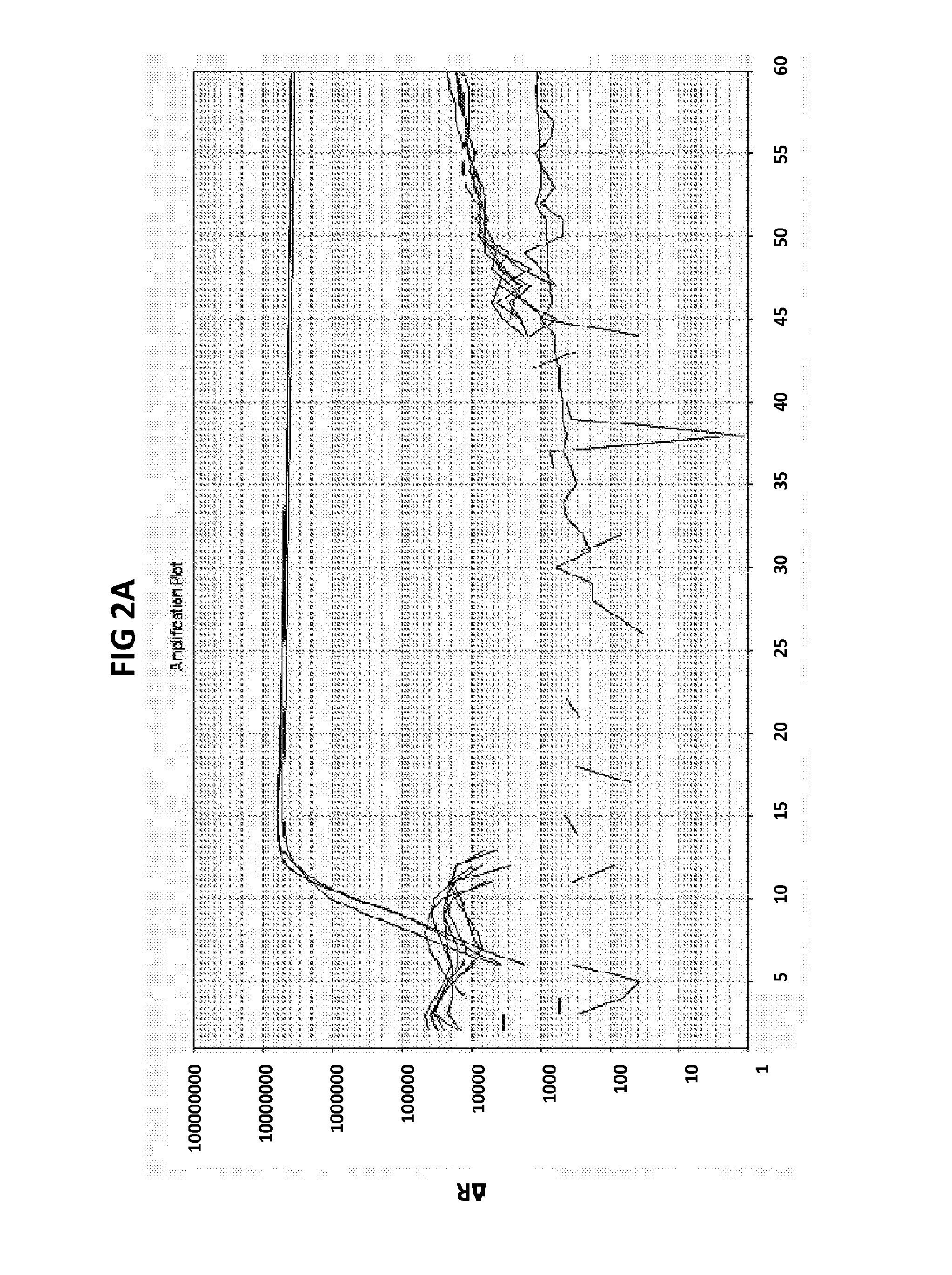
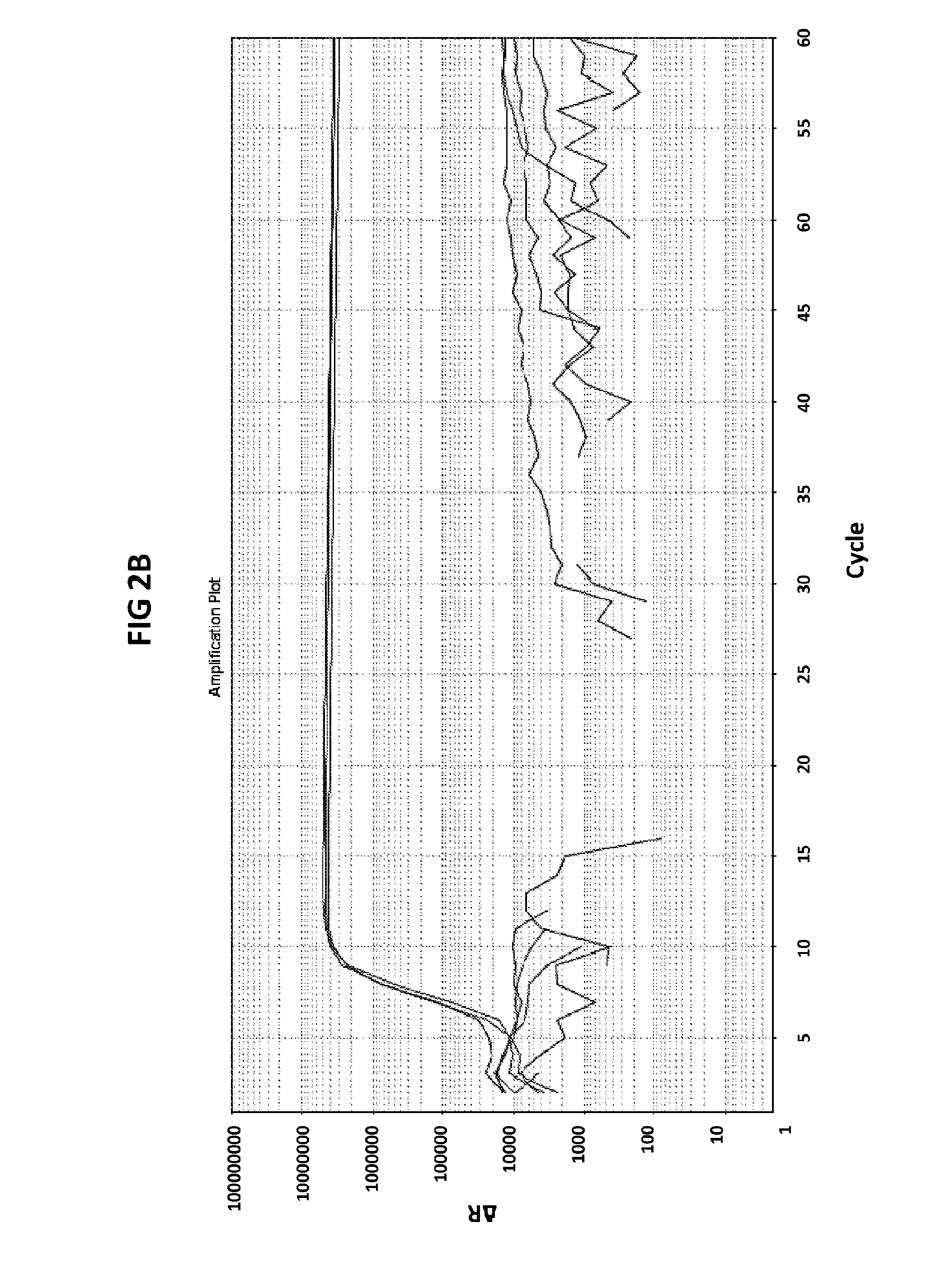
[0062]FIGS. 2A to 2F shows amplification plots generated with the CT PB1 (FIG. 2A and FIG. 2D), GC glnA7 (FIG. 2B and FIG. 2E) and GC porA7 (FIG. 2C and FIG. 2F) primers in V6.21 buffer containing V13 (FIGS. 2A, 2B and 2C) or V6.21p buffer without V13 dye (FIGS. 2D, 2E and 2F). The target sequences shown in SEQ ID NOs. 7 to 9 with CT PB1 internal probe conjugated with FAM, GC glnA7 loop probe conjugated with Joe and GC porA7 loop probe conjugated with Alexa546 respectively. All reactions were performed for 60 mins at a constant temperature of 63 C with AB17500 machine.
example 2
[0063]FIGS. 3A and 3B are melt curve analyses of LAMP products generated with CT PB1 primers in the presence of CT PB1 internal probe conjugated with FAM. 100 pg per reaction of ATTC CT DNA standard was used as a positive control. A—normalized reporter plot, B—derivative reporter plot. Melt curve plots were generated based on the readouts in FAM channel with AB17500 machine.
example 3
[0064]FIGS. 4A and B are melt curve analyses of LAMP product generated with GC glnA7 primers in the presence of GC glnA7 loop probe conjugated with JOE. 100 pg per reaction of ATTC GC DNA standard was used as a positive control. FIG. 4A shows a normalized reporter plot and FIG. 4B shows a derivative reporter plot. Melt curve plots were generated based on the readouts in JOE channel with AB17500 machine.
PUM
| Property | Measurement | Unit |
|---|---|---|
| length | aaaaa | aaaaa |
| fluorescence | aaaaa | aaaaa |
| fluorescent | aaaaa | aaaaa |
Abstract
Description
Claims
Application Information
 Login to View More