This helps you quickly interpret patents by identifying the three key elements:
Problems solved by technology
Method used
Benefits of technology
Benefits of technology
The invention provides a building material that has better resistance to blocking and is less prone to burrs and breakage during processing. This is achieved by controlling the pencil hardnesses of the first and second mirror coatings on the surface of the base material.
Problems solved by technology
In the case where building materials are stacked this way, there is a concern that blocking may occur when the above-described mirror finished coatings are formed on the surface of the building materials.
However, if the hardness of the coating is too high, other concerns such as the occurrence of burrs in the coating and breakage of the coating may arise at the time of cutting a plate-like building material into an appropriate size.
Method used
the structure of the environmentally friendly knitted fabric provided by the present invention; figure 2 Flow chart of the yarn wrapping machine for environmentally friendly knitted fabrics and storage devices; image 3 Is the parameter map of the yarn covering machine
View more
Image
Smart Image Click on the blue labels to locate them in the text.
Viewing Examples
Smart Image
Click on the blue label to locate the original text in one second.
Reading with bidirectional positioning of images and text.
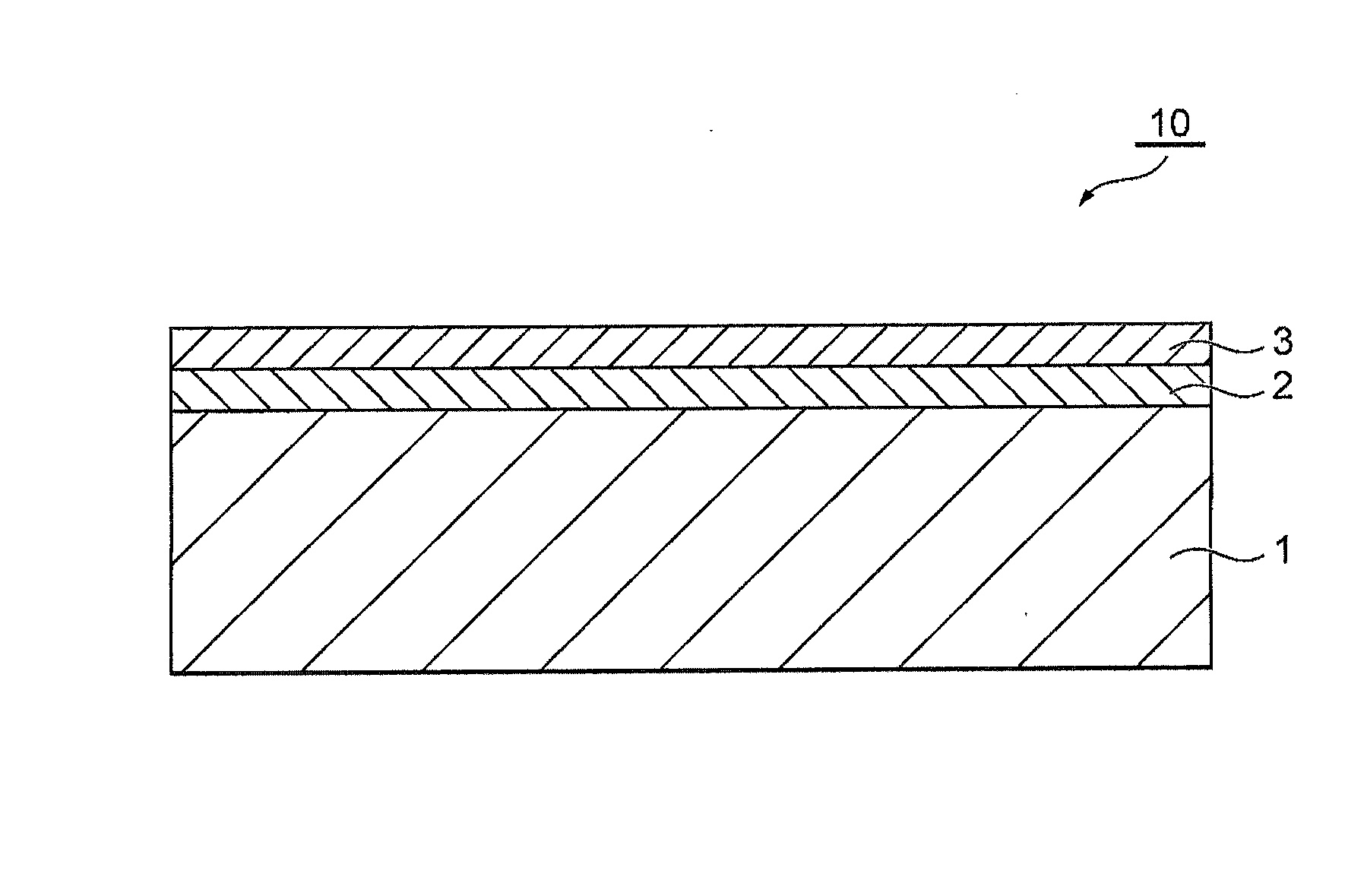
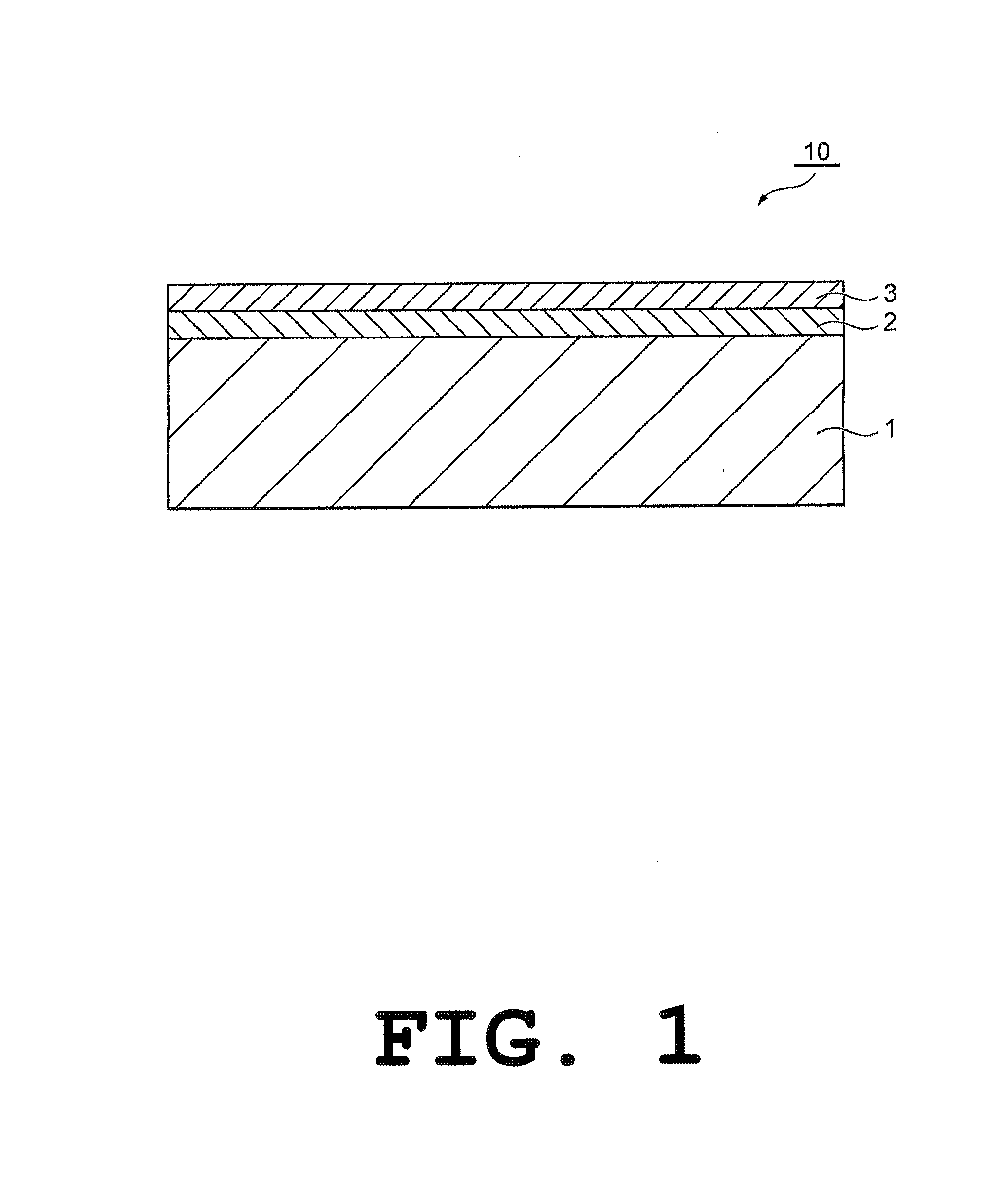
[0036]FIG. 1 is an enlarged partial vertical cross-sectional view of Embodiment 1 of a building material according to the invention.
[0037]A building material 10 as shown is configured as a whole by a first mirror coating 2 being formed on the surface of a base material 1 and a second mirror coating 3 being formed on the surface of the first mirror coating 2.
[0038]Here, the base material 1 is formed, for example, of a ceramic siding board composed mainly of cement (e.g., a wood cement board, a fiber reinforced cement board, a fiber reinforced cement / calciumsilicate board, or a slag plaster board), an ALC board, a metal siding board made of a metal plate, or a resin board.
[0039]The first mirror coating 2 is formed from a filler and a first resin material. Here, as the filler, it is possible to adopt, for example, one or more of talc, calciumcarbonate, silica (crystalline silica, fused silica, amorphous silica), glass (glass flake, powdered glass fiber), quartz (p...
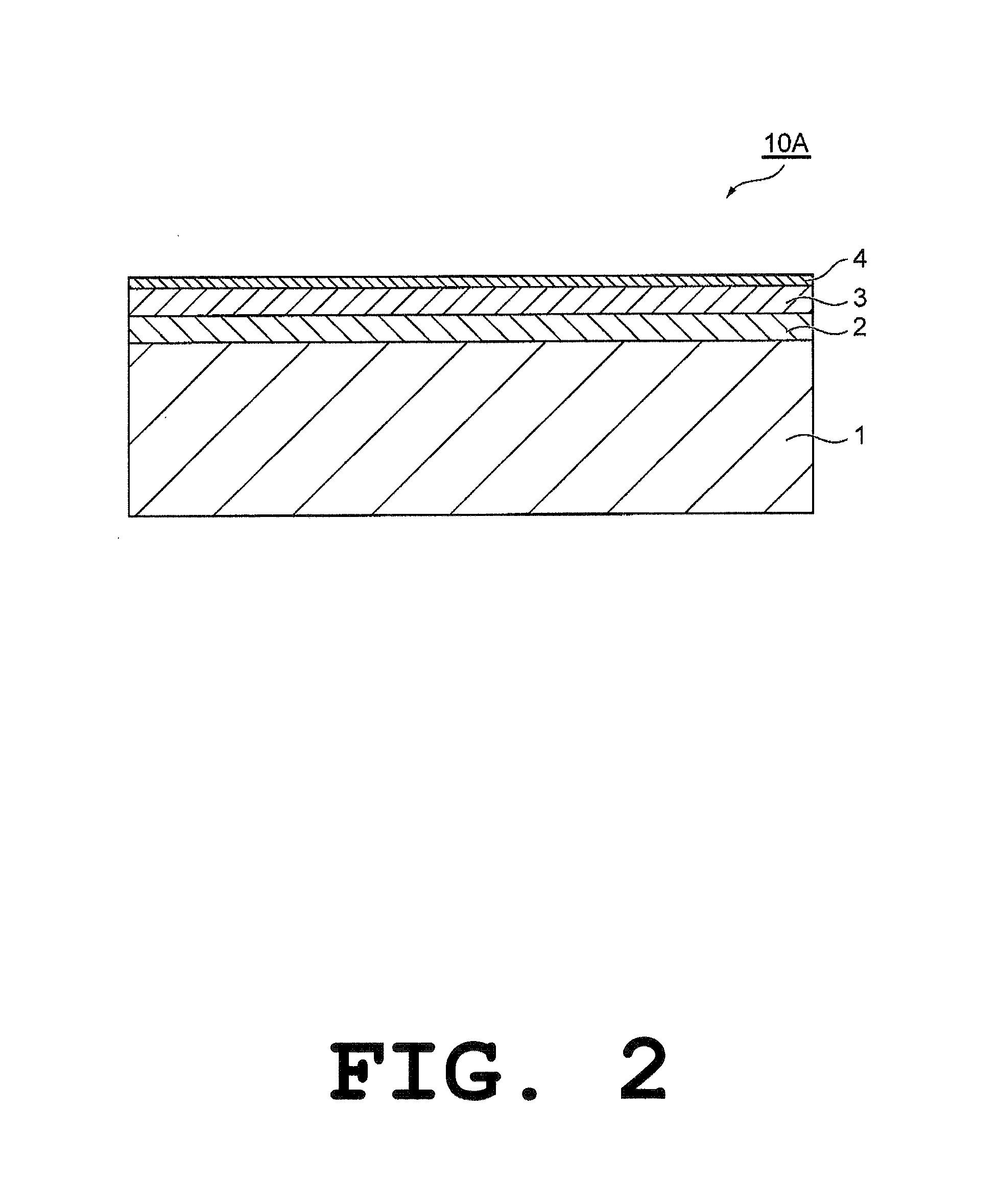
[0051]FIG. 2 is an enlarged partial vertical cross-sectional view of Embodiment 2 of a building material according to the invention.
[0052]In a building material 10A as shown, a first mirror coating 2 is formed on the surface of a base material 1, and a second mirror coating 3 is formed on the surface of the first mirror coating 2. The building material 10A is configured as a whole by further forming a protective coating 4 on the surface of the second mirror coating 3.
[0053]Here, the protective coating 4 is formed, for example, from a fluororesin, an acrylic resin, or an acrylic silicone resin. In other words, the protective coating 4 can be formed from the same resin material as the second resin material that forms the second mirror coating 3. Accordingly, it is possible to achieve a pencil hardness in the range of about B or more and about 2H or less, which is comparable to the pencil hardness of the second mirror coating 3.
[0054]With the building material 10A, ...
the structure of the environmentally friendly knitted fabric provided by the present invention; figure 2 Flow chart of the yarn wrapping machine for environmentally friendly knitted fabrics and storage devices; image 3 Is the parameter map of the yarn covering machine
Login to View More
PUM
Property
Measurement
Unit
Percent by mass
aaaaa
aaaaa
Percent by mass
aaaaa
aaaaa
Hardness
aaaaa
aaaaa
Login to View More
Abstract
A building material includes a base material, a first mirror coating formed on the surface of the base material, a second mirror coating formed on the surface of the first mirror coating, wherein the first mirror coating contains a filler and a first resin material, the pencil hardness of the first mirror coating is in the range of about 3H to about 8H, the second mirror coating contains at least a second resin material, and the pencil hardness of the second mirror coating is in the range of about B to about 2H.
Description
CROSS REFERENCE TO RELATED APPLICATIONS[0001]This application is based on Japanese Patent Application No. 2015-068568 filed with the Japanese Patent Office on Mar. 30, 2015, the entire content of which is hereby incorporated by reference.BACKGROUND OF THE INVENTION[0002]1. Field of the Invention[0003]The present invention relates to a building material such as a siding board.[0004]2. Description of the Related Art[0005]A ceramic siding board, a metal siding board, an ALC board (Autoclaved Lightweight aerated Concrete board), and the like are used as building materials constituting the exterior walls and the interior walls of buildings.[0006]In recent years, there has been an increasing need for the above-described building materials to have a high-quality appearance. As one measure to meet this need, mirror finish on the surface of the building materials has been examined.[0007]JP 2006-181492A discloses a method of forming a finished layer in the following manner. First, a polyester...
Claims
the structure of the environmentally friendly knitted fabric provided by the present invention; figure 2 Flow chart of the yarn wrapping machine for environmentally friendly knitted fabrics and storage devices; image 3 Is the parameter map of the yarn covering machine
Login to View More
Application Information
Patent Timeline
Application Date:The date an application was filed.
Publication Date:The date a patent or application was officially published.
First Publication Date:The earliest publication date of a patent with the same application number.
Issue Date:Publication date of the patent grant document.
PCT Entry Date:The Entry date of PCT National Phase.
Estimated Expiry Date:The statutory expiry date of a patent right according to the Patent Law, and it is the longest term of protection that the patent right can achieve without the termination of the patent right due to other reasons(Term extension factor has been taken into account ).
Invalid Date:Actual expiry date is based on effective date or publication date of legal transaction data of invalid patent.


 Login to View More