Method and device for monitoring a setpoint trajectory to be traveled by a vehicle for being collision free

a technology of collision free and setpoint trajectory, which is applied in the direction of process and machine control, using reradiation, instruments, etc., can solve the problems of not always expedient to check the trajectories based on detected objects, and may not determine the precise contour of objects

US20180050694A1Active Publication Date: 2018-02-22ROBERT BOSCH GMBH
1 Cites 4 Cited by

Patent Information

Authority / Receiving Office
US · United States
Patent Type
Applications(United States)
Current Assignee / Owner
Publication Date
2018-02-22

Smart Images

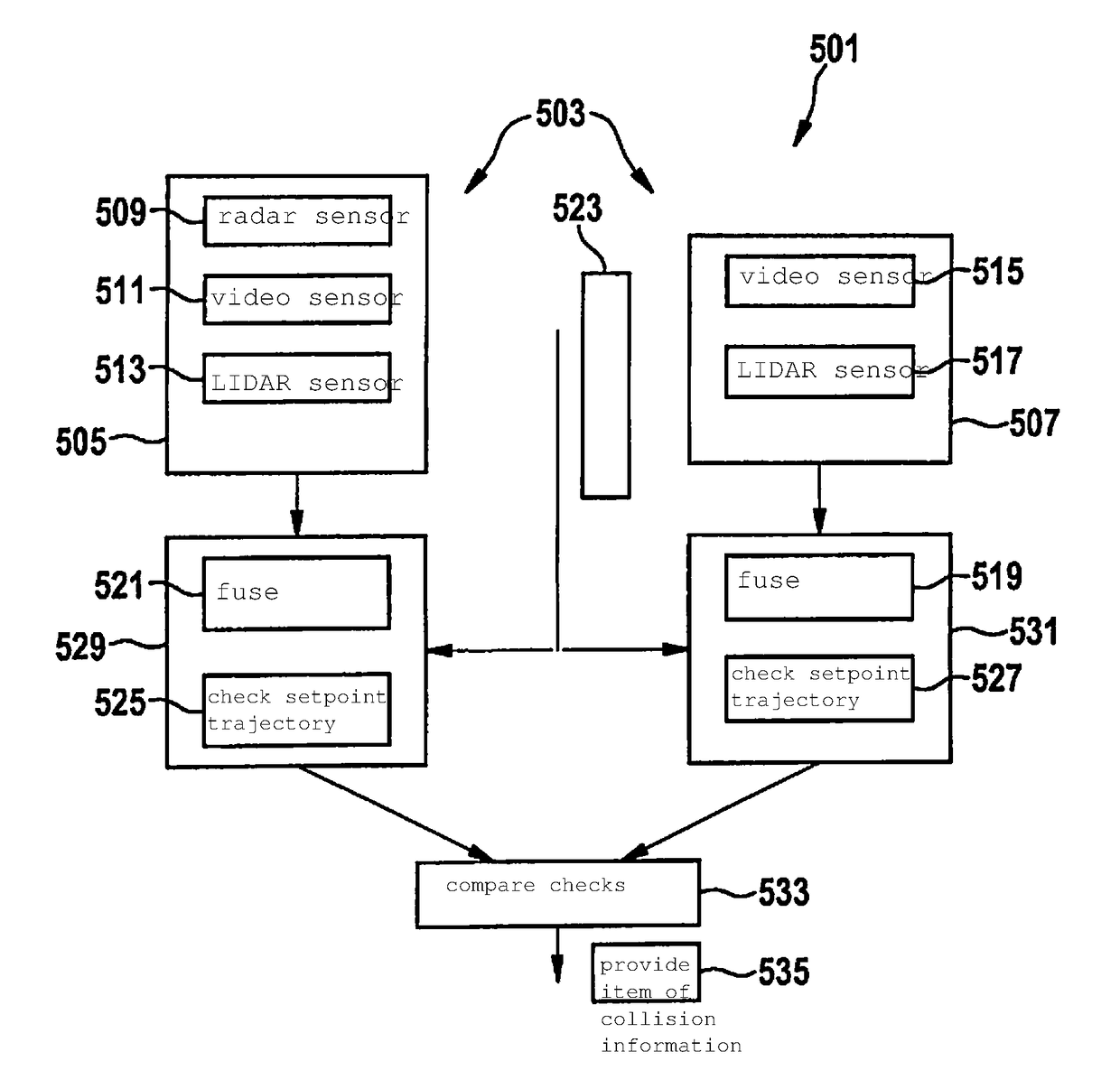
  • Figure 1
    Figure 1
  • Figure 2
    Figure 2
  • Figure 3
    Figure 3
Patent Text Reader

Abstract

A method for monitoring a setpoint trajectory to be traveled by a vehicle for being collision free, including carrying out a clearance measurement of vehicle surroundings with the aid of a surroundings sensor system to determine a clearance in the vehicle surroundings, carrying out an object measurement of the vehicle surroundings with the aid of the surroundings sensor system to determine objects in the vehicle surroundings, checking the setpoint trajectory for being collision free based on the determined clearance and the determined objects, and comparing particular results of the checks for being collision free to one another, an item of collision information being provided based on the comparison.
Need to check novelty before this filing date? Find Prior Art

Description

FIELD

[0001] The present invention relates to a method and a device for monitoring a setpoint trajectory to be traveled by a vehicle for being collision free. The present invention furthermore relates to a system for monitoring a setpoint trajectory to be traveled by a vehicle for being collision free, a vehicle, and a computer program.BACKGROUND INFORMATION

[0002] In highly-automated driving, monitoring the setpoint trajectory computed by the vehicle before it is traveled is indispensable for reasons of safety. Fundamentally, the setpoint trajectory including all detected objects is checked for collisions. If a setpoint trajectory is to result in a collision, it is classified as inadvisable and is not traveled. However, it is generally not trivial to determine the actual size (in particular width and length) of objects. In particular surroundings sensors, for example, a radar sensor or a monocamera, are at best capable of recognizing that an object is located somewhere in the field of ...

Examples

Embodiment Construction

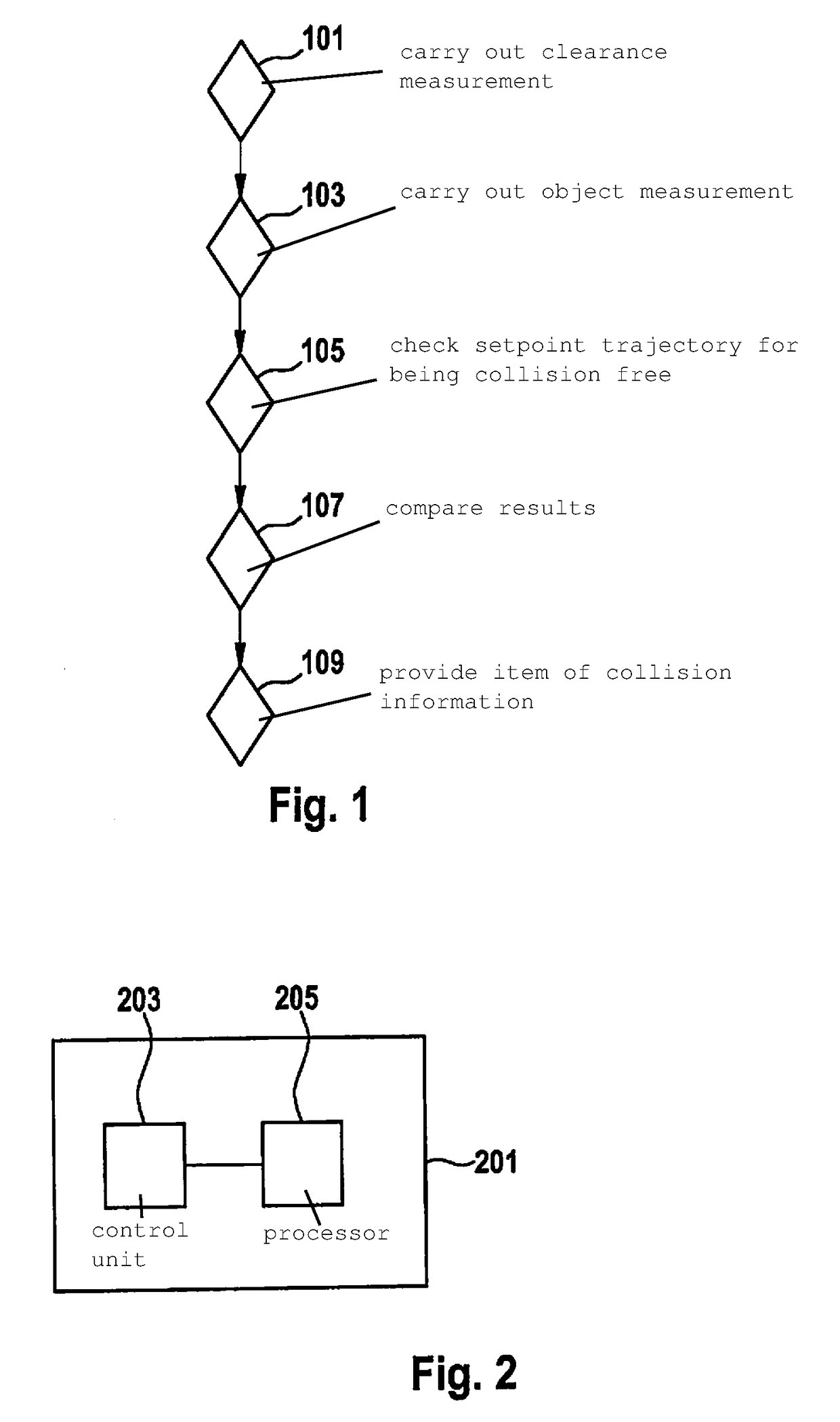
[0044]FIG. 1 shows a flow chart of a method for monitoring a setpoint trajectory to be traveled by a vehicle for being collision free.

[0045]According to a step 101, a clearance measurement of vehicle surroundings is carried out with the aid of a surroundings sensor system to determine a clearance in the vehicle surroundings. According to a step 103, an object measurement of the vehicle surroundings is carried out with the aid of the surroundings sensor system to determine objects in the vehicle surroundings. In a step 105, the setpoint trajectory is checked for being collision free in each case based on the determined clearance and the determined objects.

[0046]In a step 107, particular results of the checks for being collision free according to step 105 are compared to one another, an item of collision information being provided based on the comparison according to a step 109.

[0047]The collision information is provided, for example, to an ascertainment unit for ascertaining the setp...