
Near-infrared absorbing composition, optical structure, and camera module and electronic device comprising the same
a composition and near-infrared technology, applied in the field of near-infrared absorbing composition, optical structure, camera module and electronic device, to achieve the effect of low visible absorban
- Summary
- Abstract
- Description
- Claims
- Application Information
AI Technical Summary
Benefits of technology
Problems solved by technology
Method used
Image

Examples
example 1
[0228]The near-infrared absorbing composition is coated with a bar #75 on an about 100 μm-thick cycloolefin polymer (COP, Zeon Co., Ltd.) film and photo-cured with a UV light dose of about 1000 mJ to form a first near-infrared absorption layer.
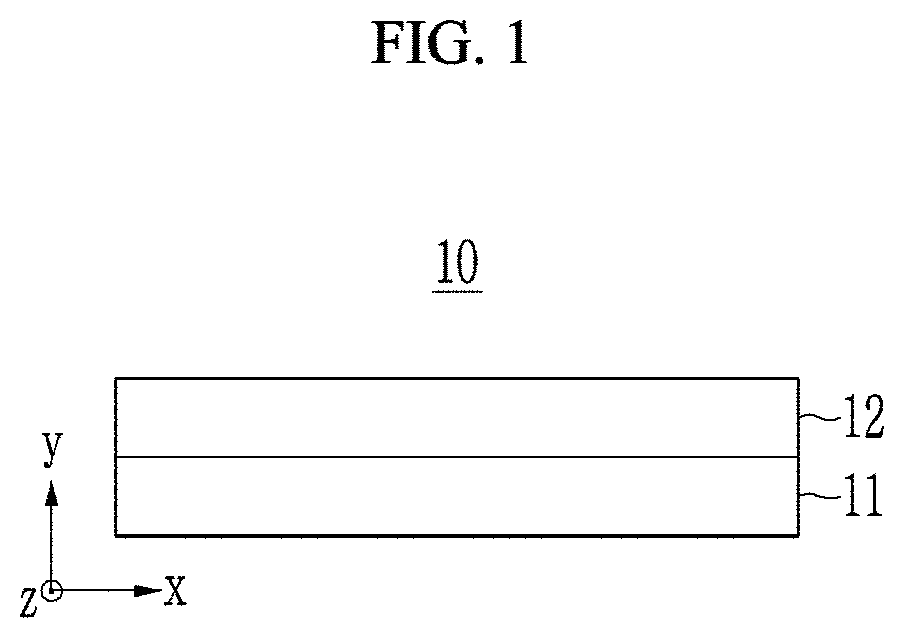
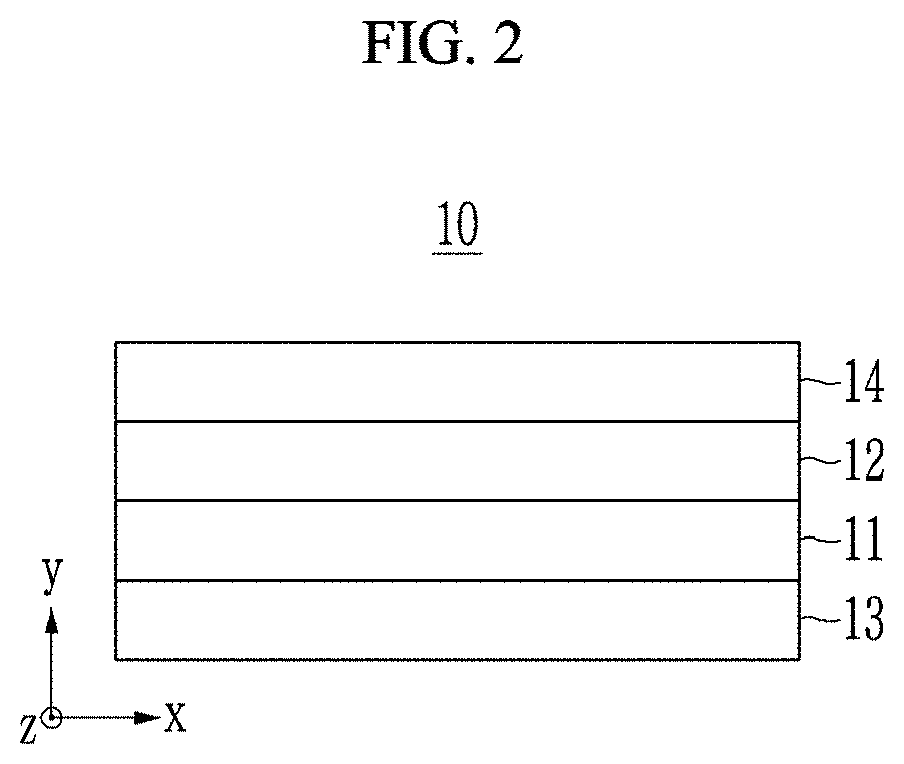
[0229]Subsequently, on the first near-infrared absorption layer, an acryl-based urethane primer (ERS-698, DIC Co., Ltd.) is coated with a bar #8 and photocured with a UV light dose of about 500 mJ, and then, a solution obtained by dissolving 1 g of polycarbonate (Lupoy, LG Chem Ltd.) in 4.5 g of chloroform is coated with a bar #10 thereon and dried in a 60° C. drying oven for 10 minutes to sequentially form a primer layer and an overcoating layer on the first near-infrared absorption layer (the copper complex 1) and thus manufacture a optical structure.
example 2
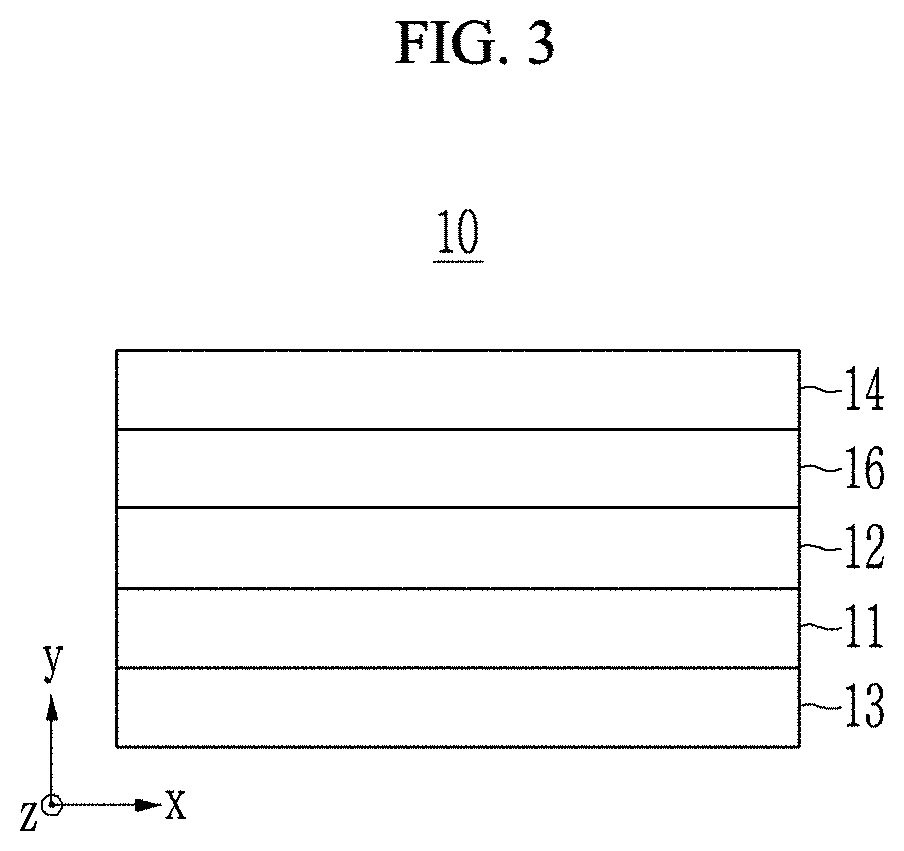
[0230]An acryl-based urethane primer (ERS-698, DIC Co., Ltd.) is bar-coated on the first near-infrared absorption layer and photocured with a UV light dose of about 300 mJ, and then, a solution obtained by dissolving 1 g of polycarbonate (Lupoy, LG Chem Ltd.), 0.015 g of a squarylium dye, and 0.01 g of a dimmonium dye (Epolight™ 1178, Epolin Inc.) in 4.5 g of chloroform is bar-coated and dried in a 60° C. drying oven for 10 minutes to sequentially from an about 100 μm-thick first near-infrared absorption layer (the copper complex 1), a primer layer, and an about 3 μm-thick second near-infrared absorption layer (an organic dye) and thus manufacture a optical structure.
PUM
| Property | Measurement | Unit |
|---|---|---|
| wavelength region | aaaaa | aaaaa |
| light transmittance | aaaaa | aaaaa |
| light transmittance | aaaaa | aaaaa |
Abstract
Description
Claims
Application Information
 Login to View More