
Method and system for reducing cross-talk and avoiding bridged taps
a technology of bridged taps and cross-talk, applied in the field of high-speed communications, can solve the problems of impaired dsl modem performance, impaired communications performance, and impairments of dsl technology, so as to improve the performance of communications links and improve communications performan
- Summary
- Abstract
- Description
- Claims
- Application Information
AI Technical Summary
Benefits of technology
Problems solved by technology
Method used
Image

Examples
Embodiment Construction
Exemplary System
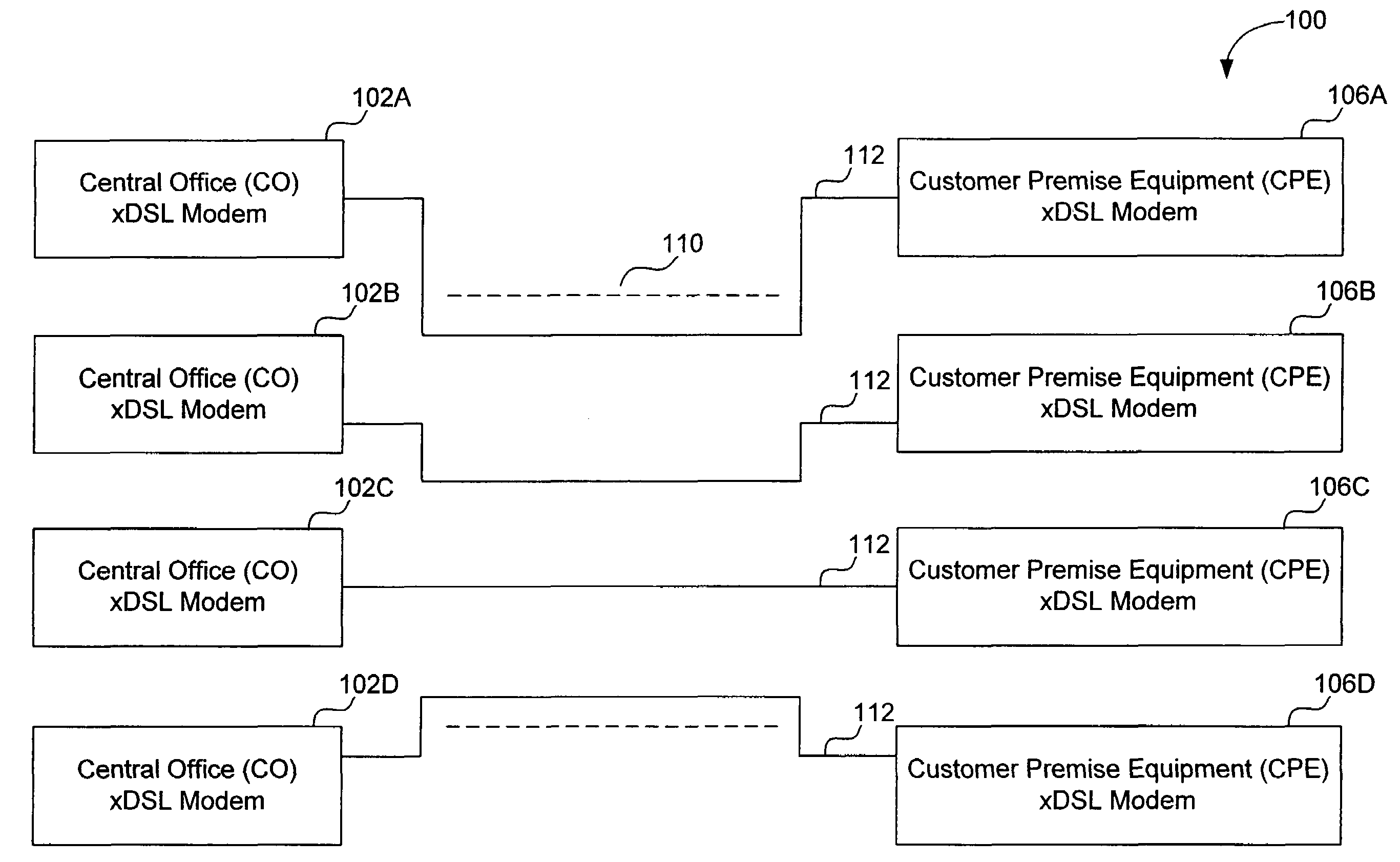
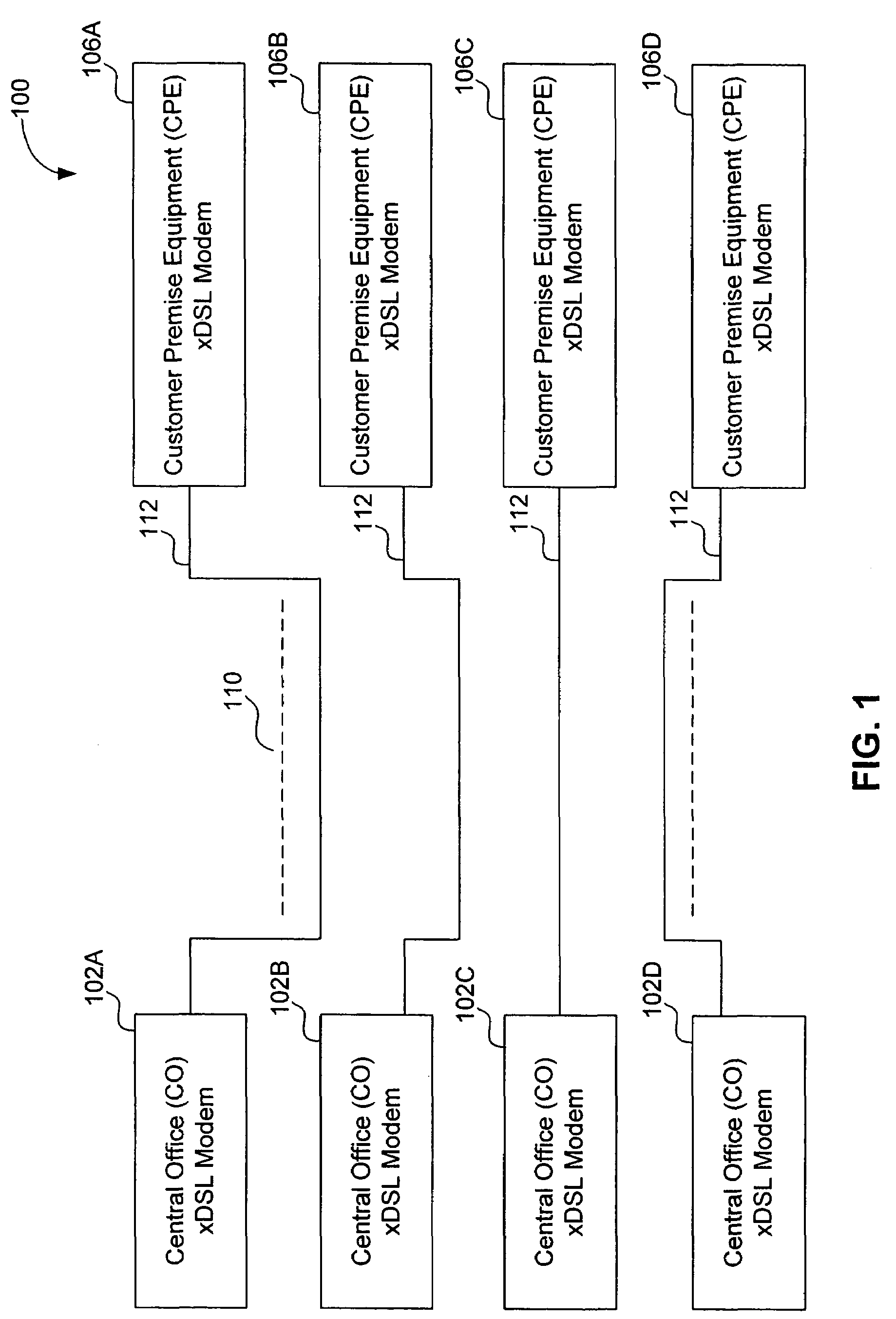
[0031]FIG. 1 is a high level block diagram of a communications system in accordance with embodiments of the present invention. The communications system 100 enables voice communications, video, and data services to be exchanged based on bidirectional transfer of Internet Protocol (IP) or Asynchronous Transfer Mode (ATM) traffic between a plurality of central office (CO) xDSL modems 102A, 102B, 102C, and 102D (referred to collectively as 102) and a plurality of customer premise equipment (CPE) xDSL modems 106A, 106B, 106C, and 106D (referred to collectively as 106) over a communications network 110.
[0032]The communications network 110 provides for the high-speed, reliable, and secure transport of data between the CO modems 102 and the CPE modems 106. As will be appreciated by persons skilled in the relevant arts(s), the functionality of the modems 102 and 106 may be combined into a single modem or device. In this way, the single modem or device can operate as either a...
PUM
 Login to View More
 Abstract
Description
Claims
Application Information
 Login to View More