
Dental mill blank assembly
a milling and assembly technology, applied in the field of milling blank assembly, can solve the problems of high cost of gold in comparison to other dental materials, not considered aesthetics, and widely considered, and achieve the effect of enhancing fracture resistance and safely resisting forces
- Summary
- Abstract
- Description
- Claims
- Application Information
AI Technical Summary
Benefits of technology
Problems solved by technology
Method used
Image

Examples
Embodiment Construction
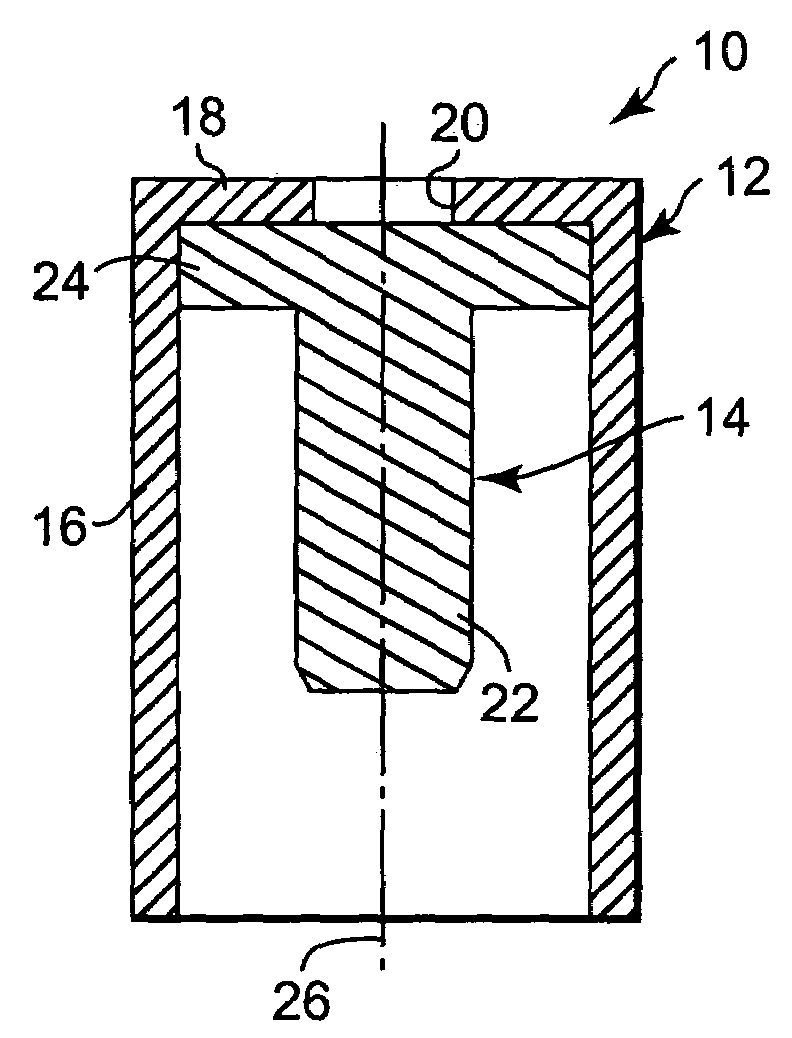
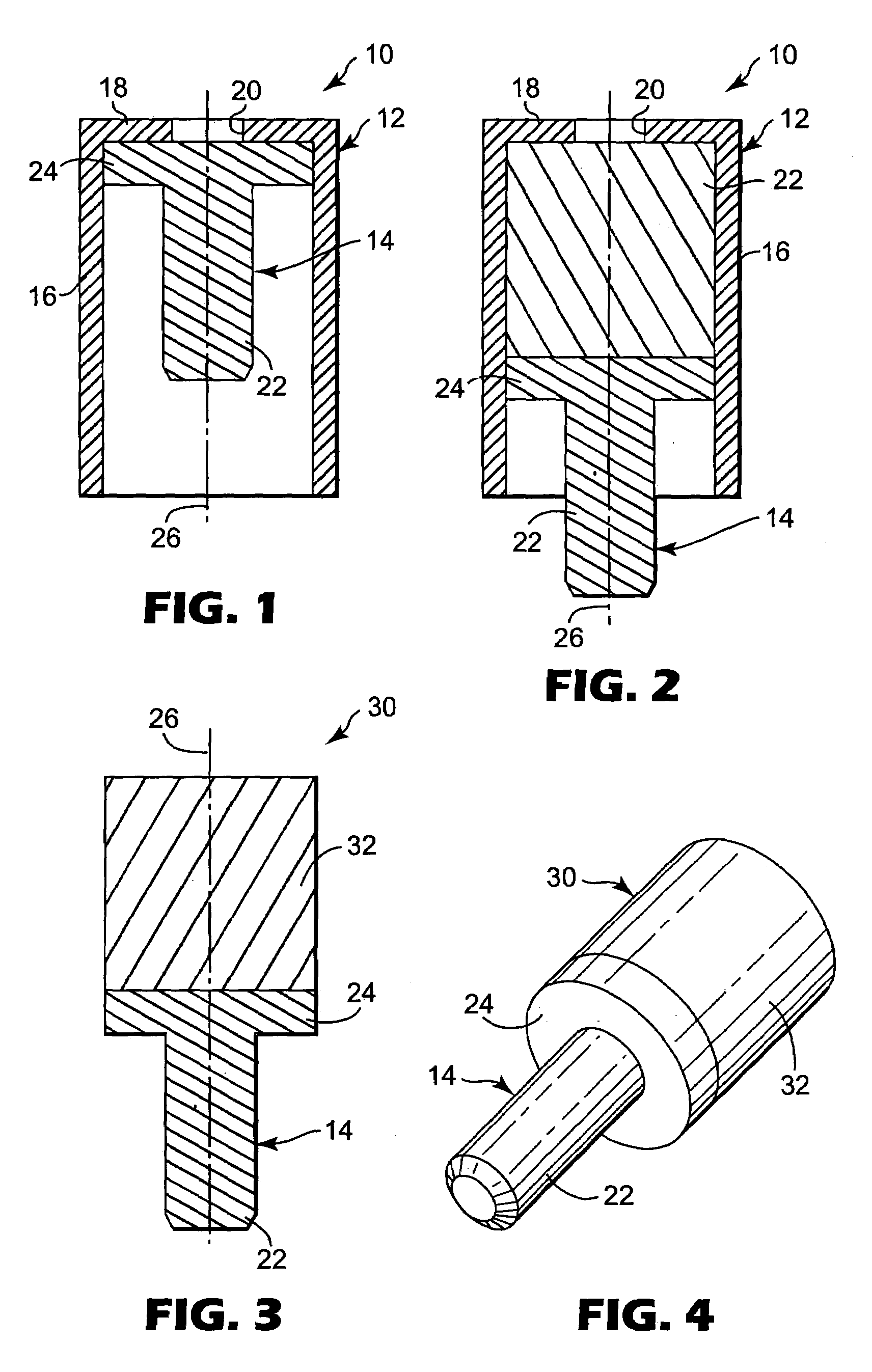
[0042]FIG. 1 is an illustration of a mold assembly 10 according to one embodiment of the invention. The mold assembly 10 includes an outer, hollow first mold component 12 and an inner, second mold component 14. The second mold component 14 is received in the hollow space of the first mold component 12, although other constructions are also possible.
[0043]The outer mold component 12 in this embodiment has an outer wall 16 with a generally cylindrical shape that is open at one end to admit the inner mold component 14. An opposite end of the outer mold component 12 has a flat end wall 18 with a central passageway 20 for admitting flowable dental restoration material. The end wall 18 and the outer wall 16 are integrally joined together and form a single, unitary body.
[0044]The inner mold component 14 includes a shaft 22 as well as a flange 24. Preferably, the shaft 22 and the flange 24 are integrally joined together and form a single, unitary body. Preferably, an outer end of the shaft ...
PUM
| Property | Measurement | Unit |
|---|---|---|
| Length | aaaaa | aaaaa |
| Composition | aaaaa | aaaaa |
| Area | aaaaa | aaaaa |
Abstract
Description
Claims
Application Information
 Login to View More