Method and apparatus for controlling ATM streams

a technology of atm cell and stream, which is applied in the field of method and an apparatus for receiving and transmitting atm cell streams, can solve the problems of less adaptability to sudden surges in network traffic and performance disadvantages, and achieve the effect of preventing overflow of storage devices

US7239640B1Inactive Publication Date: 2007-07-03MICROSEMI SEMICON U S
2 Cites 1 Cited by

Patent Information

Authority / Receiving Office
US · United States
Patent Type
Patents(United States)
Current Assignee / Owner
Publication Date
2007-07-03
Estimated Expiration
Not applicable · inactive patent

Smart Images

  • Figure 1
    Figure 1
  • Figure 2
    Figure 2
  • Figure 3
    Figure 3
Patent Text Reader

Abstract

The invention relates to a method and an apparatus for receiving and transmitting asynchronous transfer mode (ATM) cell streams over a bus. The invention provides a method for receiving ATM cells in a host from a client over a bus, comprising the steps of determining whether an ATM cell in a first storage device within the client is ready to be transferred over the bus to a second storage device within the host, preventing overflow of the second storage device by calculating a first available cell space in the second storage device as a function of a write value, a read value image and a size value of the second storage device, and transferring an ATM cell from the first storage device to the second storage device.
Need to check novelty before this filing date? Find Prior Art

Description

BACKGROUND OF THE INVENTION

[0001] 1. Field of the Invention

[0002] The present invention relates to a method and an apparatus for receiving and transmitting ATM cell streams over a bus.

[0003] 2. Background of the Invention

[0004] The increasing demand for ATM (Asynchronous Transfer Mode) equipment having higher transfer rate, improved reliability and lower hardware complexity is prompting research in new ATM control technologies. ATM is a network technology based on transferring data in cells or packets of a fixed size. The cell used with ATM is relatively small compared to units used with other technologies. The small, constant cell size allows ATM equipment to transmit video, audio, and computer data over the same network, and assures that no single type of data occupies the line. ATM creates a fixed channel between two points whenever data transfer starts. This feature makes ATM less adaptable to sudden surges in network traffic. State of the art buffer management in ATM networks requi...

Examples

Embodiment Construction

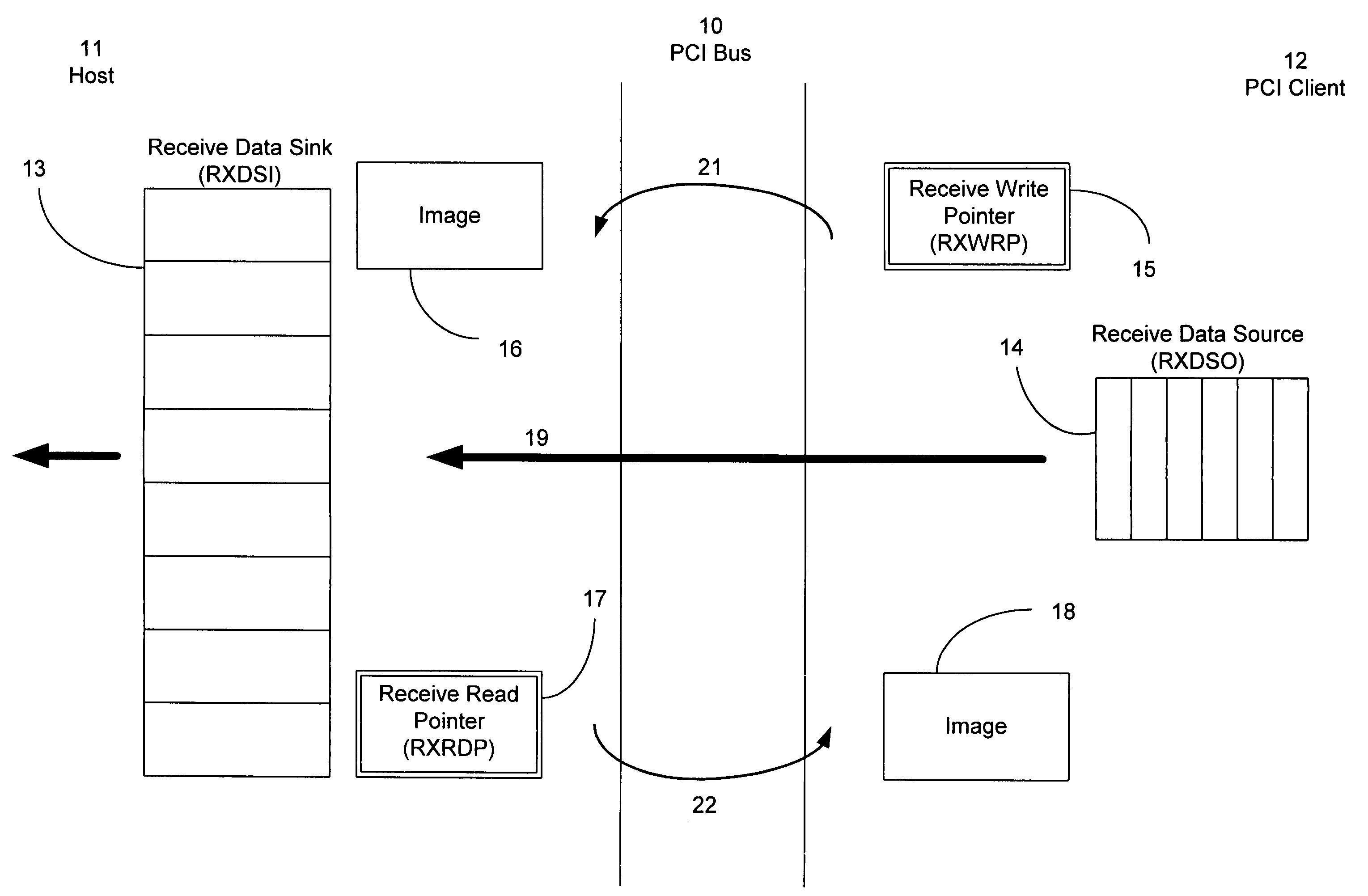
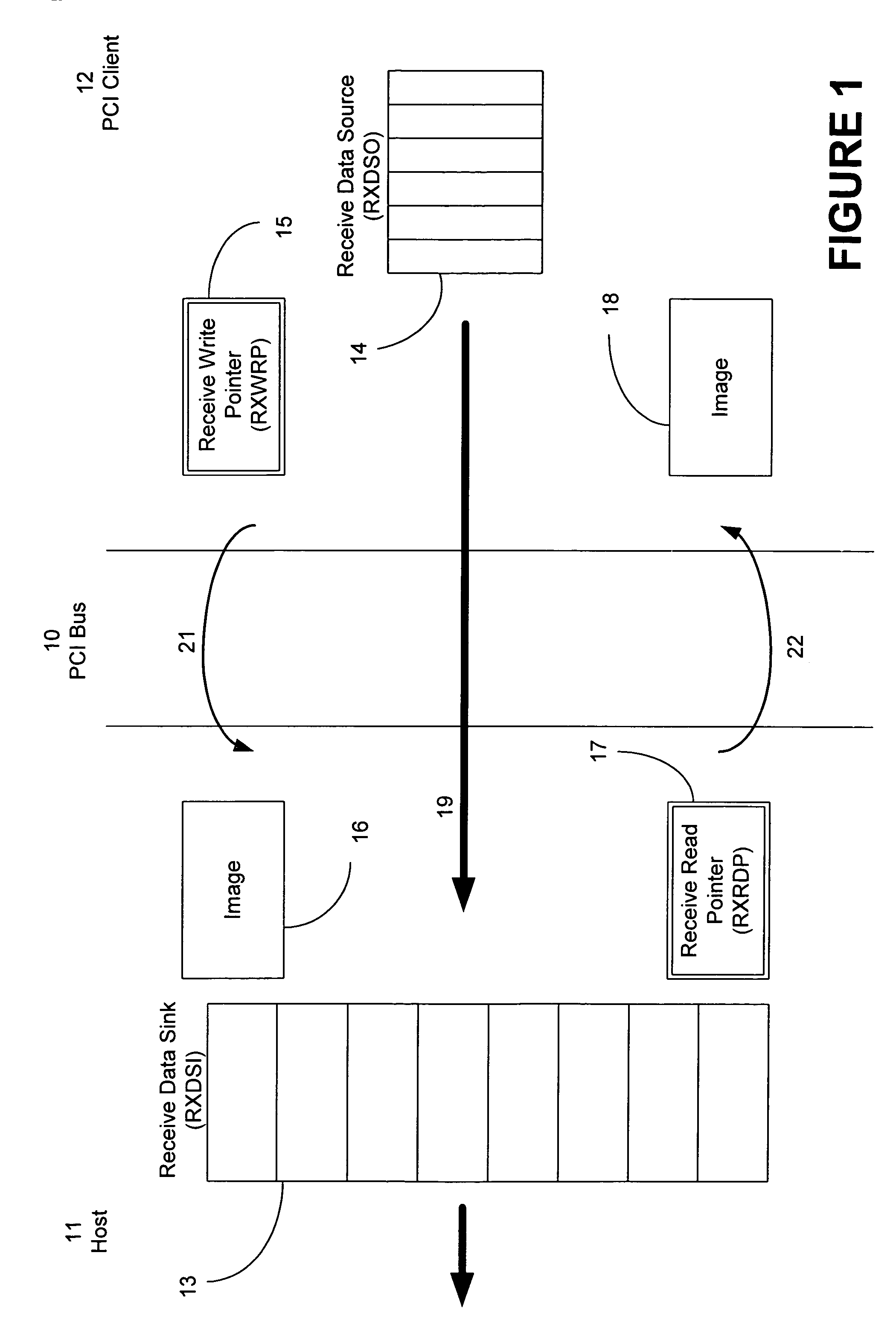
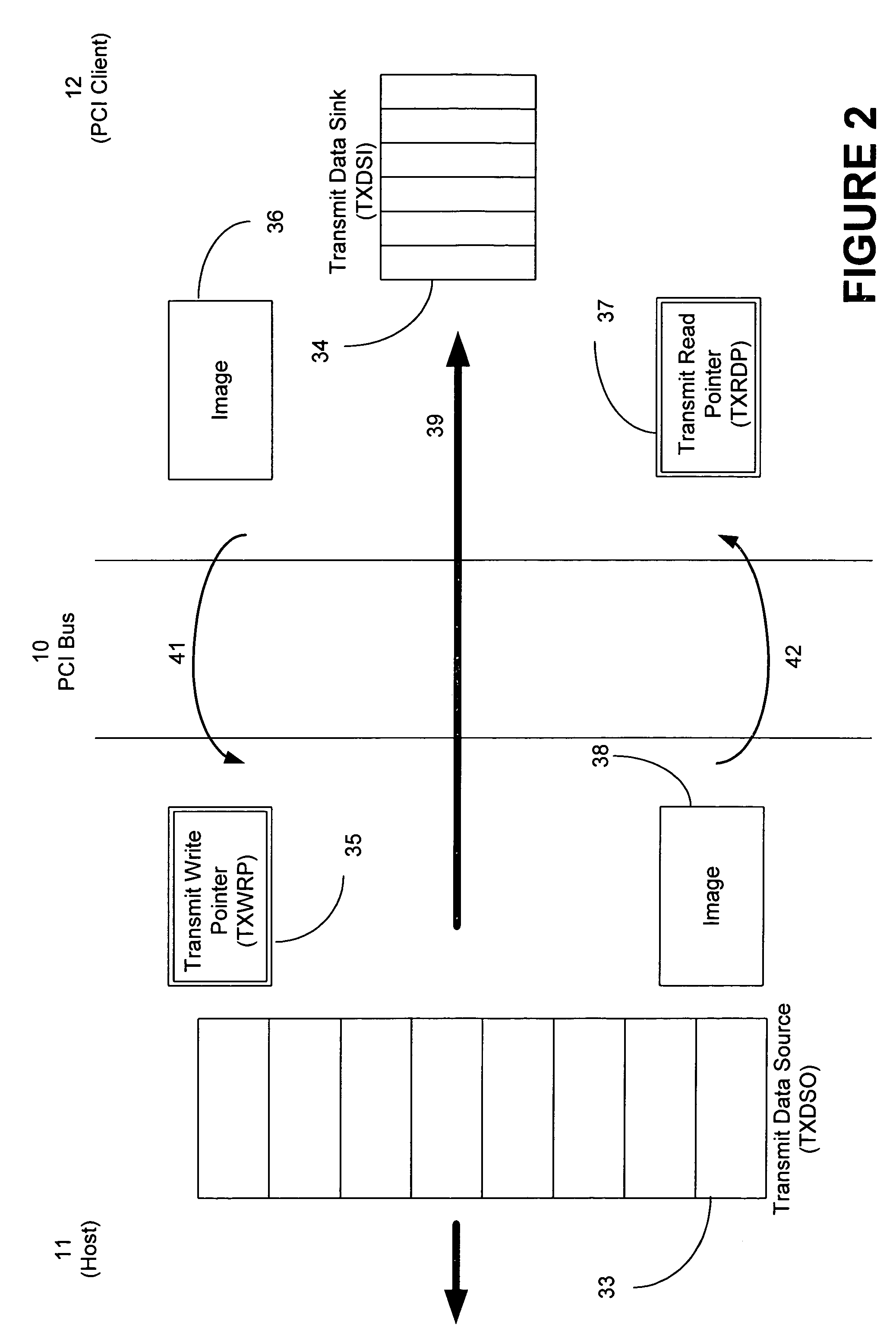
[0023]Referring to FIGS. 1 and 2, there is shown a system for transmitting and receiving cell streams according to the present invention. The system comprises a host indicated generally by 11 and a PCI client indicated generally by 12. Cells are transferred over a PCI bus 10.

[0024]The PCI client 12 comprises a receive (RX) data source (RXDSO) 14 and a transmit (TX) data sink (TXDSI) 34 realized as a FIFO (first in first out) buffer. The host 11 comprises a TX data source (TXDSO) 33 and a RX data sink (RXDSI) 13 realized as a ring buffer. The client 12 further comprises a RX write pointer (RXWRP) 15 and a TX read pointer (TXRDP) 37 and the host further comprises a RX read pointer (RXRDP) 17 and a TX write pointer (TXWRP) 35.

[0025]In addition, the client 12 comprises an image 18 of the RXRDP 17 (RXRDPI) and an image 36 of the TXWRP 35 (TXWRPI) and the host includes an image 16 of the RXWRP 15(RXWRPI) and an image 38 of the TXRDP 37 (TXRDPI).

[0026]Referring now specifically to FIG. 1, ...