
Atmospheric refractivity profiling apparatus and methods
a technology of atmospheric refractivity and profiling apparatus, applied in the direction of instruments, direction finders using radio waves, heat measurement, etc., can solve the problems of difficult characterization and/or prediction, short radio links such as those associated with cellular communications, and ducting of long-range radio communications
- Summary
- Abstract
- Description
- Claims
- Application Information
AI Technical Summary
Benefits of technology
Problems solved by technology
Method used
Image

Examples
Embodiment Construction
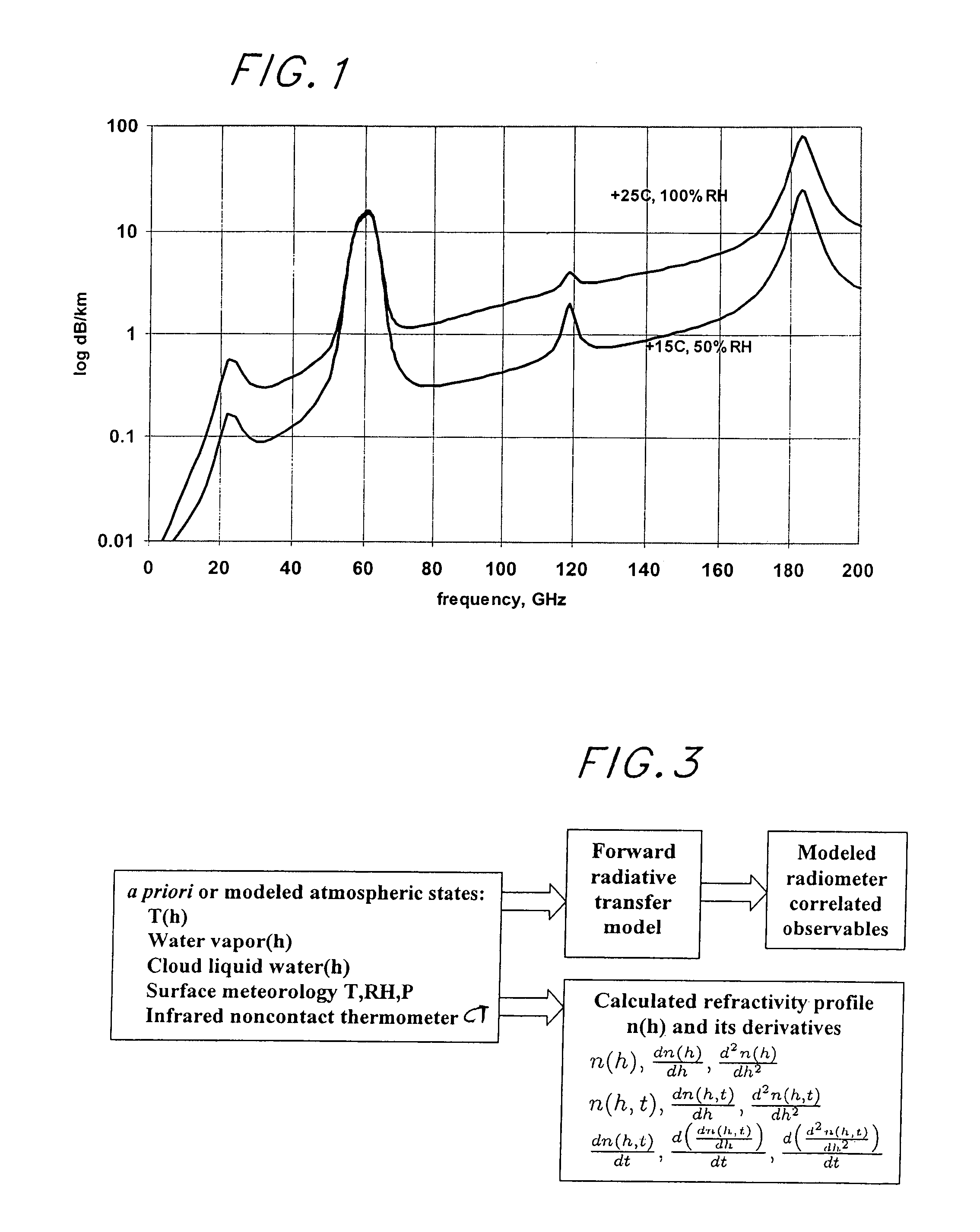
[0034]The Earth's atmosphere emits thermal radiation in all wavebands that consists of blackbody radiation from both atmospheric atomic and molecular constituents. This emitted thermal radiation is reabsorbed and re-emitted by these atomic and molecular species. The absorption spectrum of the clear atmosphere in the microwave signal region from 10 GHz to 200 GHz (at sea level) is shown in graphical form in FIG. 1. The prominent peaks in this spectral region are caused by absorption lines or, equivalently, emission lines, of atmospheric water vapor and oxygen. Regions of the spectrum between these peaks have lower signal absorption and therefore are called transmission windows. The downwelling radiation reaching the Earth is expressed as brightness temperature, the temperature of a blackbody emitting equivalent radiation, and can be written in a linearized equation as:
Tb=Tcosmice−T+(1−e−T)TMR
[0035]Where Tcosmic is the residual radiation from the Big Bang, tau is the atmospheric opac...
PUM
 Login to View More
 Abstract
Description
Claims
Application Information
 Login to View More