
Method and device for ensuring storage time for digital broadcast
a technology of digital broadcast and storage time, applied in the direction of electronic editing, digital analogue information signals, instruments, etc., can solve the problem of ensuring storage and recording time, and achieve the effect of high image quality and inexpensive provision
- Summary
- Abstract
- Description
- Claims
- Application Information
AI Technical Summary
Benefits of technology
Problems solved by technology
Method used
Image

Examples
Embodiment Construction
[0036]Preferred embodiments of the present invention will be described hereinafter with reference to the attached drawings.
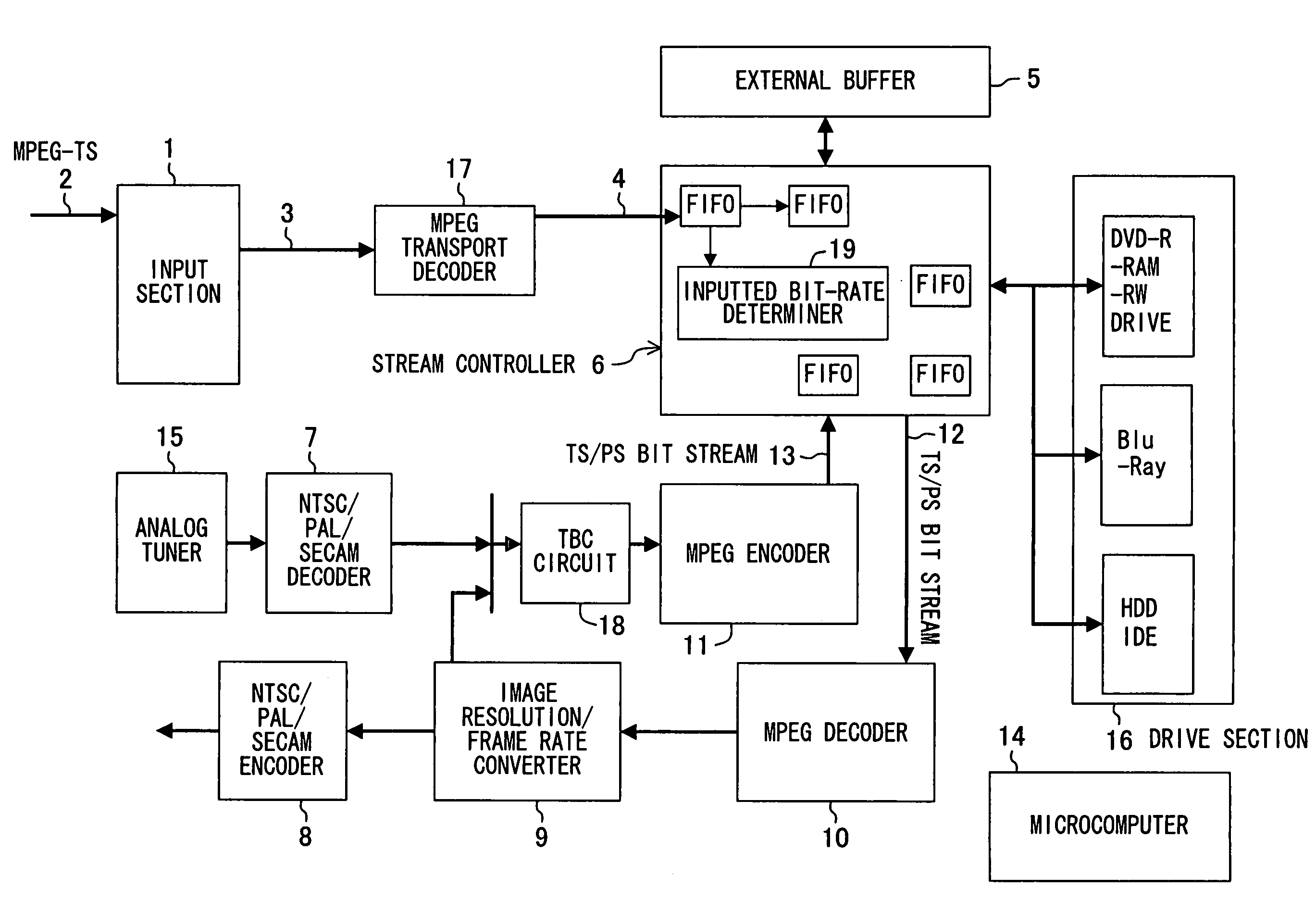
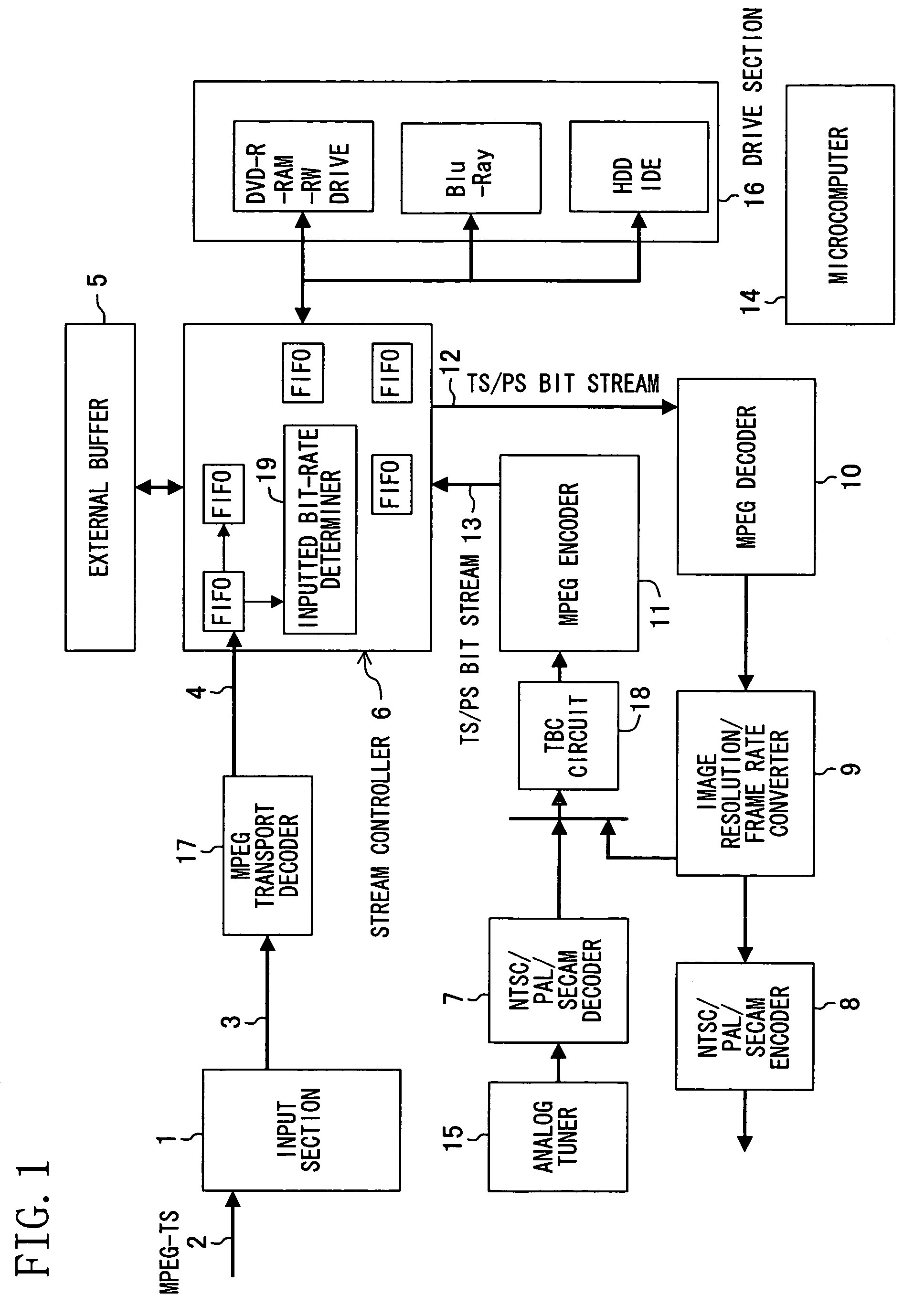
[0037]FIG. 1 is a block diagram illustrating the specific structure of a device for ensuring storage time for digital broadcast relating to the embodiments of the present invention.
[0038]The device for ensuring storage time for digital broadcast illustrated in FIG. 1 is mainly configured by an input section 1, an MPEG transport decoder 17, a stream controller 6, an MPEG decoder 10, an image resolution / frame rate converter 9, an MPEG encoder 11, a drive section 16 and a microcomputer 14 for entirely controlling these elements.
[0039]Inputted to the input section 1 is a broadcast signal MPEG-TS 2 obtained by multiplexing at least one broadcast program inputted from a tuner section of a satellite, cable television or ground wave digital broadcasting, such as an MPEG-TS signal. The input section 1 outputs the multiplexed TS bit stream 3 to the MPEG transport decoder ...
PUM
| Property | Measurement | Unit |
|---|---|---|
| storage time | aaaaa | aaaaa |
| storage time | aaaaa | aaaaa |
| storage time | aaaaa | aaaaa |
Abstract
Description
Claims
Application Information
 Login to View More