
Data simplifying and merging method for a voice decoding memory system
a data and memory system technology, applied in data processing applications, code conversion, instruments, etc., can solve the problems of occupying many processor resources, unable to provide multiplication instructions and barrel shift instructions, and conventional adpcm decoding methods are not satisfactory, so as to improve decoding efficiency, simplify codes, and save processor resources
- Summary
- Abstract
- Description
- Claims
- Application Information
AI Technical Summary
Benefits of technology
Problems solved by technology
Method used
Image

Examples
Embodiment Construction
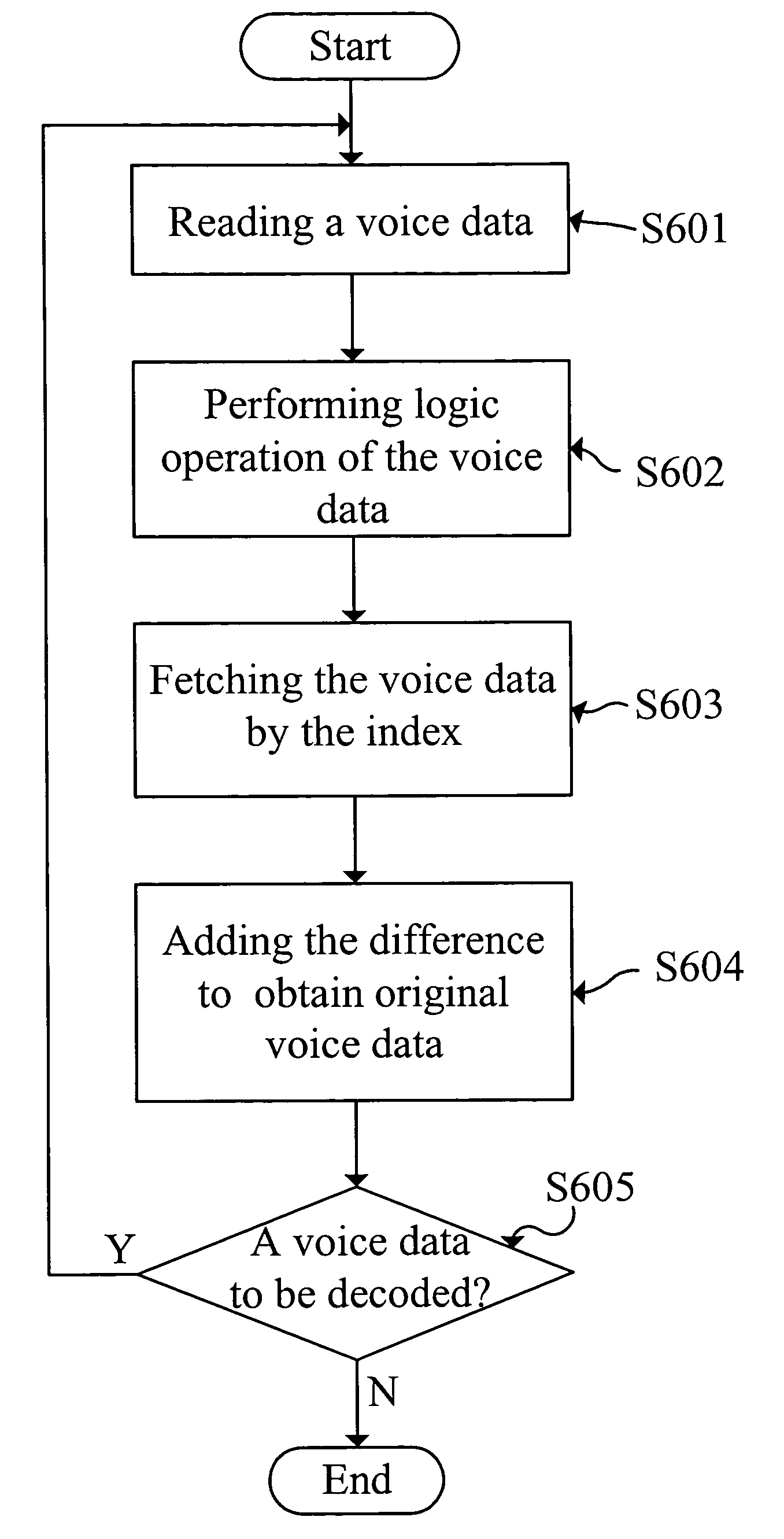
[0023]FIG. 6 is a flowchart of the data simplifying and merging method for a voice decoding memory system in accordance with the invention. The voice decoding memory system includes a non-volatile memory. As shown in FIG. 7, the non-volatile memory has plural 2N-bit words 700 to store plural encoded voice data 701, plural step sizes 702 and a table 703. For illustrative purpose, the word 700 has a length of 8 bits (N=4). Namely, each word 700 is defined as a byte 700. The encoded voice data 701 is read sequentially by a processor 800 for decoding.
[0024]The length of each encoded voice data 701 is a nibble. Namely, each voice data 701 has N=4 bits. A byte 700 has odd and even voice data O[3:0] and E[3:0]. The odd voice data O[3:0] and the even voice data E[3:0] are interlaced to form a byte of E3O3 . . . E0O0, which is stored in a byte 700 of the non-volatile memory. Each step size 702 has four effective bits S[3:0] to be arranged in every other bit as an 8-bit form of S30 . . . S00,...
PUM
 Login to View More
 Abstract
Description
Claims
Application Information
 Login to View More