Patellar cutting guide

a cutting guide and patellar technology, applied in the field of total knee arthroplasty, can solve the problems of pain, stiffness, swelling, and permanent cartilage deterioration, and achieve the effects of minimizing the length of the peg, reducing the profile of the component, and low profil

US7604639B2Inactive Publication Date: 2009-10-20SMITH & NEPHEW INC
16 Cites 166 Cited by

Patent Information

Authority / Receiving Office
US · United States
Patent Type
Patents(United States)
Current Assignee / Owner
Publication Date
2009-10-20
Estimated Expiration
Not applicable · inactive patent

Smart Images

  • Figure 1
    Figure 1
  • Figure 2
    Figure 2
  • Figure 3
    Figure 3
Patent Text Reader

Abstract

A patellar cutting guide is particularly useful in a method of minimally invasive knee arthroplasty in which an incision is made along the medial or lateral aspect of a patient's knee, exposing the knee joint. The patellar cutting guide includes a clamp configured to be located exterior to the knee over the anterior portion of the patella, a stop having at least one portion configured to extend through an incision to a location posterior to the patella, and a cutting guide defining a cutting slot. The clamp may have outwardly extending spikes for passage through the tissue overlying the patella and into engagement with the patella. The stop is movable relative to the clamp and / or cutting guide. In one embodiment, the cutting guide is offset laterally and posteriorly relative to the clamp so that the slot is aligned with a medially or laterally-formed incision in the knee.
Need to check novelty before this filing date? Find Prior Art

Description

RELATED APPLICATION

[0001] This application is a continuation of U.S. application Ser. No. 10 / 143,203 filed May 10, 2002, now U.S. Pat. No. 7,048,741.FIELD OF THE INVENTION

[0002] The present invention relates to methods and apparatus for total knee arthroplasty.BACKGROUND OF THE INVENTION

[0003] Total knee replacement (also known as total knee arthroplasty) surgery is a common procedure that is performed on hundreds of thousands of people each year. A number of circumstances may require replacement of a person's knee. For example, excessive deterioration of knee cartilage may necessitate knee replacement. This type of problem and other injuries to the knee may result from accidents, disease such as osteo-arthritis or rheumatoid arthritis, or other causes.

[0004] The knee joint or “knee” is formed by the bottom or distal end of the femur (or “thigh bone”) which extends from the hip, the top or proximal end of the tibia (or “shin bone”) which extends to the ankle, and the patella (or “knee c...

Examples

Embodiment Construction

[0059]The invention is a method and apparatus for total knee arthroplasty. In the following description, numerous specific details are set forth in order to provide a more thorough description of the present invention. It will be apparent, however, to one skilled in the art, that the present invention may be practiced without these specific details. In other instances, well-known features have not been described in detail so as not to obscure the invention.

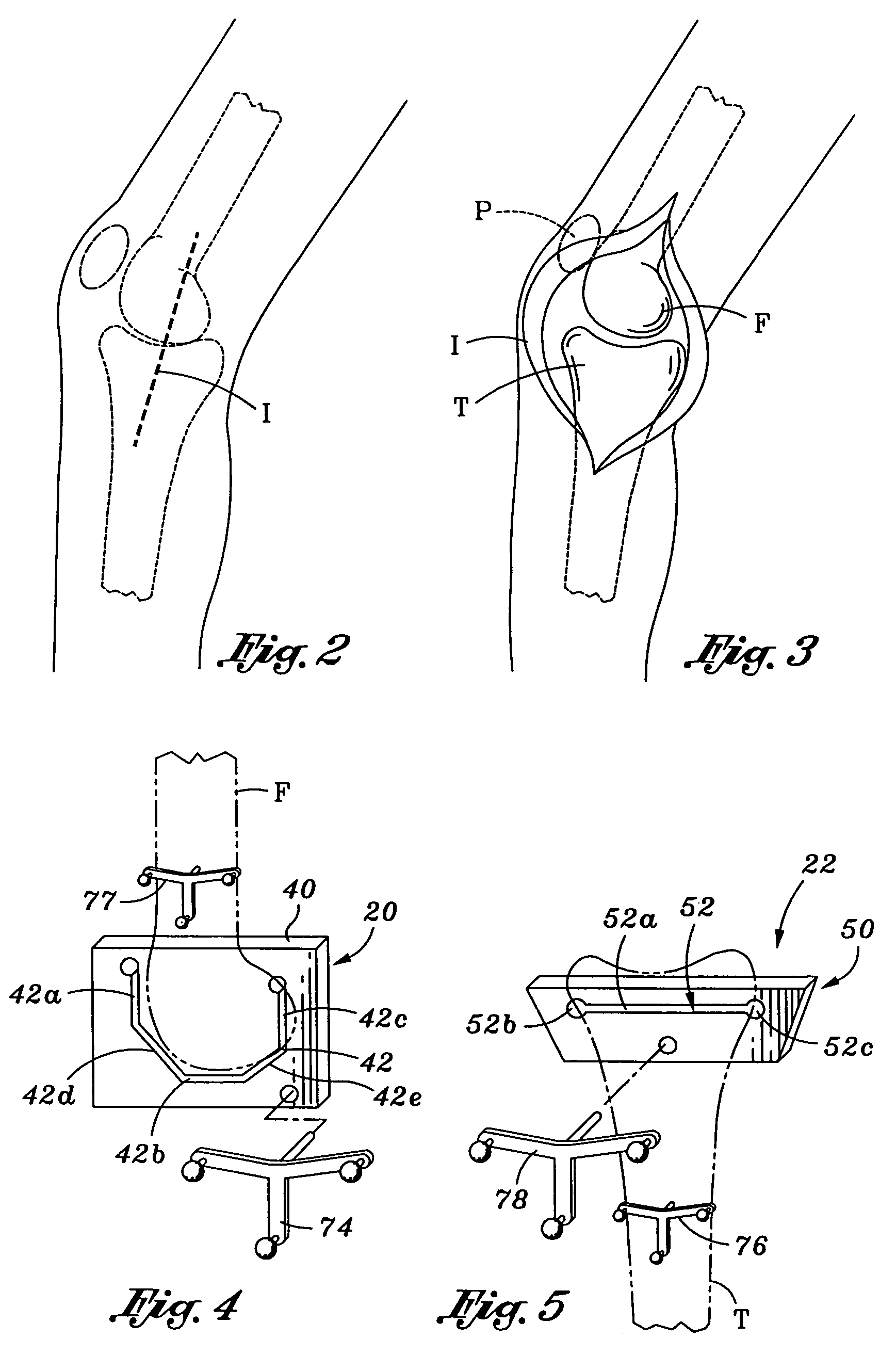
[0060]One embodiment of the invention is a method for total knee replacement which is minimally invasive. Referring to FIG. 2, in accordance with the method, an incision I is made either generally medially or laterally along the mid-lateral line of the knee. By “generally” medially or laterally, it is contemplated that the incision I may be somewhat anterior or posterior to the mid-lateral line. So located, the incision I is generally centered over the tibio-femoral or “knee” joint. In a preferred embodiment, the incision I is abo...