
Heat-sensitive transfer image-receiving sheet and coating composition for forming heat-sensitive transfer image-receiving sheet
a technology of heat-sensitive transfer and image-receiving sheet, which is applied in the direction of thermal imaging, nuclear engineering, inks, etc., can solve the problems of deteriorating image sharpness, reducing printing sensitivity, and white voids and/or density unevenness
- Summary
- Abstract
- Description
- Claims
- Application Information
AI Technical Summary
Benefits of technology
Problems solved by technology
Method used
Image

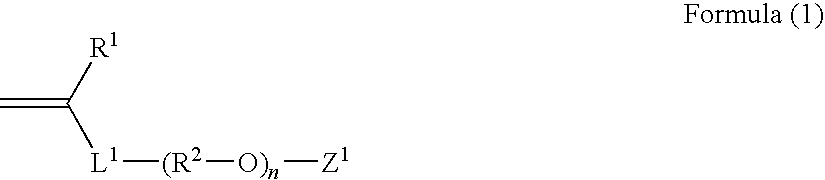
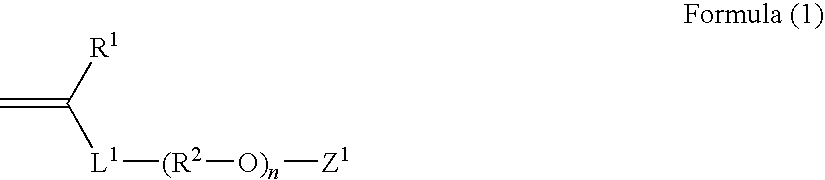
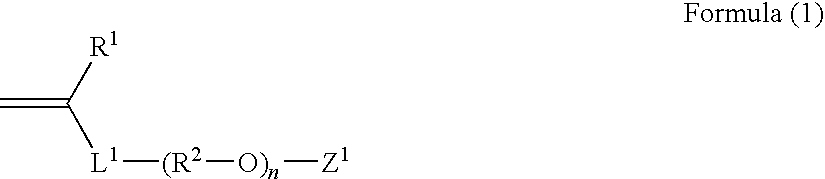
Examples
example 1
Preparation of Ink Sheet 1
[0165]A polyester film 6.0 μm in thickness (trade name: Lumirror, manufactured by Toray Industries, Inc.) was used as the substrate film. A heat-resistant slip layer (thickness: 1 μm) was formed on the back side of the film, and the following yellow, magenta, and cyan compositions were respectively applied as a monochromatic layer (coating amount: 1 g / m2 after drying) on the front side.
[0166]
Yellow compositionDye (trade name: Macrolex Yellow 6G, manufactured5.5 parts by massby Byer)Polyvinylbutyral resin (trade name: ESLEC BX-1,4.5 parts by massmanufactured by Sekisui Chemical Co., Ltd.)Methyl ethyl ketone / toluene (1 / 1, at mass ratio) 90 parts by massMagenta compositionMagenta dye (trade name; Disperse Red 60)5.5 parts by massPolyvinylbutyral resin (trade name: ESLEC BX-1,4.5 parts by massmanufactured by Sekisui Chemical Co., Ltd.)Methyl ethyl ketone / toluene (1 / 1, at mass ratio) 90 parts by massCyan compositionCyan dye (trade name; Solvent Blue 63)5.5 parts...
example 2
[0219]Samples were prepared in the same manner as in Example 1, except that the ultraviolet absorber latex polymer ULS 1700 (trade name; manufactured by Ipposha Oil Industries Co., Ltd.) was replaced with ULS 1635 MH (trade name, manufactured by Ipposha Oil Industries Co., Ltd.). Herein, a used amount of ULS 1635 MH was equal to that of ULS 1700 in parts by mass, based on the solid content of the latex polymer. The samples were then evaluated in the same manner as in Example 1. As a result, it was understood that good results were also obtained in the samples according to the present invention.
example 3
[0220]The same evaluations were conducted as in Examples 1 and 2, except that the ink sheet 1 was replaced with the ink sheet 2. As a result, good properties were obtained in all of the heat-sensitive transfer image-receiving sheets according to the present invention.
PUM
 Login to View More
 Abstract
Description
Claims
Application Information
 Login to View More