
Simultaneous viewing and reliable recording of multimedia content over a network
a multimedia content and network technology, applied in the field of video surveillance systems, can solve the problems of ignoring retransmitted content, and achieve the effect of high-quality recorded video signal and restoring the quality of live display
- Summary
- Abstract
- Description
- Claims
- Application Information
AI Technical Summary
Benefits of technology
Problems solved by technology
Method used
Image

Examples
Embodiment Construction
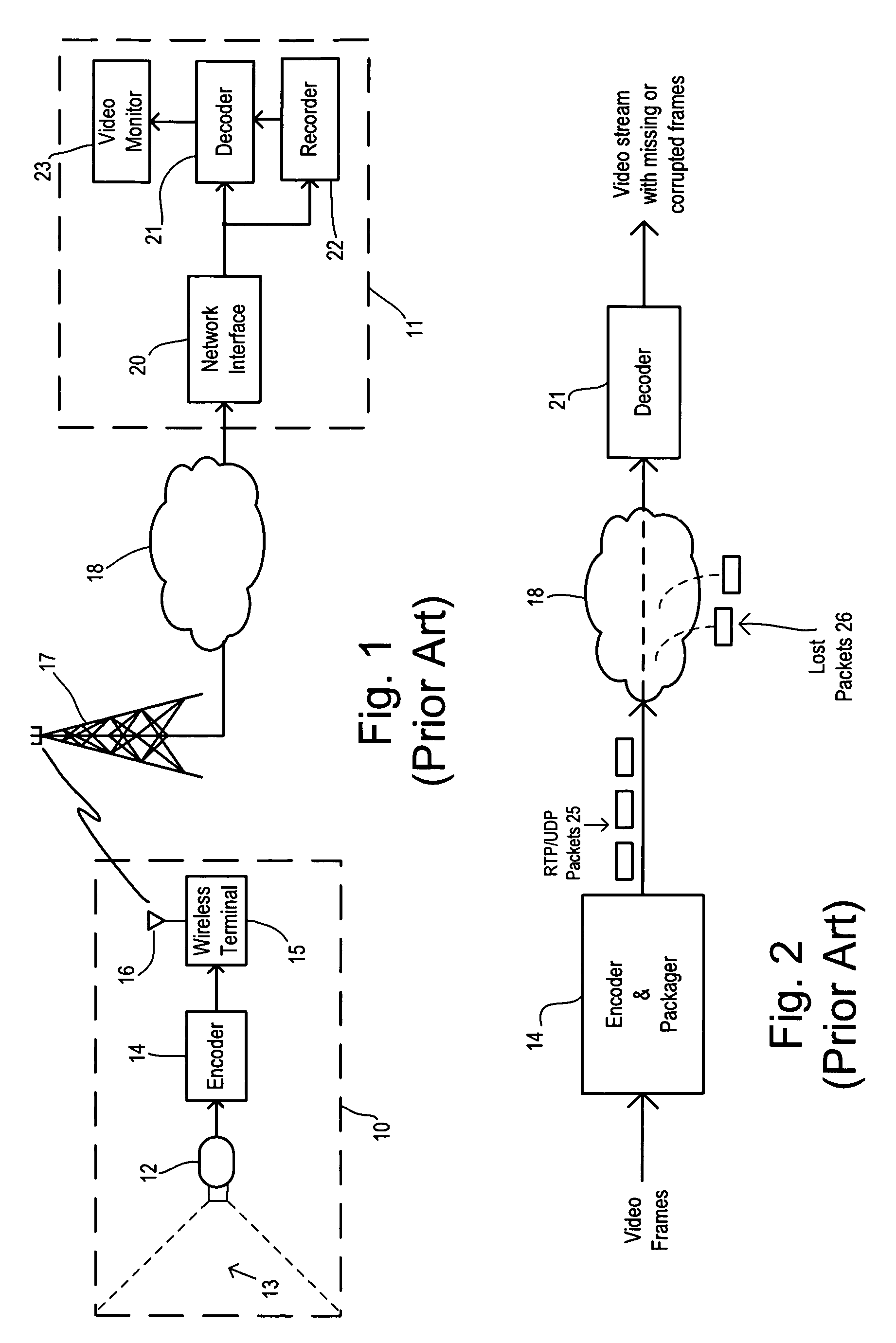
[0016]Referring to FIG. 1, a conventional system is shown for streaming surveillance video from a surveillance location 10 to a monitoring location 11. Such a system may be used as part of a security system for a bank or a store, for example. A camera 12 collects video images within a field of view 13 and provides resulting video signals to an encoder 14. Encoder 14 compresses and packetizes the video data, preferably compliant with a multimedia protocol such as RTP. The resulting packets are streamed by a wireless terminal 15 from an antenna 16 to a base station 17 in a wireless network 18 (e.g., a wireless cellular data network). Network 18 preferably includes an Internet Protocol (IP) network for conveying digital data. The packets are delivered by network 18 to a network interface 20 at monitoring location 11. The received RTP packets are sent in parallel to a decoder 21 and a recorder 22. Decoder 21 performs complementary functions to those of encoder 14 in order to generate a ...
PUM
 Login to View More
 Abstract
Description
Claims
Application Information
 Login to View More