Drill bit assembly for bone tissue including depth limiting feature

a bone tissue and depth limitation technology, applied in the field of drill bit assembly, can solve the problems of limited clinician's ability to use these visual markers, the inability to properly perform sterilization process, and the root of adjacent teeth may be affected by the bore siz

US8460297B2Active Publication Date: 2013-06-11BIOMET 3I LLC
40 Cites 45 Cited by

Patent Information

Authority / Receiving Office
US · United States
Patent Type
Patents(United States)
Current Assignee / Owner
Publication Date
2013-06-11

Smart Images

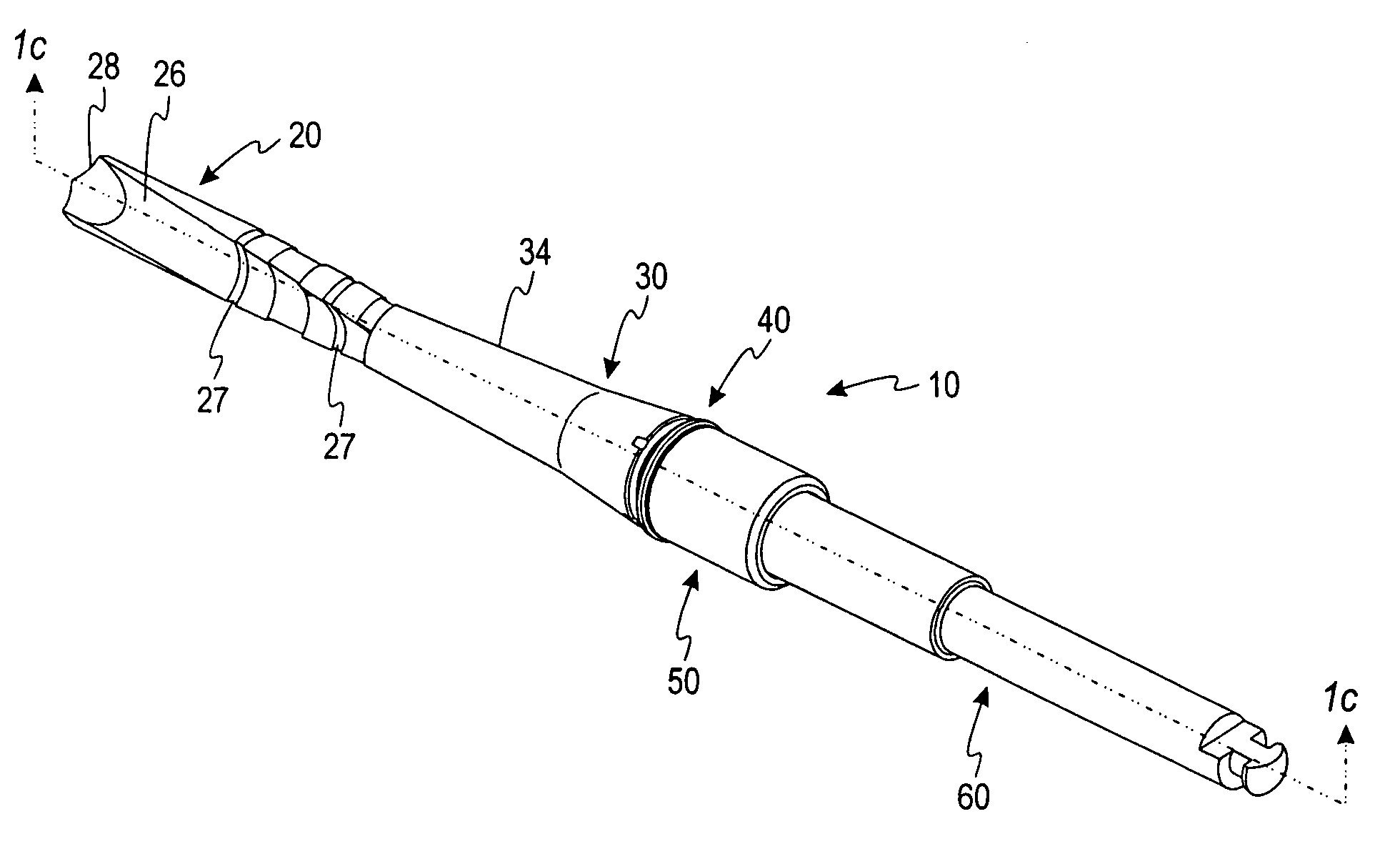
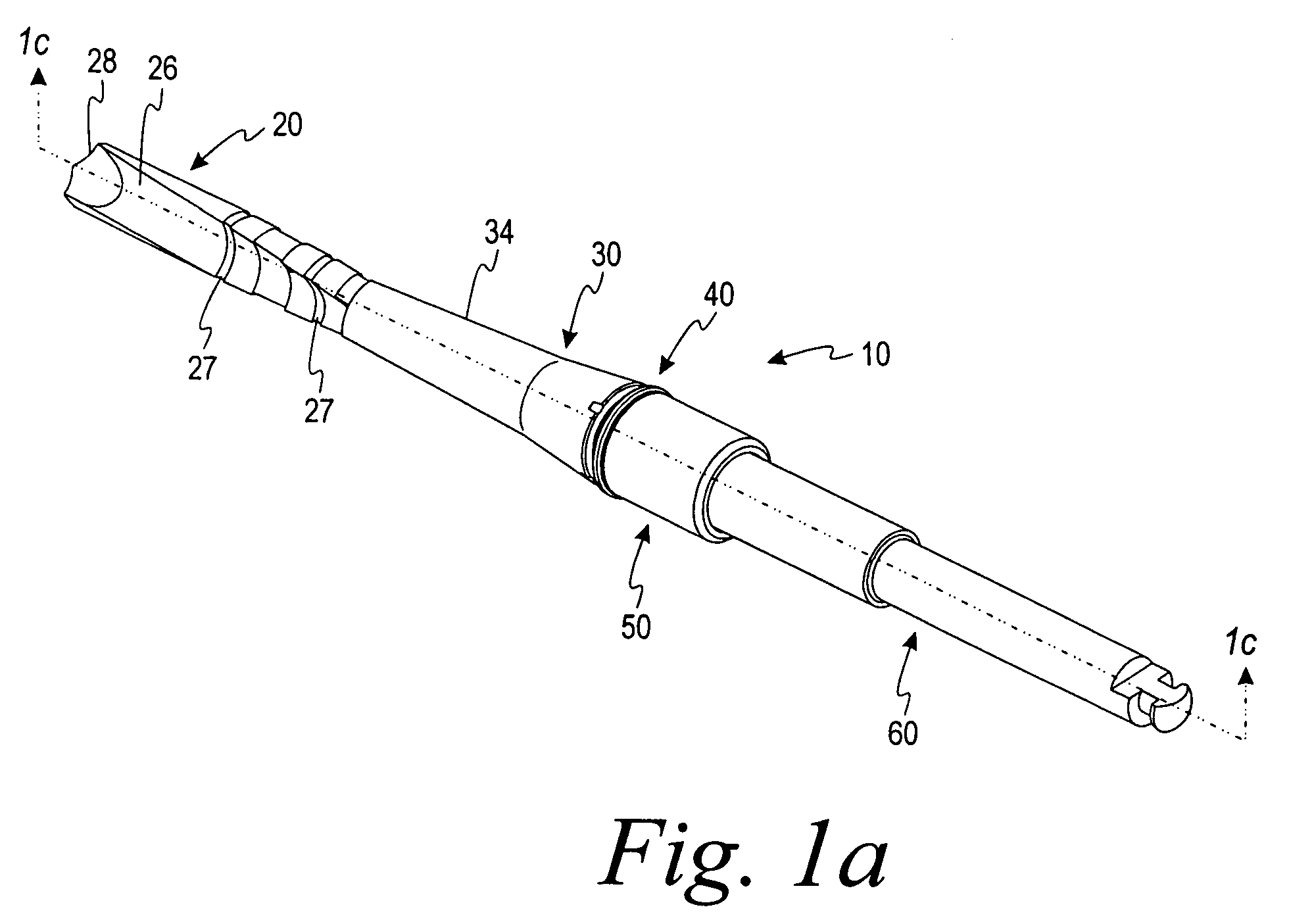
  • Figure 1
    Figure 1
  • Figure 2
    Figure 2
  • Figure 3
    Figure 3
Patent Text Reader

Abstract

A drill assembly for creating a bore in living bone comprises a drill bit, a collet-nose drill stop, a collet sleeve, a collet body, a concealment collar, a retaining spring, and a plurality of retaining balls. The drill bit inserts into the collet body and is retained in the collet body by the plurality of retaining balls. The collet-nose drill stop extends over a portion of the drill bit to limit the depth of the bore formed by the drill bit. The collet body has a drive shank and a connection region. The connection region of the collet body is adapted to receive a portion of the drill bit. The plurality of retaining balls are adapted to longitudinally secure the drill bit to the collet body.
Need to check novelty before this filing date? Find Prior Art

Description

CROSS REFERENCE TO RELATED APPLICATIONS

[0001] This application claims the benefit of the U.S. Provisional Application 60 / 878,764, filed on Jan. 5, 2007, which is hereby incorporated by reference in its entirety.FIELD OF INVENTION

[0002] The invention relates to devices for developing a bore in bone tissue and, in particular, to a drill bit assembly that prohibits insertion of that assembly into the bone tissue beyond a predetermined depth.BACKGROUND OF THE INVENTION

[0003] It is common for a dentist, or oral surgeon, to use tools such as drills, to create bores in bone tissue of a patient's mouth. Drills come in various styles, sizes, and lengths, but all have a common goal of creating a bore of a known size. The diameter of the drill dictates the diameter of the bore. However, the length of the bore is determined by the amount of axial movement that the clinician imparts on the drill as he or she inserts the drill into the bone tissue.

[0004] The size of the bore is a critical parameter i...

Examples

Embodiment Construction

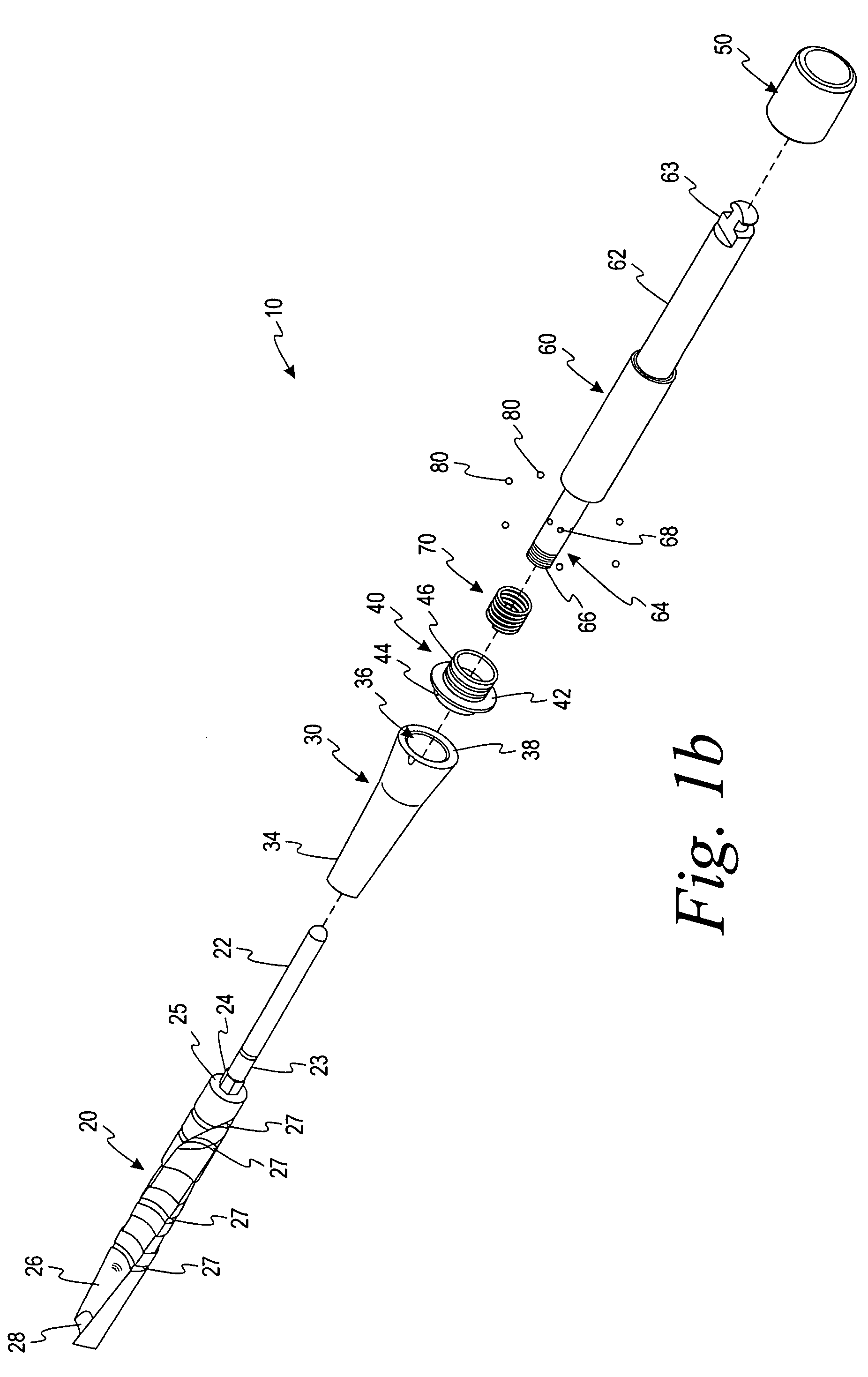
[0024]As shown in FIGS. 1a-1c, a drill assembly 10 comprises a drill bit 20, a collet nose drill stop 30, a collet sleeve 40, a concealment collar 50, a collet body 60, a retaining spring 70, and a plurality of retaining balls 80. The various components of the drill assembly 10 are each described in greater detail below.

[0025]The drill bit 20 includes a drive portion 22 at its one end that inserts into a receiving portion 65 (FIG. 2a) of the collet body 60. The drive portion 22 further has a retaining groove 23 around a periphery of the drive portion 22. The retaining groove 23 receives the plurality of retaining balls 80 to secure the drill bit 20 within the drill assembly 10. An anti-rotational portion 24 is located at a shoulder 25. The anti-rotational portion 24 shown in FIGS. 1a-1c has a hexagonal shape, but any other non-round cross sectional shape may be utilized. Each of a plurality of flutes 26 terminates in a cutting edge 28 which slices the bone tissue to develop a bore. ...