
Pyrrolyl acrylamide compound and application thereof to synthesis of sunitinib
A kind of compound, technology of dimethylformamide, applied in the field of preparing sunitinib
Patent Information
- Authority / Receiving Office
- CN · China
- Current Assignee / Owner
- Publication Date
- 2010-11-17
- Estimated Expiration
- Not applicable · inactive patent
Smart Images
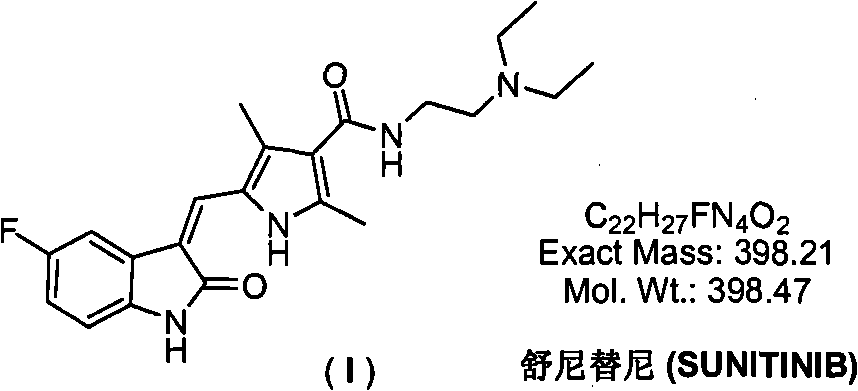
Figure 1 
Figure 2 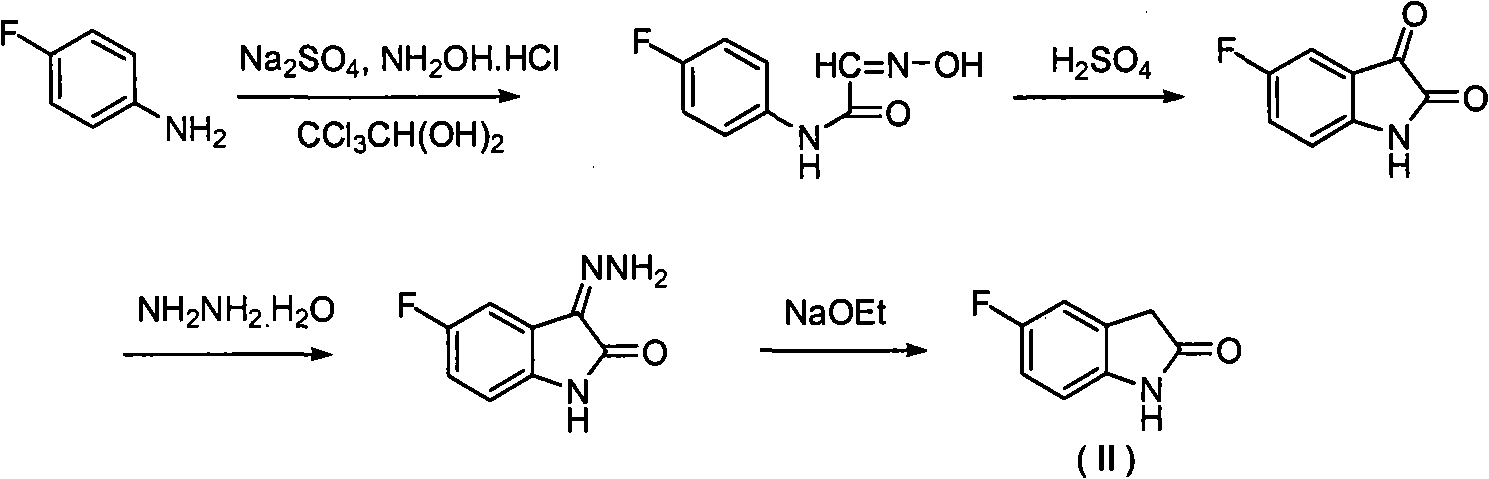
Figure 3
Abstract
Description
technical field
[0001] The present invention relates to a precursor compound of sunitinib—pyrrolylacrylamide compound, a preparation method of the compound, and a new method for preparing sunitinib with the compound. Background technique
[0002] Sunitinib (sunitinib, I) is a highly selective multi-target tyrosine kinase inhibitor with a chemical name of N-[2-(diethylamino)ethyl]-5-[(Z )-5-fluoro-1,2-dihydro-2-oxo-3H-indol-3-ylmethylene]-2,4-dimethyl-1H-pyrrole-3-carboxamide, chemical structure As shown in formula (I):
[0003]
[0004] WO 01 / 45689, US 6,316,429, US 7,119,209, WO 01 / 60814, etc. and J. Med. Chem. 2003: 1116-1119, Bioorganic & Medicinal Chemistry Letters 2005: 4380-4384, J. Org. Chem., 2003: 6447-6450 reported the synthesis of sunitinib.
[0005] The above synthetic method of Sunitinib all uses 5-fluoro-1,3-dihydroindolin-2-ketone (II) as raw material, and 2,4-dimethyl-5-formyl-1H- Pyrrole-3-carboxylic acid derivatives (A) or their analogues are obtaine...
Examples
example 1
[0045] Example 1.2-Chloro-N-(4-fluoro-2-iodo-phenyl)-acetamide (VII-A)
[0046]
[0047] In a 250mL four-neck flask equipped with a drying tube, a thermometer, a dropping funnel and a mechanical stirring paddle, add 4-fluoro-2-iodo-aniline (15.0g, 0.63mol), diisopropylethylamine (8.4g, 0.65mol), and dichloromethane (100mL), stir to dissolve, and cool down. At -10-0°C, a dichloromethane (30 mL) solution of chloroacetyl chloride (7.3 g, 0.64 mol) was added dropwise. After the addition was complete, the temperature was naturally raised and reacted at room temperature until the raw material was completely converted. Wash successively with 2×80 mL saturated brine and 80 mL deionized water, and dry the organic phase over anhydrous sodium sulfate. Filter and remove dichloromethane under reduced pressure. The residue was recrystallized with ethanol, and after vacuum drying, 18.1 g of light yellow flaky crystals were obtained, with a yield of 91.8%. Melting point: 106.6-107.7°C; ...
example 2
[0048] Example 2. Preparation of [(4-fluoro-2-iodo-phenylcarbamoyl)-methyl]-phosphonic acid diethyl ester (IV-A)
[0049]
[0050] In a 100mL three-necked flask equipped with a reflux condenser, a thermometer, and a nitrogen inlet tube, add 2-chloro-N-(4-fluoro-2-iodo-phenyl)-acetamide (VII-A) (11.1g, 35.4mmol), triethyl phosphite (6.1g, 36.5mmol). Under the protection of nitrogen, the reaction was stirred at 130-140° C. for about 16 hours, and TLC showed that the raw materials basically disappeared. After cooling, the obtained reactant was recrystallized with ethyl acetate, and after vacuum drying, 13.6 g of white needle crystals were obtained with a yield of 92.6%. Melting point: 89.1-90.6°C; 12 h 16 FINO 4 P, ESI-MS m / z: [M+H] + 416.04; 1 H NMR (400MHz, DMSO-d6) 9.51(s, 1H), 7.78-7.75(m, 1H), 7.47-7.43(m, 1H), 7.30-7.25(m, 1H), 4.13-4.05(m, 4H), 3.20(d, J=21Hz, 2H), 1.25(t, J=8.0Hz, 3H)ppm; 13 C NMR (100MHz, DMSO-d6) 164.0, 160.8 (d, J C-F =246Hz), 136.5(d, J ...
example 3
[0051] Example 3. Preparation of [(4-fluoro-2-bromo-phenylcarbamoyl)-methyl]-phosphonic acid diethyl ester (IV-B)
[0052]
[0053] According to the method of Example 2, the target compound (IV-B) was prepared from 2-chloro-N-(4-fluoro-2-bromo-phenyl)-acetamide with a yield of 93.6%. Melting point: 112-114°C; 12 h 16 BrFNO 4 P, ESI-MS m / z: [M+H] + 369.04; 1 H NMR (400MHz, CDCl 3 ) = 9.96 (br, 1H), 7.70-7.68 (m, 1H), 7.36-7.32 (m, 1H), 6.85 (t, J = 8.4Hz, 1H), 4.28-4.20 (m, 4H), 3.08 (d, J=21.8Hz, 2H), 1.41(t, J=7.0Hz, 6H); 13 C NMR (100MHz, CDCl 3 )□=162.2(d, J C-P =4.7Hz), 155.5(d, J C-F =242.8Hz), 135.3(d, J C-F = 3.0Hz), 123.9, 119.5 (d, J C-F =6.7Hz), 116.0(d, J C-F =23.1Hz), 108.6(d, J C-F =21.7Hz), 63.3(d, J C-P =6.7Hz), 37.0(d, J C-P =128.9Hz), 16.4(d, J C-P = 6.1 Hz).