

Oxygen ether dual-triazole copper complex capable of catalyzing p-fluorophenylboronic acid and preparation method of oxygen ether dual-triazole copper complex
A technology of bistriazole copper and copper complexes, which is applied in the direction of organic chemical methods, copper organic compounds, organic compounds/hydrides/coordination complex catalysts, etc., can solve the problems of expensive palladium catalysts, etc., and achieve simple and easy reaction operations OK, suitable for large-scale production, high reaction yield
Patent Information
- Authority / Receiving Office
- CN · China
- Patent Type
- Applications(China)
- Current Assignee / Owner
- Publication Date
- 2015-04-29
- Estimated Expiration
- Not applicable · inactive patent
Smart Images
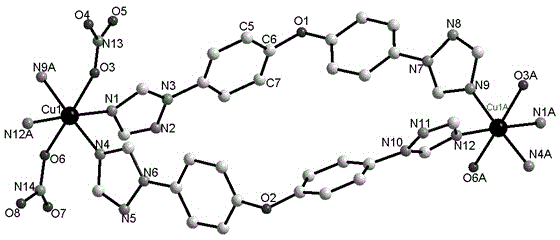
Figure 1 
Figure 2 
Figure 3
Abstract
Description
[0001] The present invention has been funded by the National Natural Science Foundation of China (21471113), the Tianjin Municipal Education Commission project (20140506), the Tianjin Normal University academic innovation promotion project for young and middle-aged teachers, and the Tianjin Higher Education Innovation Team Training Program (TD12-5038). technical field
[0002] The invention belongs to the technical field of inorganic synthesis and relates to copper complexes [Cu(L) 2 (NO 3 ) 2 ] ( 1 ) (L = 1-(4-(4-(1H-1,2,4-triazol-1-yl)phenoxy)phenyl)-1H-1,2,4-triazole) The preparation method and the application as a catalyst for the coupling reaction of p-fluorophenylboronic acid. Background technique
[0003] The study of highly selective synthesis catalyzed by transition metal complexes has been an active field. Reactions that are difficult to achieve with common synthetic means can sometimes be completed in one step using transition metal complexes under mild condit...
Examples
Embodiment 1
[0028] Preparation of 1-(4-(4-(1H-1,2,4-triazol-1-yl)phenoxy)phenyl)-1H-1,2,4-triazole (L)
[0029] Preparation of 1-(4-(4-(1H-1,2,4-triazol-1-yl)phenoxy)phenyl)-1H-1,2,4-triazole of the present invention Method, it is characterized in adopting " one pot method ", in DMF polar solvent, 1,1,2,2-tetrakis (4-bromophenyl) ethene, triazole, potassium carbonate and cupric oxide are under heating condition Prepare the organic compound; wherein the molar ratio of 4,4'-dibromodiphenyl ether: triazole: potassium carbonate: copper oxide is 2:10:30:1;
[0030]
[0031] The reaction temperature was 150°C, and the reaction time was 18 hours.
Embodiment 2
[0033] Cu(NO 3 ) 2 and the moles of 1-(4-(4-(1H-1,2,4-triazol-1-yl)phenoxy)phenyl)-1H-1,2,4-triazole (L) The ratio is 1:1;
[0034] L (0.0304 g, 0.1 mmol) and Cu(NO 3 ) 2 (0.0242 g, 0.1 mmol) in H 2 O (6 mL) and CH 3OH (4 mL) was stirred in a mixed solvent at room temperature for half an hour and then filtered, and the filtrate was volatilized at room temperature as yellow rod-shaped crystals analyzed by X-ray single crystal diffraction. Yield: 45% (calculated based on L). Elemental analysis (C 32 h 24 CuN 14 o 8 ) Theoretical value (%): C, 48.27; H, 3.04; N, 24.63. Found: C, 48.25; H, 3.16; N, 24.66.
Embodiment 3
[0036] The crystal structure was determined using an APEX II CCD single crystal diffractometer, using graphite monochromatized Mokα rays (λ = 0.71073 ?) as the incident radiation, and ω -2 θ Diffraction points are collected by scanning, and the unit cell parameters are obtained by least square method correction. The crystal structure is solved by software from the difference Fourier electron density map, and corrected by Lorentz and polarization effects. All H atoms were synthesized by difference Fourier transform and determined by ideal position calculation. The detailed crystal determination data are shown in Table 1. Structural primitives see figure 1 , one-dimensional chain structure see figure 2 .
[0037] Table 1. Complexes 1 The crystallographic data of
[0038]