
Preparation method of transportation fuel or lubricating base oil using biomass
Patent Information
- Authority / Receiving Office
- US · United States
- Current Assignee / Owner
- Publication Date
- 2013-01-17
Smart Images
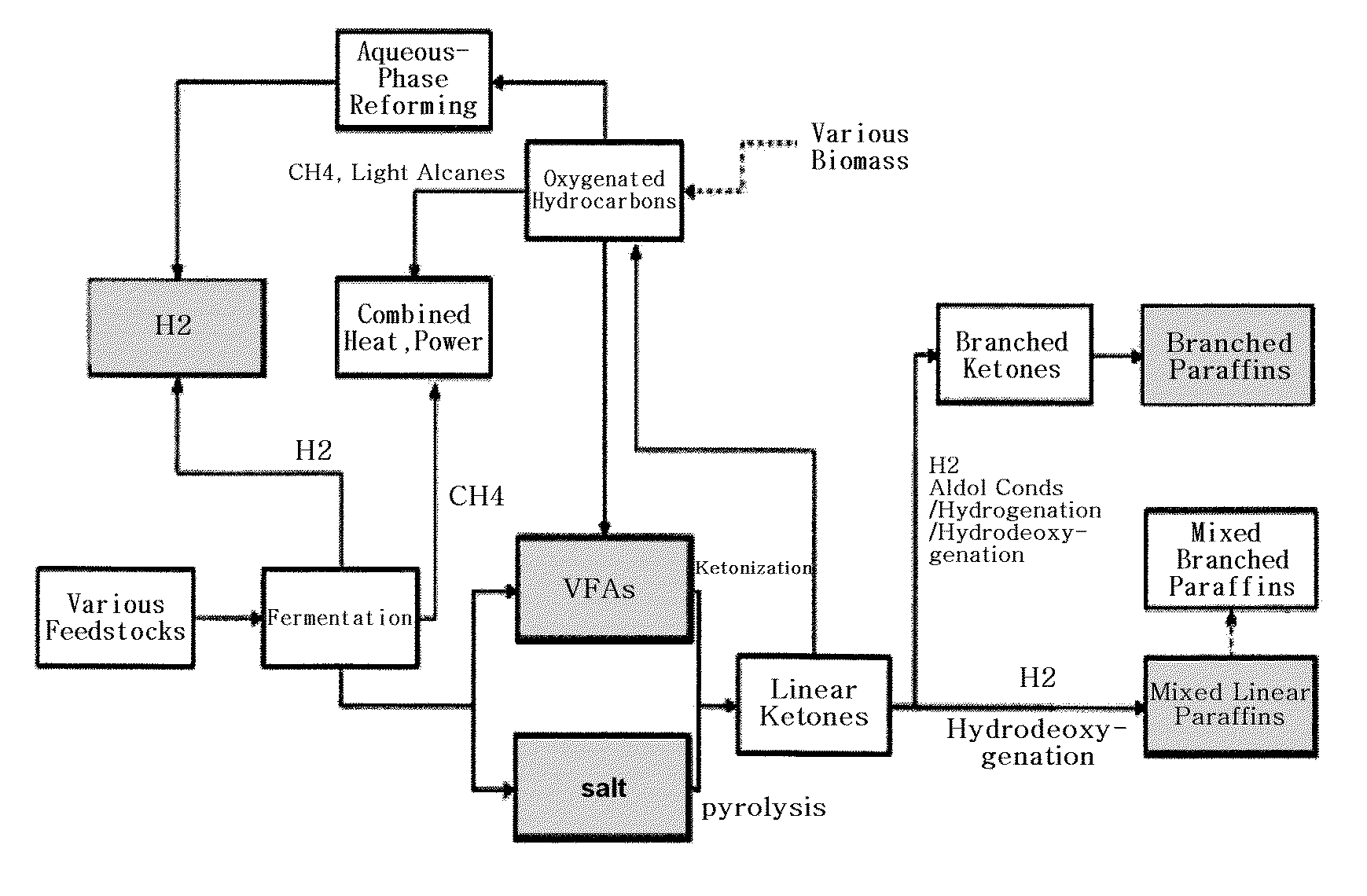
Figure 1 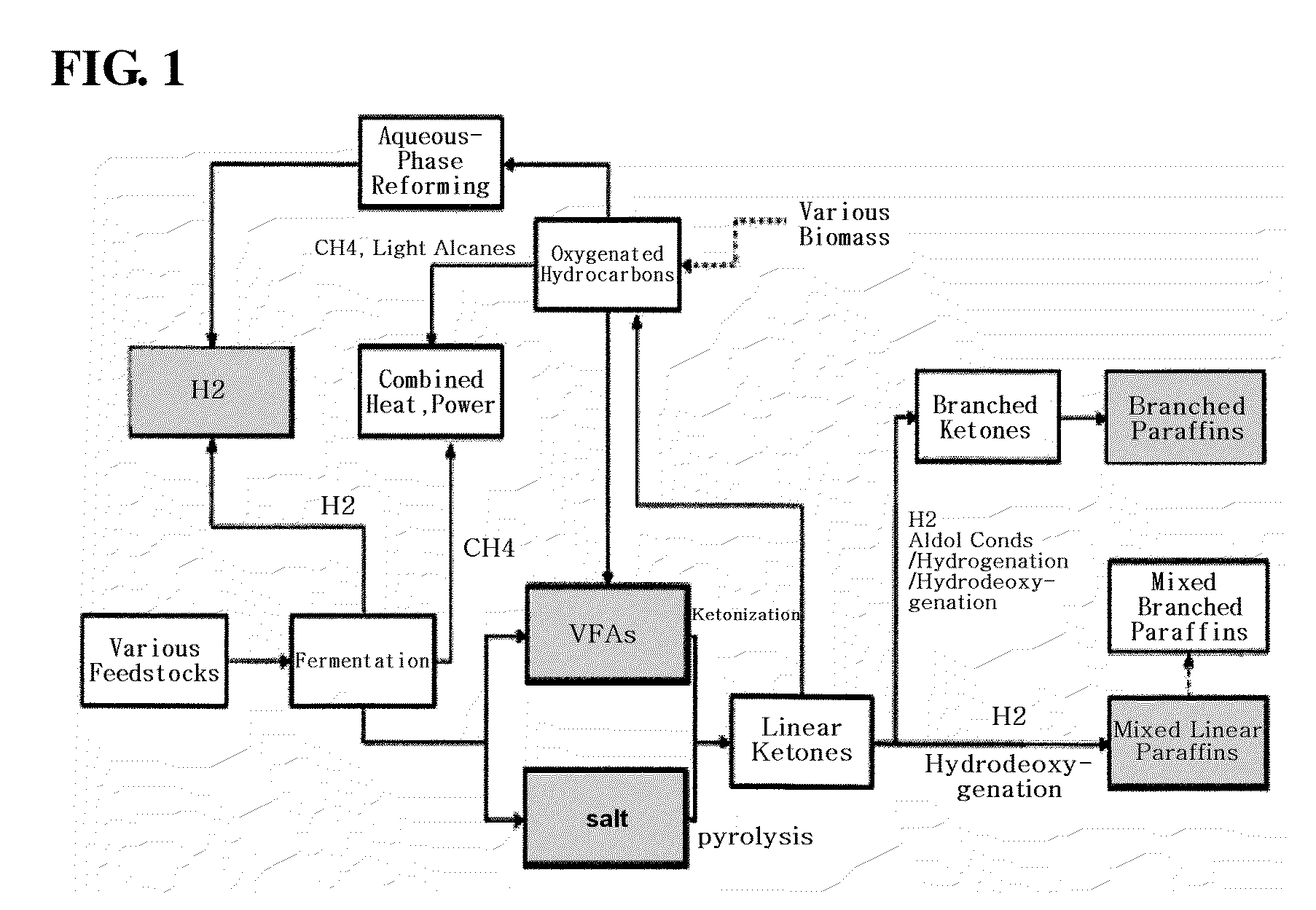
Figure 2 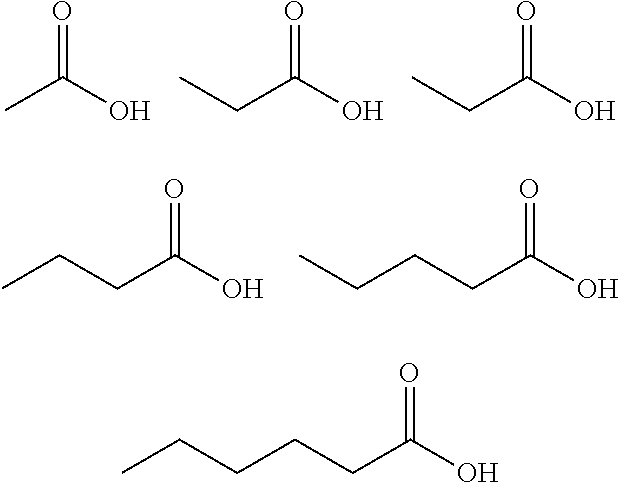
Figure 3
Abstract
Description
TECHNICAL FIELD
[0001] The present invention relates to a method of economically preparing paraffinic compounds corresponding to gasoline fuel or lubricating base oil using volatile fatty acids (VFAs) derived from biomass. More specifically, the present invention relates to a method of preparing a branched non-polar paraffinic transportation fuel or lubricating base oil in high yield by converting volatile fatty acids, obtained by fermentation of raw materials from biological sources, into a mixture of ketones by a catalytic reaction, and subjecting the ketone mixture to aldol condensation, hydrogenation and hydrodeoxygenation alone or sequentially.BACKGROUND ART
[0002] Fossil fuels or petroleum-based fuels have formed the basis for energy production and transportation. In recent years, due to rising costs and threats of shortages and supply interruptions, biofuels have particularly received as alternative fuels to petroleum-based products.
[0003] Biofuel is generally regarded as any fuel...
Examples
example 1
[0109]A mixture of ketones was prepared from volatile fatty acids, derived from biomass, using a known technique [Journal of Molecular Catalysis A: Chemical 227 (2005) 231-239]. The composition of this ketone mixture is shown in Table 1 below. For the ketone mixture having the composition shown in Table 1, an experiment of preparing branched paraffinic hydrocarbons was carried out using a 0.2 wt % Pd / Nb2O5 catalyst. The 0.2 wt % Pd / Nb2O5 catalyst was prepared by loading Pd(NO3)2 (10 wt % Aldrich) onto niobic acid by an incipient wetness method, drying the loaded material at 393 K for 3 hours, and calcining the dried material at 533 K for 3 hours in an air atmosphere. The reaction was carried out using a high-pressure micro-reactor, and 6 g of the 0.2 wt % Pd / Nb2O5 catalyst prepared by the above was used in the experiment. The reduction of the catalyst was performed by heating it to 723 K at a rate of 0.5° C. / min at a hydrogen flow rate of 200 sccm, maintaining it at that temperature...
example 2
[0111]For the ketone mixture having the composition shown in Table 1, an experiment of preparing branched paraffinic hydrocarbons was carried out using a Cu / Mg10Al7Ox catalyst. The Cu / Mg10Al7Ox catalyst was prepared by mixing Cu, Mg and Al nitrate precursors at a molar ratio of 1:10:7 and co-precipitating the mixture at pH of 10 using a mixed solution of KOH and K2CO3. The prepared cake was stirred at 338 K while distilled water was added dropwise thereto, and then allowed to stand for 2 hours, and the precipitate was filtered and washed. The washed material was dried at 393 K for a sufficient time and calcined at 773 K in an air atmosphere for a sufficient time. For the reduction of the catalyst, 6 g of the catalyst was introduced in a high-pressure micro-reactor in which it was reduced in-situ at 573 K at a hydrogen flow rate of 200 sccm for 1 hour. The reaction for preparing branched paraffinic compounds was carried out under the same conditions as Example 1. After the reaction, ...
example 3
[0113]For the ketone mixture having the composition shown in Table 1, an experiment of preparing branched paraffins was carried out using a 0.2 wt % Pd / CeZrOx catalyst. To prepare the 0.2 wt % Pd / CeZrOx catalyst, the CeZrOx support was prepared in the following manner. Ce(No3)36H2O and ZrO(NO3)2 were mixed at a ratio of 1:1 and co-precipitated for 65 hours while the pH was kept of 10 with NH4OH. The precipitate was filtered, washed, dried at 383 K for a sufficient time and then calcined at 723 K for 2 hours. To reduce the catalyst, 6 g of the catalyst was introduced in a high-pressure micro-reactor in which it was reduced by heating it to 623 K at a rate of 0.5° C. / min and maintaining it at a hydrogen flow rate of 200 sccm for 2 hours. The reaction for preparing branched paraffinic compounds was carried out under the same conditions as Example 1. After the reaction, the conversion of each of the mixed ketones was analyzed by GC, and the results of the analysis are shown in Table 6 b...