
Synergistic Compositions That Reduce UV-Induced Lipid Peroxidation, Formulations and Related Methods
Patent Information
- Authority / Receiving Office
- US · United States
- Current Assignee / Owner
- Publication Date
- 2017-08-10
- Estimated Expiration
- Not applicable · inactive patent
Smart Images
Figure 1 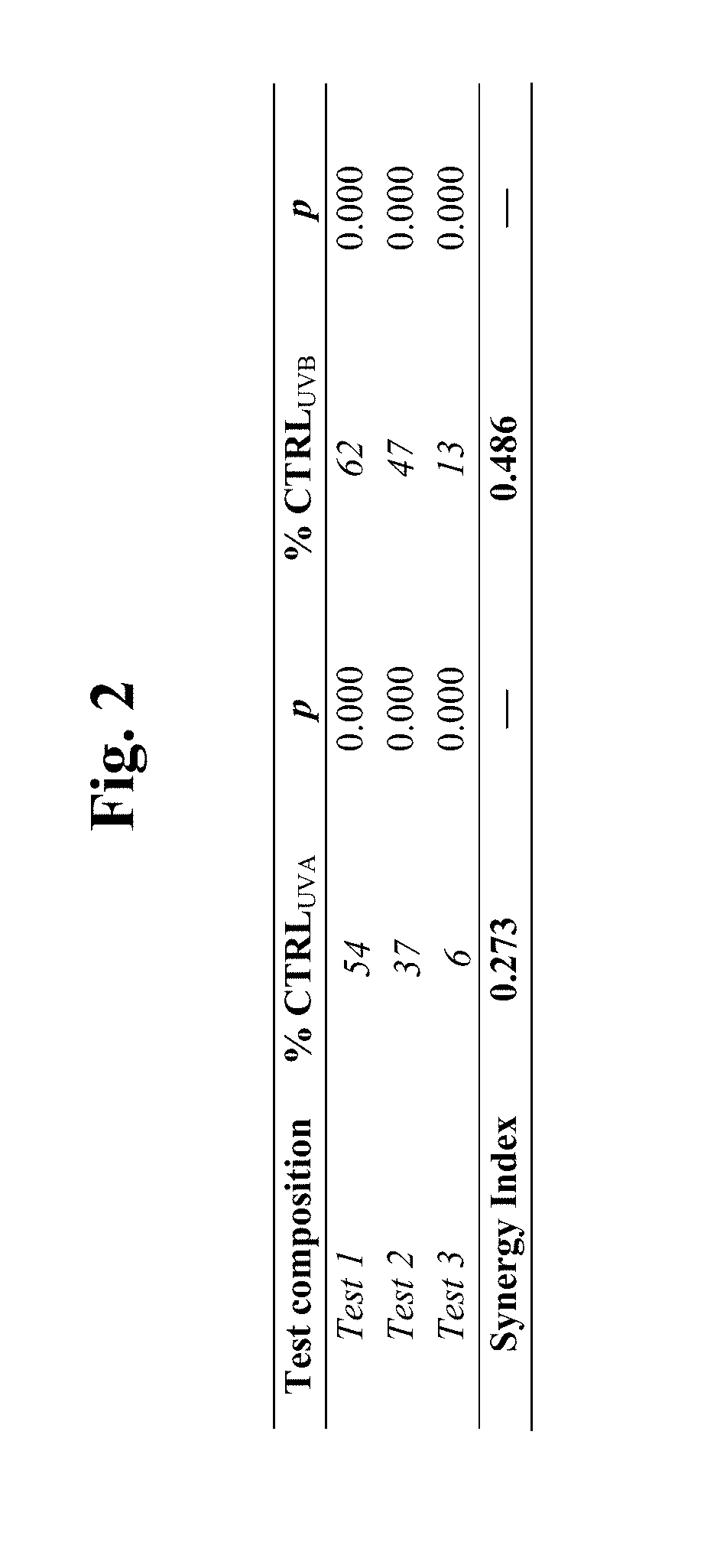
Figure 2 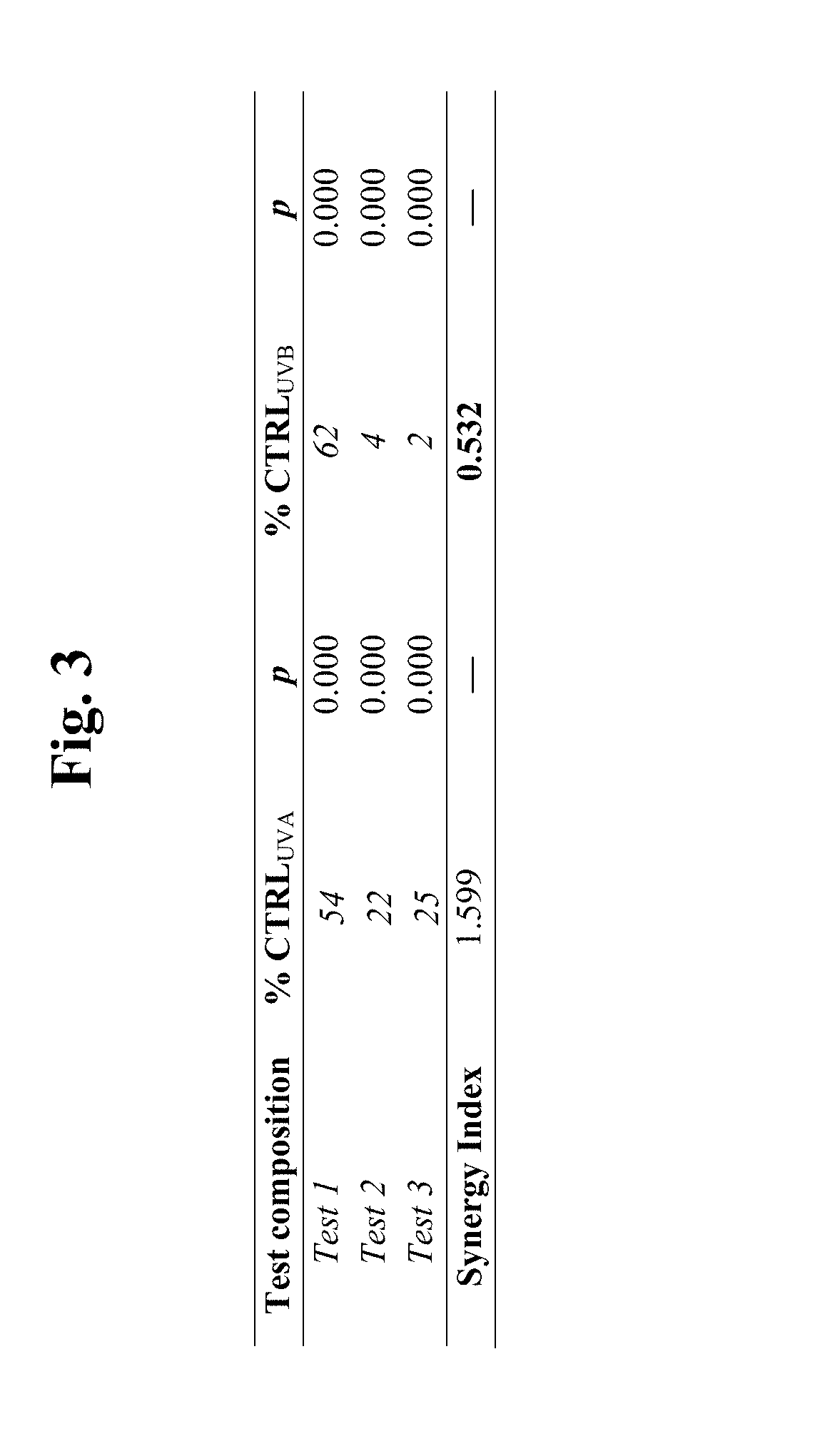
Figure 3
Abstract
Description
BACKGROUND OF THE INVENTION
[0001] Solar radiation is a form of energy emitted by the sun and comprised of at least three spectra of electromagnetic waves: visible light, infrared radiation and ultraviolet radiation. Visible light is the portion of the spectrum represented by wavelengths of 400 to 700 nanometers. Infrared radiation is invisible radiant of wavelength of greater than about 700 nanometers (i.e., wavelength extending from the nominal red edged of the visible spectrum), which can be physically perceived as heat. Ultraviolet radiation has wavelengths in the range of about 400 nm to about 10 nm. Excessive exposure to solar radiation might result in harmful outcomes for living beings, including acute and immediate damage such as sunburn and erythema, and / or longer term damage, such as premature aging of skin and skin cancer. Exposure to UV radiation may be of particular seriousness, since it cannot be perceived by an individual so he or she cannot gauge his or her exposure le...
Examples
example 1
[0057]Test composition 1 was prepared to contain caprylohydroxamic acid (0.15% w / w) diluted in dimethyl isosorbide (0.4% w / w) and water (qsp 100% w / w). Test composition 2 contained ascorbic acid (0.5% w / w) diluted in the same solvent as test composition 1. Finally, test composition 3 was prepared containing both caprylohydroxamic acid (0.15% w / w) and ascorbic acid (0.5% w / w) diluted as test compositions 1 and 2.
[0058]UV-induced lipid peroxidation was evaluated for each of the test compositions 1-3, using the method develop by Pelle et al. from Estee Lauder (Pelle, E., D., Maes, G. A. Padulo, E. K. Kim and W. P. Smith, “An in vitro model to test relative antioxidant potential: ultraviolet-induced lipid peroxidation in liposomes”, Arch. Biochem. Biophys., 283, pp. 234-240 (1990)) as modified by Wang et al. (Wang, Y. R., H. Zhao, X. S. Sheng, P. E. Gambino, B. Costello and Bojanowski K., “Protective effect of Fructus lycii Polysaccharides against time- and hyperthermia-induced damage i...
example 2
[0062]In this example, test composition 4 was prepared to contain caprylohydroxamic acid (0.15% w / w) diluted in dimethyl isosorbide (0.4% w / w) and water (qsp 100% w / w). Test composition 5 contained a pool of antioxidants (1.8% w / w), which comprised ascorbic acid (0.4% w / w); sodium ascorbyl phosphate (0.4% w / w); α-tocopherol (0.4% w / w); tocopheryl acetate (0.4% w / w) and butylated hydroxytoluene (0.2% w / w) diluted in a mixture of dimethyl isosorbide (0.4% w / w), polysorbate-60 (0.3% w / w) and water (qsp 100% w / w). Finally, test composition 6 was prepared to contain both caprylohydroxamic acid (0.15% w / w) and the pool of antioxidants (1.8% w / w) diluted as test composition 2 was.
[0063]Evaluation of lipid peroxidation was carried out as in Example 1. Using the data generated, the synergy index for test composition 6 was calculated using the Kull equation. FIG. 3 presents the synergy index results for UV-induced lipid peroxidation.
example 3
[0064]A test composition 7 is prepared to contain caprylohydroxamic acid (0.15% w / w) diluted in dimethyl isosorbide (qsp 100% w / w). A test composition 8 is prepared to contain a combination of beta-carotene (0.5% w / w) and carrot oil (0.5% w / w) diluted in the same solvent as test composition 7. Finally, a test composition 9 is prepared to contain both caprylohydroxamic acid (0.15% w / w) and the combination of beta-carotene and carrot oil (0.5% w / w, respectively), diluted as test composition 7 is.
[0065]Evaluation of lipid peroxidation is carried out as in Example 1. Using the data generated, the synergy index for test composition 9 is calculated using the Kull equation. FIG. 4 presents the synergy index results for UV-induced lipid peroxidation.