Emulsion composition, method for softening fiber structure and fiber containing base material
What is AI technical title?
AI technical title is built by PatSnap AI team. It summarizes the technical point description of the patent document.
A technology of emulsion composition and fiber base material, applied in fiber treatment, non-fiber pulp addition, fiber raw material treatment, etc., can solve the problems of natural and beneficial property damage
Inactive Publication Date: 2010-01-27
DOW CORNING SHANGHAI
View PDF2 Cites 23 Cited by
Summary
Abstract
Description
Claims
Application Information
AI Technical Summary
This helps you quickly interpret patents by identifying the three key elements:
Problems solved by technology
Method used
Benefits of technology
Problems solved by technology
That is, the present inventors have discovered that in order to impart some softness to the substrate in the prior art, some natural and beneficial properties of the fibrous substrate are destroyed
Method used
the structure of the environmentally friendly knitted fabric provided by the present invention; figure 2 Flow chart of the yarn wrapping machine for environmentally friendly knitted fabrics and storage devices; image 3 Is the parameter map of the yarn covering machine
View more
Image
Smart Image Click on the blue labels to locate them in the text.
Viewing Examples
Smart Image
Click on the blue label to locate the original text in one second.
Reading with bidirectional positioning of images and text.
Smart Image
Examples
Experimental program
Comparison scheme
Effect test
Embodiment
[0133] The present invention is described in more detail with reference to Examples and Comparative Examples, but it should be understood that these Examples should not limit the scope of the present invention.
[0134] [Average particle size of emulsion particles]
[0135] Emulsion particles were measured using a submicron particle analyzer (product of Malvern Instruments Co. Ltd.; Mastersizer 2000) for measuring submicron-sized particles by laser diffraction average particle size.
[0136] [Viscosity of organopolysiloxane]
[0137] The viscosity of the organopolysiloxane was measured using a Brookfield Engineering Laboratories rotational viscometer (trademark: Brookfield DV-III super type); measurement stability: 25°C.
[0138] [Appearance of emulsion composition]
[0139] The appearance of the emulsion composition was evaluated by visual observation. Use the following criteria.
[0140] ◎Completely transparent
[0141] ○ Transparent with some cloudiness (i.e. transluc...
Embodiment 7
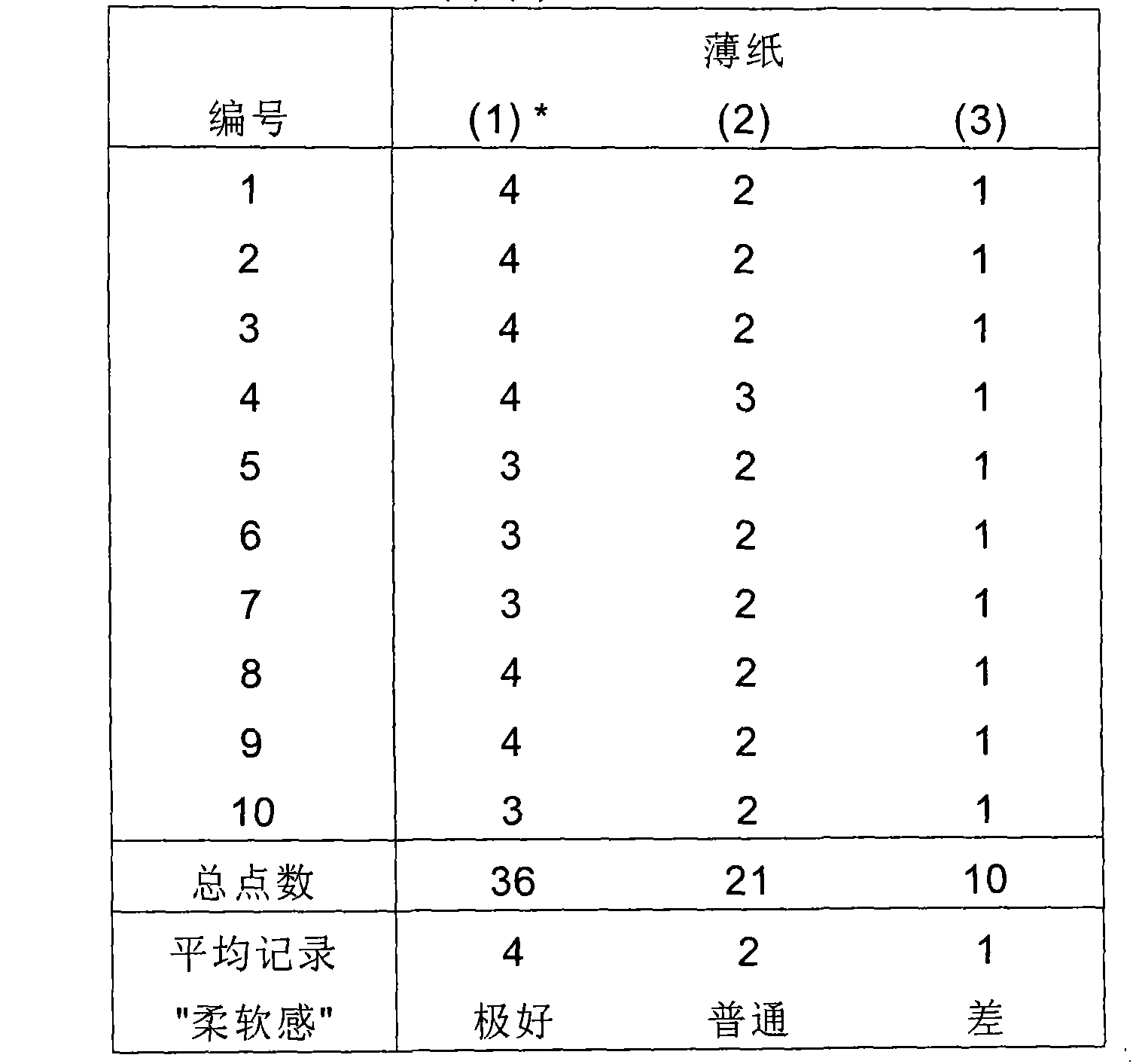
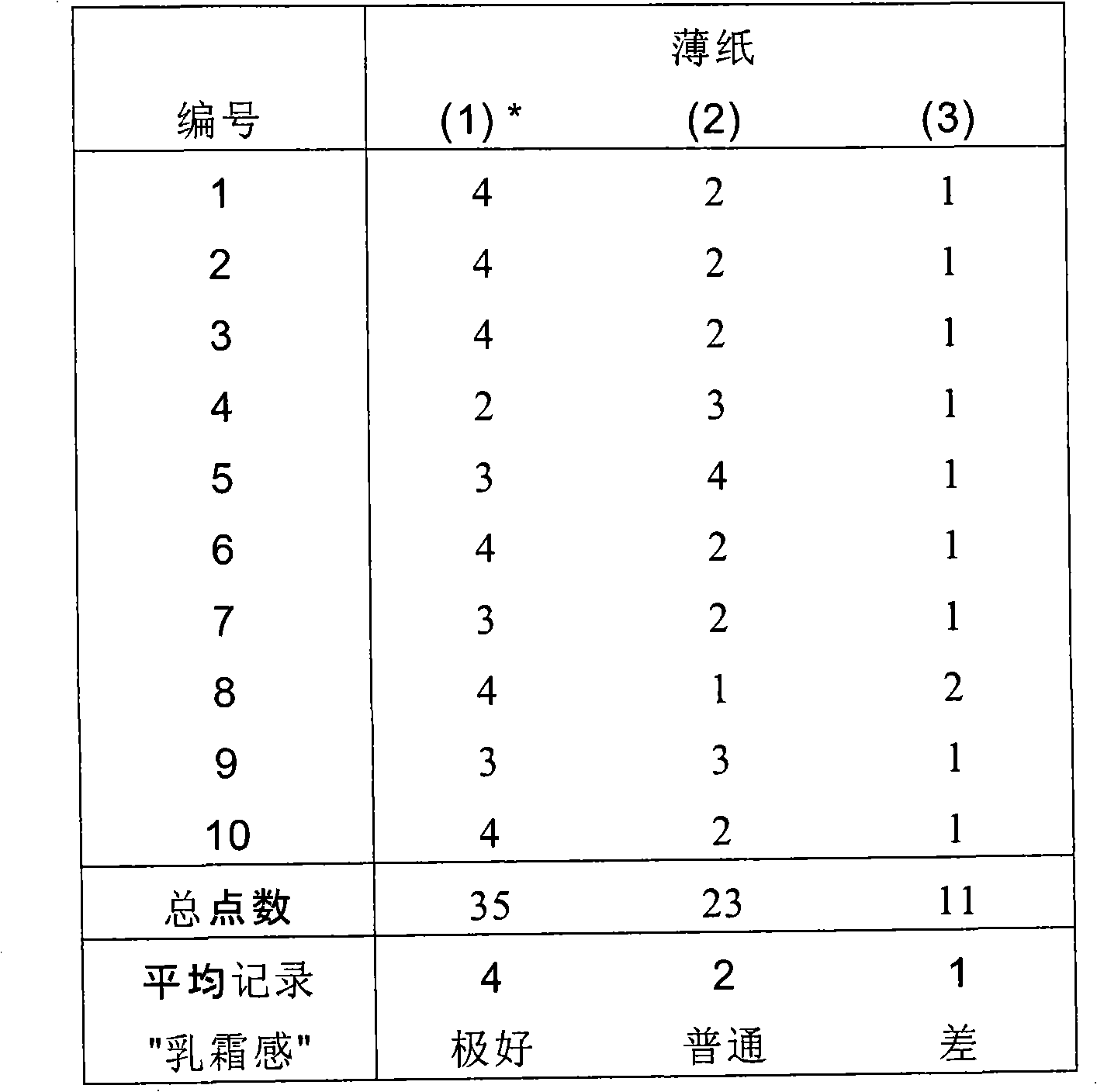
[0156] Tissue (2) is a commercially available tissue product (as a target reference),
[0157] Tissue paper (3) is a crude tissue paper substrate that has not been treated with any emulsion (as a blank).
[0158] Table: Hand properties of "soft feel" for tissue papers (1)-(3)
[0159]
[0160] * Equivalent to working example 7.
[0161] Table: Hand properties of "cream feel" for tissue papers (1)-(3)
[0162]
[0163] * Equivalent to working example 7.
[0164] Table: Hand properties of "fluffy" for tissue papers (1)-(3)
[0165]
[0166] * Equivalent to working example 7
the structure of the environmentally friendly knitted fabric provided by the present invention; figure 2 Flow chart of the yarn wrapping machine for environmentally friendly knitted fabrics and storage devices; image 3 Is the parameter map of the yarn covering machine
Login to View More
PUM
Property
Measurement
Unit
particle size
aaaaa
aaaaa
particle size
aaaaa
aaaaa
Login to View More
Abstract
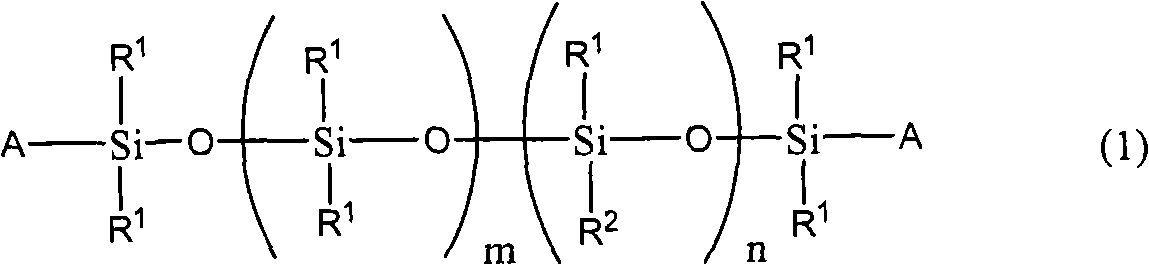
The invention relates to an emulsion composition, a method for softening fiber structure by using the same and a fiber containing base material processed by the same. The composition comprises the following components in portion by weight: (A) 0.01 to less than 25.0 portions of bi-organic group polyorganosiloxane; (B) 0.01 to less than 20.0 portions of softener; (C) 8.0 to 60.0 portions of water; and (D) 20.0 to 90.0 portions of aqueous solution formed by water soluble mono-hydroxyl groups or polyhydric alcohols, wherein the continuous phase of the emulsion composition is formed by the (C) water and the (D) aqueous solution formed by the water soluble mono-hydroxyl groups or alcohols in a ratio of between 1:0.5 and 1:10, and based on the weight of the emulsion composition, the total content of the components (C) and (D) is 30.0 to 98.0 weight portions.
Description
technical field [0001] The present invention relates to novel emulsion compositions having an aqueous continuous phase consisting of water and a water-soluble alcohol. The novel emulsion composition is further characterized in that it comprises diorganopolysiloxane and softener as emulsion particles emulsified in said aqueous solution. The emulsion composition has good stability and homogeneous appearance after storage for several months. [0002] The present invention also relates to a new softener emulsion composition for fibrous substrates, especially tissue paper. The softener emulsion composition not only imparts a soft feel to human skin to a fibrous substrate treated therewith, but also has excellent slippery, wet / creamy, and comfortable bulky feel. In addition, the fibrous substrate retains a specific water absorbency after treatment with the softener emulsion composition. [0003] The invention also relates to methods of softening fibrous structures using said emul...
Claims
the structure of the environmentally friendly knitted fabric provided by the present invention; figure 2 Flow chart of the yarn wrapping machine for environmentally friendly knitted fabrics and storage devices; image 3 Is the parameter map of the yarn covering machine
Login to View More
Application Information
Patent Timeline
Application Date:The date an application was filed.
Publication Date:The date a patent or application was officially published.
First Publication Date:The earliest publication date of a patent with the same application number.
Issue Date:Publication date of the patent grant document.
PCT Entry Date:The Entry date of PCT National Phase.
Estimated Expiry Date:The statutory expiry date of a patent right according to the Patent Law, and it is the longest term of protection that the patent right can achieve without the termination of the patent right due to other reasons(Term extension factor has been taken into account ).
Invalid Date:Actual expiry date is based on effective date or publication date of legal transaction data of invalid patent.



 Login to View More