Qi-blood exchange blood oxygen saturation monitoring device

A gas-blood exchange and saturation technology, applied in the field of medical devices, can solve problems such as interference and inaccurate measurement, achieve high accuracy and sensitivity, ensure quality, and eliminate interference from external factors

CN103091275AActive Publication Date: 2013-05-08江苏三和生物工程股份有限公司
9 Cites 0 Cited by

Patent Information

Authority / Receiving Office
CN · China
Patent Type
Applications(China)
Current Assignee / Owner
Publication Date
2013-05-08

Smart Images

  • Figure 1
    Figure 1
Patent Text Reader

Abstract

The invention relates to a qi-blood exchange blood oxygen saturation monitoring device. The device comprises a qi-blood exchange chamber and a blood oxygen detection part; the qi-blood exchange chamber is divided into three cavities by two gas-permeable films, the three cavities comprise a blood cavity positioned in the middle and an ethyl nitrite mixed gas cavity and an oxygen cavity which are positioned at two sides of the blood cavity respectively, and an ethyl nitrite mixed gas in the ethyl nitrite mixed gas cavity and oxygen in the oxygen cavity respectively permeate the two gas-permeable films and enter blood in the blood cavity for qi-blood exchange; and the blood oxygen detection part is a photoelectric blood oxygen detector and is used for detecting the blood oxygen saturation of the blood after the qi-blood exchange. The qi-blood exchange is carried out by permeating the gas-permeable films through adopting the device in order to improve the oxygen content of the blood; whether the exchanged blood has a full oxygen content or not is detected through the blood oxygen detection part; and the adoption of the photoelectric blood oxygen detector enables the accuracy to be high and the blood oxygen detection accuracy to be improved.
Need to check novelty before this filing date? Find Prior Art

Description

technical field

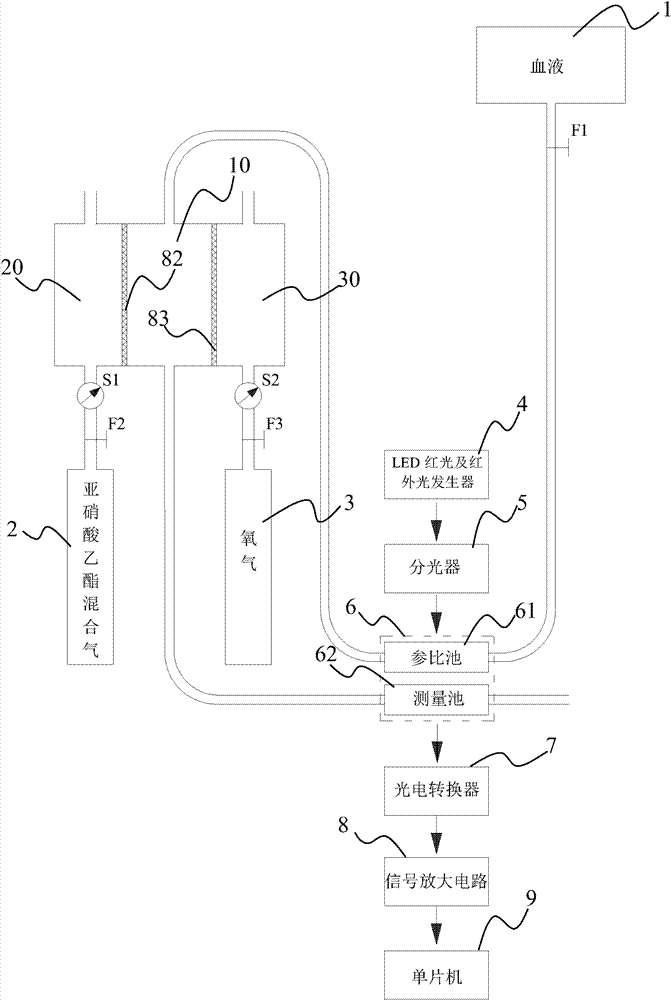
[0001] The invention relates to the field of medical devices, and more specifically, to a gas-blood exchange blood oxygen saturation monitoring device. Background technique

[0002] The deformability of red blood cells (also known as red blood cells, RBC for short) is one of the main factors to maintain the effective perfusion of microcirculation. mass, and these changes in RBC were associated with the absence of nitric oxide (NO). Quantitative supplementation of ethyl nitrite gas to the transfused blood can form nitrosothiol (RSNO) in the blood, thereby releasing NO, which can not only improve the quality of transfused blood, but also make the formed RSNO and the released NO play a role. Certain physiological effects.

[0003] Ethyl nitrite is a congener of NO, and the covalent bond of ethyl nitrite is broken mainly in the form of heterocleavage to produce NO + , has many biological activities similar to NO, and is easy to produce RSNO through transnitrol...

Examples

Embodiment Construction

[0020] The invention relates to a gas-blood exchange blood oxygen saturation monitoring device, which mainly includes a gas-blood exchange cavity and a blood oxygen detection component.

[0021] Such as figure 1 As shown, two gas-permeable membranes are arranged in the gas-blood exchange cavity, namely a first gas-permeable membrane 82 and a second gas-permeable membrane 83 . The two gas-permeable membranes divide the cavity space into three independent chambers, namely the blood chamber 10 in the middle, the ethyl nitrite mixed gas chamber 20 and the oxygen chamber 30 on both sides of the blood chamber 10 . The ethyl nitrite mixed gas chamber 20 is used to accommodate the ethyl nitrite mixed gas, and the ethyl nitrite mixed gas is composed of nitrogen and ethyl nitrite gas, wherein the volume ratio concentration of the ethyl nitrite gas is Between 70-100ppm, the specific content is adjusted according to the actual situation; the oxygen chamber 30 is filled with oxygen. The ...