
A liquid crystal composition with fast response
A liquid crystal composition, a fast-response technology, applied in liquid crystal materials, chemical instruments and methods, etc., to achieve the effects of appropriate optical anisotropy, wide application range, excellent high temperature stability and ultraviolet stability
- Summary
- Abstract
- Description
- Claims
- Application Information
AI Technical Summary
Problems solved by technology
Method used
Image

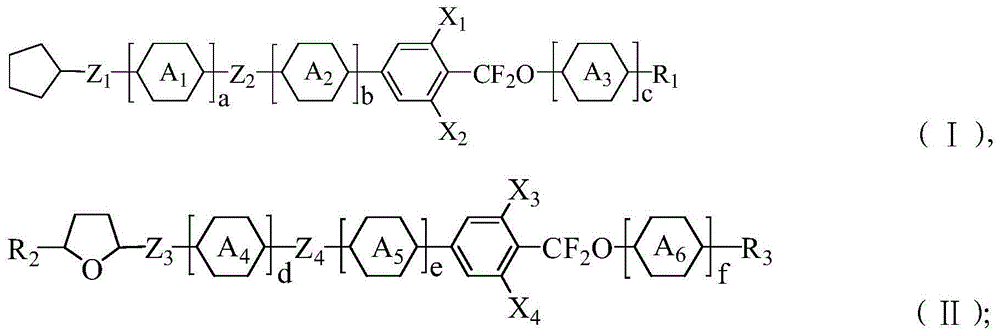


Examples
Embodiment Construction
[0036] Below in conjunction with embodiment the present invention is described in further detail:
[0037] The parts involved in the following examples are all percentages by weight, and the unit of temperature is ° C. The specific meanings and test conditions of other symbols are as follows:
[0038] c.p. indicates the clearing point of the liquid crystal (°C);
[0039] S-N represents the melting point (°C) from the crystalline state of the liquid crystal to the nematic phase;
[0040] Δn means optical anisotropy, Δn=n o -n e , where n o is the refractive index of ordinary light, n e is the refractive index of extraordinary light, test conditions: 589nm, 25°C;
[0041] △ε means dielectric anisotropy, △ε=ε ∥ -ε ⊥ , where ε ∥ is the dielectric constant parallel to the molecular axis, ε ⊥ is the dielectric constant perpendicular to the molecular axis, test conditions: 25°C, 1KHz, HP4284A, 5.2 micron TN left-handed cell;
[0042] τ means response time (ms), test instrum...
PUM
 Login to View More
 Abstract
Description
Claims
Application Information
 Login to View More