
A kind of dsrna that inhibits the expression of the wheat aphid salivary gland secretion polypeptide gene and its application
A salivary gland and gene technology, applied in the field of dsRNA, can solve the problem of decreased expression of target genes
- Summary
- Abstract
- Description
- Claims
- Application Information
AI Technical Summary
Problems solved by technology
Method used
Image

Examples
Embodiment 1
[0021] Example 1. Preparation of dsRNA for Silencing Salivary Gland Secretory Polypeptide Gene
[0022] 1. Extract the total RNA of Aphid rubella and reverse transcribe it into cDNA.
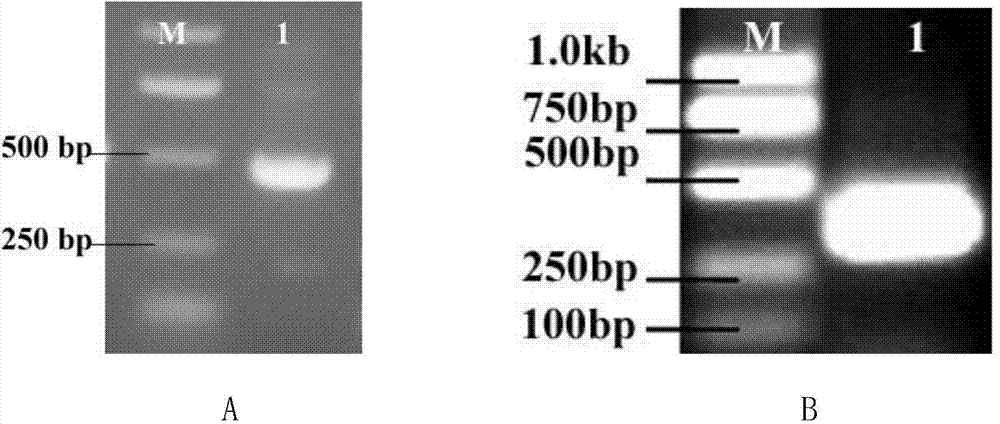
[0023] 2. Using the cDNA obtained in step 1 as a template, perform PCR amplification with a primer pair composed of P1-F and P1-R to obtain a PCR amplification product. The agarose gel electrophoresis of the PCR amplification product is shown in figure 1 a.
[0024] P1-F (upstream primer): TAATACGACTCACTATAGGG AG CGAGGGCGTCATAGCACGGTTT;
[0025] P1-R (downstream primer): TAATACGACTCACTATAGGG AG CCTCTAGGGTACGGGTACGAACAAGGC.
[0026] The underlined region is the T7 promoter sequence.
[0027] PCR reaction system: 10×PCR Buffer 5μL, dNTP (2.5mmol L -1 ) 4 μL, rTaq 0.5 μL, upstream primer (20 μmol L -1 ) 1 μL, downstream primer (20 μmol L -1 ) 1 μL, template 1 μL, with ddH 2 O to make up to 50 μL.
[0028] PCR reaction conditions: 94°C for 4min; 39 cycles of 94°C for 30s, 55°C for 30s,...
Embodiment 2
[0032] Embodiment 2, preparation of dsRNA for silencing GFP gene
[0033] 1. Synthesize the double-stranded DNA molecule shown in sequence 3 of the sequence listing.
[0034] 2. Using the double-stranded DNA molecule obtained in step 1 as a template, carry out PCR amplification with a primer pair composed of P4-F and P4-R to obtain a PCR amplification product. The agarose gel electrophoresis of the PCR amplification product is shown in figure 1 b.
[0035] P4-F (upstream primer): TAATACGACTCACTATAGGG ACGGGAACTACAAGACACG;
[0036] P4-R (downstream primer): TAATACGACTCACTATAGGG C TTTGGAAAGGGCAGATT.
[0037]The PCR reaction system and PCR reaction conditions are the same as those in Step 2 of Example 1.
[0038] 3. Preparation of dsRNA-2
[0039] The PCR amplification product obtained in step 2 was recovered and used as a template, and the T7 in vitro transcription kit was used for in vitro transcription (incubated at 42°C for 16 hours), and the residual template DNA an...
Embodiment 3
[0041] Embodiment 3, the application of dsRNA in inhibiting the growth of aphids
[0042] 1. Preparation of artificial diet for aphids and preparation of feeder
[0043] For the artificial feed preparation method and the structure of the incubator, please refer to the references (Li Caixia, Gao Lifeng, Gao Lingling, Li Runzhi. Research on feeding aphids with pure artificial nutrient solution. Journal of Shanxi Agricultural University, 1997,17(3):225-228.LiC X, Gao L F, Gao L L, Li R Z. Study on the rearing of aphids on an artificially solid diets. Journal of Shanxi Agricultural University, 1997, 17(3):225-228. (in Chinese)). Filter the artificial feed with a bacterial filter with a pore size of 0.2 μm, dispense it into 2.0 mL sterilized centrifuge tubes, and store it in a -20°C refrigerator to avoid repeated freezing and thawing.
[0044] 2. Application of dsRNA in inhibiting the growth of aphids
[0045] See the references for the feeding method of Aphid aphid: Jiao Min, Li...
PUM
 Login to View More
 Abstract
Description
Claims
Application Information
 Login to View More