Full-duplex transceiver in flat fading environment and method for canceling self-interference

A flat fading, full-duplex technology, applied to the shaping network, electrical components, transmission system, etc. in the transmitter/receiver, and can solve problems such as complex structure

CN103634022AActive Publication Date: 2014-03-12UNIV OF ELECTRONICS SCI & TECH OF CHINA
5 Cites 61 Cited by

Patent Information

Authority / Receiving Office
CN · China
Patent Type
Applications(China)
Current Assignee / Owner
Publication Date
2014-03-12

Smart Images

  • Figure 1
    Figure 1
  • Figure 2
    Figure 2
  • Figure 3
    Figure 3
Patent Text Reader

Abstract

The invention discloses a full-duplex transceiver in a flat fading environment and a method for canceling self-interference. The method includes dividing received signals by a coupler to obtain a channel I of signals and a channel Q of signals at a receiving end; respectively transmitting the channel I of signals and the channel Q of signals into a channel I receiving channel and a channel Q receiving channels which are structurally symmetrical with each other; canceling the self-interference in a simulated manner in the receiving channels by the aid of multipliers, adders and a radiofrequency interference reconstruction module; digitally canceling the self-interference at the rear end via a digital cancellation unit; transmitting delay estimation parameters and channel estimation parameters to a delay module, the radiofrequency interference reconstruction module and the digital cancellation unit; circularly canceling the self-interference until the optimal cancellation effect is realized. Phase difference between the channel I of signals and the channel Q of signals is 90 degrees. The delay estimation parameters and the channel estimation parameters are generated by a channel / delay estimation unit. The full-duplex transceiver and the method have the advantages that the complexity of the structure of the transceiver can be effectively decreased by the aid of self-mixing and zero-intermediate-frequency technologies, the cost can be saved, and the size of the full-duplex transceiver can be reduced; requirements of self-interference signals on the precision of delay devices can be greatly reduced, and the devices can be selected conveniently and can be implemented easily; the receiving channels are independent from each other, are structurally symmetrical with each other and can be integrated easily.
Need to check novelty before this filing date? Find Prior Art

Description

Technical field

[0001] The invention relates to a method for removing interference in the field of wireless communication, in particular to a full-duplex transceiver and a self-interference cancellation method in a flat fading environment. Background technique

[0002] Currently, actual wireless communication systems adopt TDD (Time Division Duplexing) or FDD (Frequency Division Duplexing) duplex modes. TDD's duplex system uses the same frequency but different time slots to transmit data, thereby isolating interference between uplink and downlink. The duplex system of FDD uses the same time slot but different frequencies to transmit data, thereby isolating interference between uplink and downlink. These two duplex methods sacrifice time resources and frequency resources respectively in the process of isolating the uplink and the downlink, resulting in low spectrum utilization. If the same frequency is used to transmit and receive wireless signals at the same time, the Co-freque...

Examples

Embodiment Construction

[0055] The technical solutions of the present invention will be described in further detail below with reference to the accompanying drawings, but the protection scope of the present invention is not limited to the following.

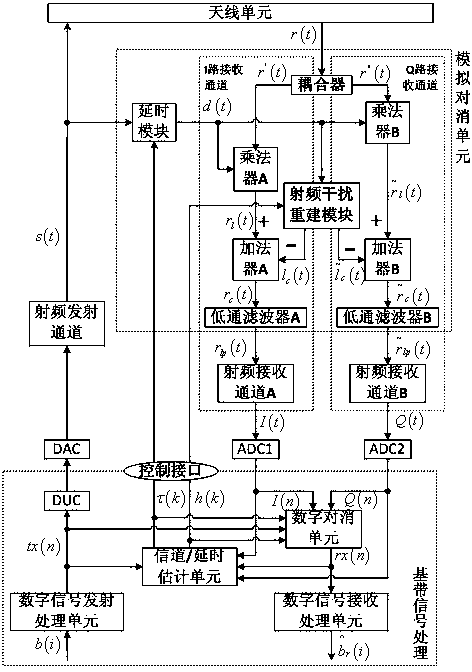
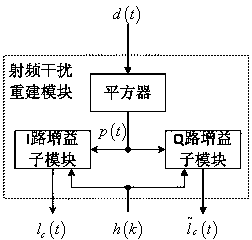
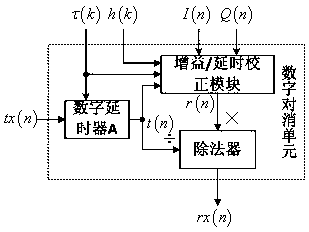
[0056] Such as figure 1 As shown, a full-duplex transceiver in a flat fading environment includes an antenna unit, a digital signal transmission processing unit, a digital signal reception processing unit, a channel / delay estimation unit, a control interface, an analog cancellation unit, and a digital cancellation unit Unit, the digital signal transmission processing unit receives the original signal b(i), the output of the digital signal transmission processing unit is connected to the radio frequency transmission channel through the digital-to-analog converter DAC, and the output of the digital signal transmission processing unit is also respectively connected to the channel / delay estimation unit It is connected to the digital cancellation unit, the outp...