
Fluidized bed synthesis gas to olefin iron-based catalyst, preparation method and use thereof
An iron-based catalyst, synthesis gas technology, applied in physical/chemical process catalysts, hydrocarbon production from carbon oxides, chemical instruments and methods, etc. Re-adsorption, reduction of carbon deposits, and promotion of activation effects
- Summary
- Abstract
- Description
- Claims
- Application Information
AI Technical Summary
Problems solved by technology
Method used
Image

Examples
Embodiment 1
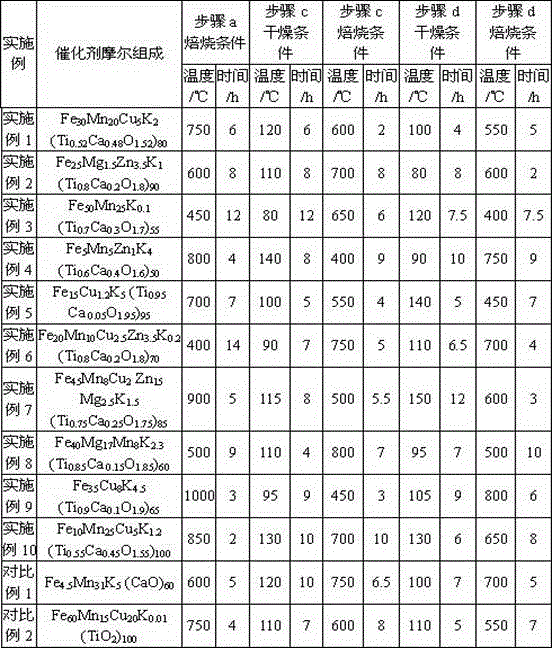
[0022] Dissolve 113.3g of calcium nitrate tetrahydrate in water, add 353.9g of n-butyl titanate to form a slurry, spray the slurry, and bake it at 750°C for 6 hours to obtain the carrier Ti 0.52 Ca 0.48 o 1.52 , Screen the 15-150 μm part for use. Dissolve 187.5g of ferric nitrate hexahydrate, 65g of manganese nitrate and 19g of copper nitrate trihydrate in water to form solution I; dissolve 2.87g of potassium hydroxide in water to form solution II.
[0023] Weigh 80g of prepared Ti 0.5 Ca 0.5 o 1.5 Carrier, using the impregnation method to impregnate solution I on the carrier, bake at 120°C for 6 hours, and then bake at 600°C for 2 hours to obtain a catalyst precursor; impregnate solution II on the catalyst precursor, bake at 100°C for 4 hours, Then calcined at 550°C for 5 hours to obtain the catalyst Fe 30 mn 20 Cu 5 K 2 (Ti 0.52 Ca 0.48 o 1.52 ) 80 , the subscript of the numbers in the brackets is the atomic molar ratio, and the numbers outside the brackets are ...
Embodiment 2~10
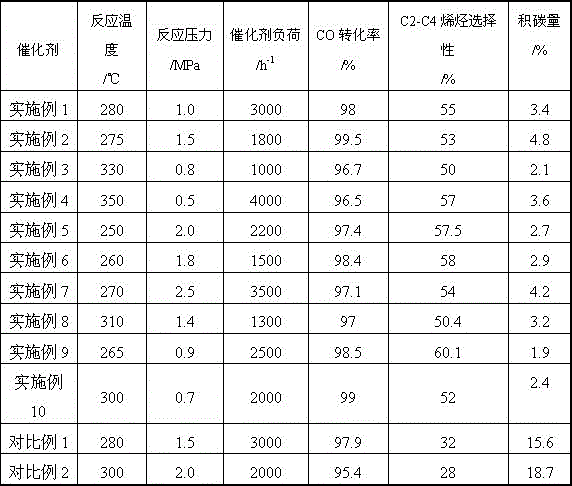
[0025] The preparation process is the same as [Example 1], except that the catalyst composition and preparation conditions are changed, and the specific composition and conditions are shown in Table 1.
PUM
| Property | Measurement | Unit |
|---|---|---|
| size | aaaaa | aaaaa |
| size | aaaaa | aaaaa |
Abstract
Description
Claims
Application Information
 Login to View More