Line speed flexible multi-tuple message classifying method

A packet classification and tuple technology, applied in electrical components, advanced technologies, digital transmission systems, etc., can solve the problems of high memory overhead, slow rule update speed, etc., and achieve low cost, fast rule update speed, and fast search speed. Effect

CN104468344AActive Publication Date: 2015-03-25NAT UNIV OF DEFENSE TECH
1 Cites 4 Cited by

Patent Information

Authority / Receiving Office
CN · China
Patent Type
Applications(China)
Current Assignee / Owner
Publication Date
2015-03-25

Smart Images

  • Figure 1
    Figure 1
  • Figure 2
    Figure 2
  • Figure 3
    Figure 3
Patent Text Reader

Abstract

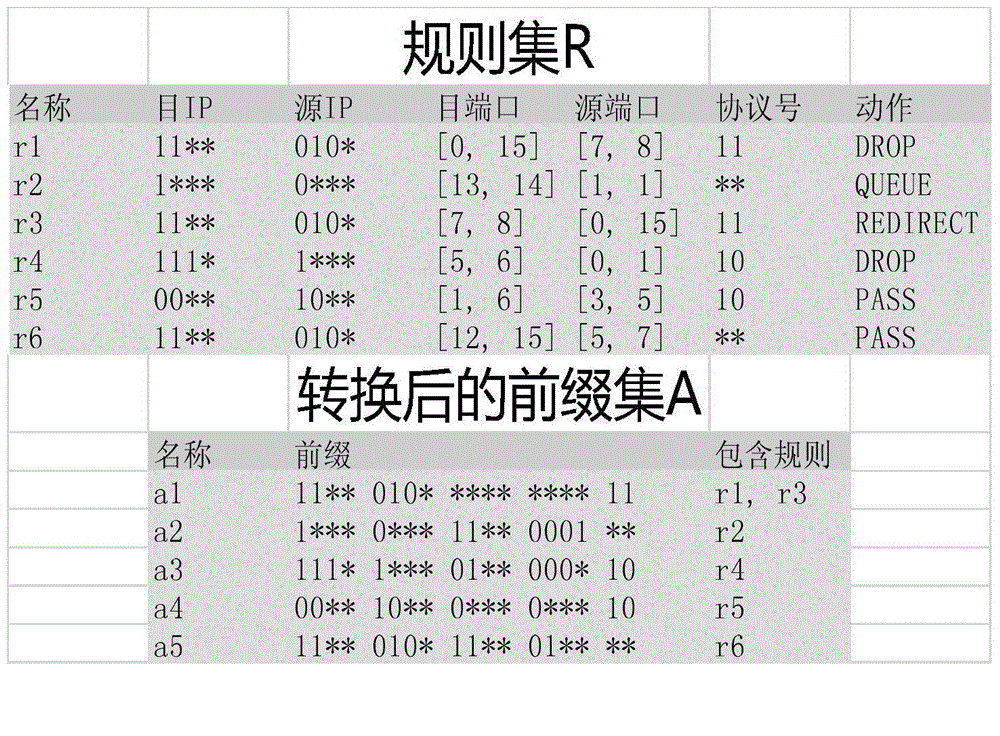
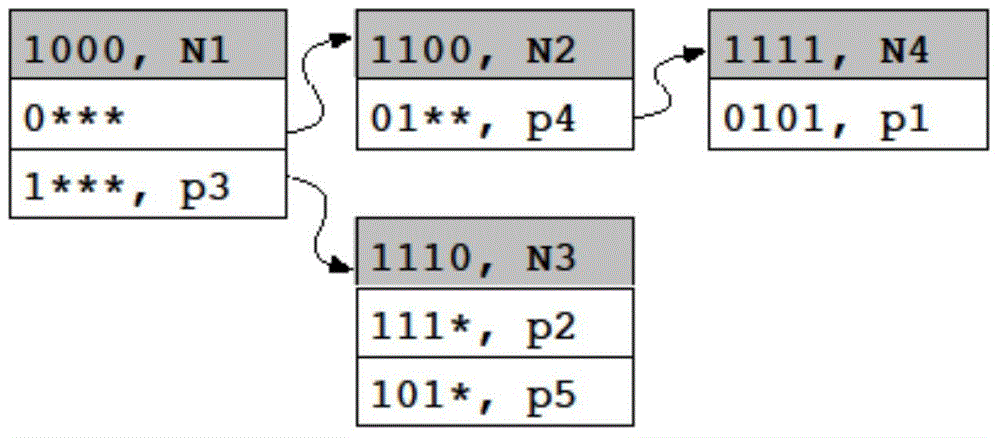
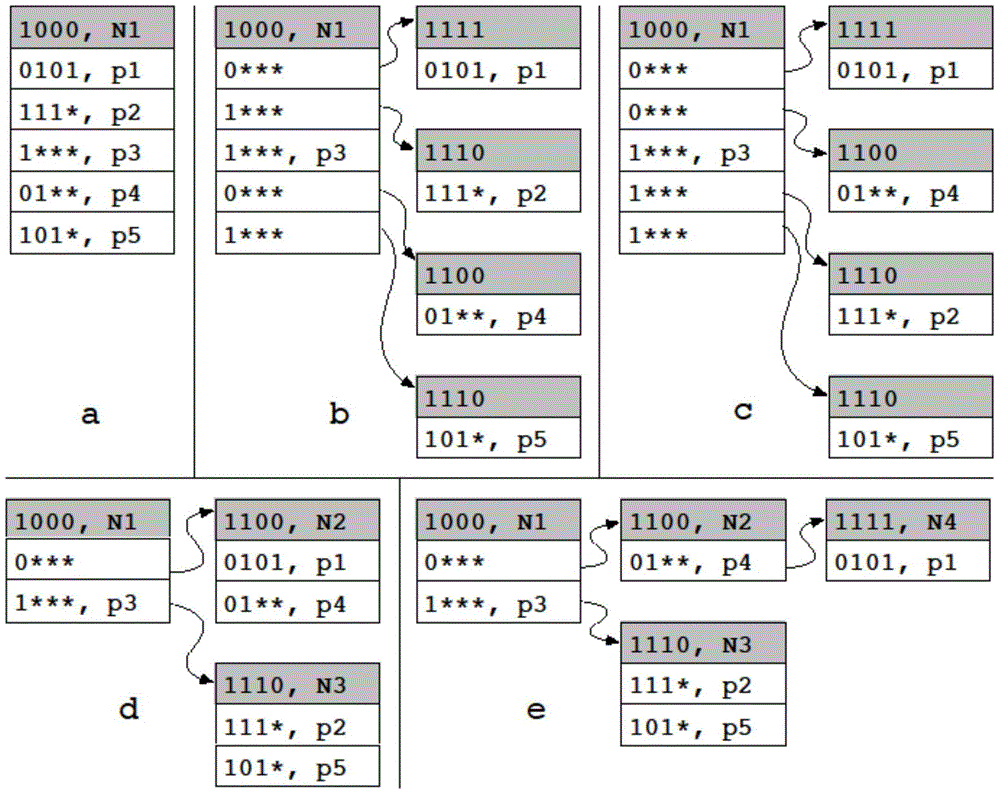
The invention discloses a line speed flexible multi-tuple message classifying method. The method includes the steps of firstly, converting a port field in a rule into a corresponding prefix closure to obtain a discontinuous mask prefix set, wherein the port field is converted into the corresponding prefix closure, that is, the shortest section used for covering the section of the port field and capable of being represented in the form of prefix is formed, and all dimensions of a five-dimension prefix set are connected together to obtain the discontinuous mask prefix set; secondly, establishing a CMT data structure through the discontinuous mask prefix set; thirdly, conducting high-speed message classification through a CMT structure search algorithm. The line speed flexible multi-tuple message classifying method has the advantages of being high in search speed, small in hardware expense, low in energy consumption and the like.
Need to check novelty before this filing date? Find Prior Art

Description

technical field

[0001] The invention mainly relates to the field of message forwarding in network technology, in particular to a line-speed soft multi-group message classification method. Background technique

[0002] Packet classification (Packet Classification) is a key step in realizing message forwarding, and is also a key technology for completing message forwarding. Data packet classification can be described as: aiming at the five-tuple information (source-destination IP, source-destination port, protocol number) in the IP data packet header, find the best rule to match the data packet header. Among them, each rule consists of five ranges (source-destination IP, source-destination port, protocol number). The source-destination IP is expressed in the form of a prefix, the source-destination port is expressed in the form of a range, and the protocol number is generally an exact value. The "best rule" here refers to the rule with the most accurate mask and the shortest ...

Examples

Embodiment Construction

[0039] The present invention will be further described in detail below in conjunction with the accompanying drawings and specific embodiments. In order to clearly describe the method of the present invention, the following assumes that the regular IP and port fields are all 4 bits wide, the protocol number field is 2 bits wide, and the discontinuous mask prefix is ​​4 bits wide.

[0040] The wire-speed soft-tuple message classification method of the present invention is as follows: convert each rule in the rule set into a corresponding multi-dimensional prefix, and use the public mask of these prefixes to convert the traditional prefix matching problem into a multi-level exact matching problem; The multilevel exact matching problem uses a hash table to achieve a lookup rate close to O(1). Furthermore, on the basis of the above method, a set of fast rule update method in a multi-core environment can be realized by using the atomic operation provided by the CPU.

[0041] like ...