ASM-based lane line detection method

A technology for lane line detection and images to be detected, which is applied to instruments, character and pattern recognition, computer components, etc., can solve the problem of not meeting the real-time performance of automobile auxiliary safety driving system, and unable to quickly and accurately realize lane line recognition and tracking and other issues to achieve the effects of improving speed and effectiveness, accurate detection and tracking, and improving speed and robustness

CN104966050AInactive Publication Date: 2015-10-07CHANGAN UNIV
3 Cites 3 Cited by

Patent Information

Authority / Receiving Office
CN · China
Current Assignee / Owner
Publication Date
2015-10-07
Estimated Expiration
Not applicable · inactive patent

Smart Images

  • Figure 1
    Figure 1
  • Figure 2
    Figure 2
  • Figure 3
    Figure 3
Patent Text Reader

Abstract

The invention discloses an ASM-based lane line detection method, which comprises the steps of separating regions of interest from an acquired image ahead of a vehicle; pre-processing the image, including graying the image after the separation of the regions of interest, then carrying out median filtering by using a 3x3 sliding window, retaining the details and removing interference noises; calibrating feature points on two lane lines in the pre-processed image and establishing a training set formed by a feature point distribution model; carrying out normalization processing for the training set established in the third step and obtaining an aligned shape; capturing statistical information of the aligned shape through principal component analysis calculation, and establishing an ASM model; and acquiring to-be-detected images ahead of the vehicle in real time, separating regions of interest from the acquired to-be-detected images ahead of the vehicle and pre-processing the images according to the first and second steps, finally searching for information matching the ASM model from the pre-processed to-be-detected images ahead of the vehicle acquired in real time by using the established ASM model, and finishing the lane line detection.
Need to check novelty before this filing date? Find Prior Art

Description

Technical field:

[0001] The invention relates to a lane line segmentation and detection method, in particular to a lane line detection method based on ASM (Active Shape Models, active shape model). Background technique:

[0002] Lane line detection and tracking is one of the important tasks in the highway assisted safety driving system, and it is the premise and basis for realizing lane keeping assistance, lane departure warning, and collision warning.

[0003] At present, the lane detection technology based on image processing can be divided into two categories: feature-based and model-based. The former mainly uses the texture, edge, color and other features of the road to detect lane lines. The method is susceptible to lighting conditions, lane curvature, occlusion, water accumulation, and pavement damage. The latter is to establish the parameter model of the road first, then analyze the image to determine the model parameters, and finally obtain the complete lane line. ...

Examples

Embodiment

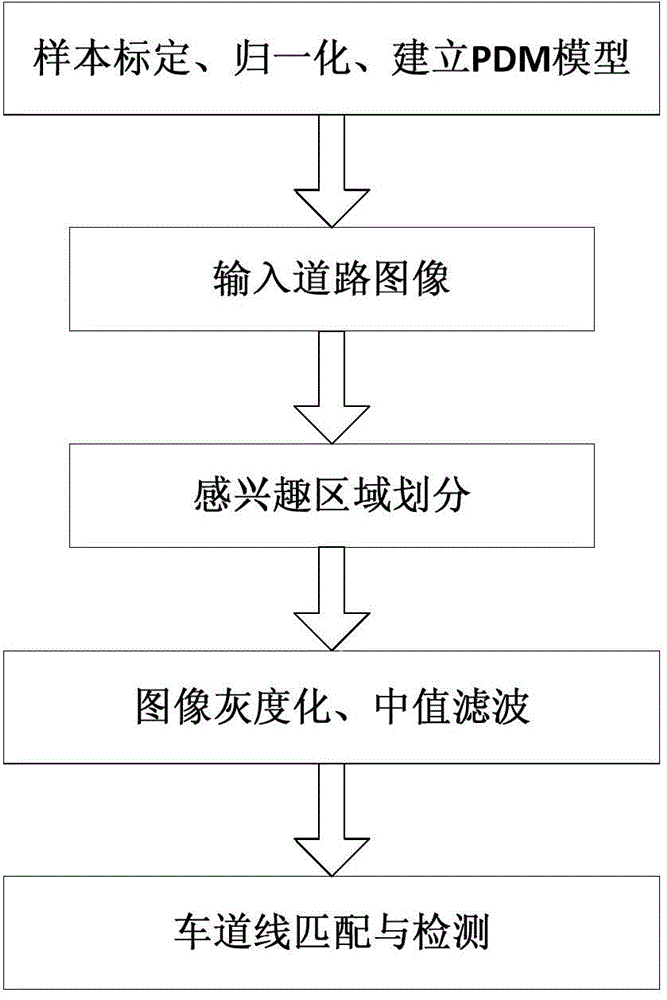
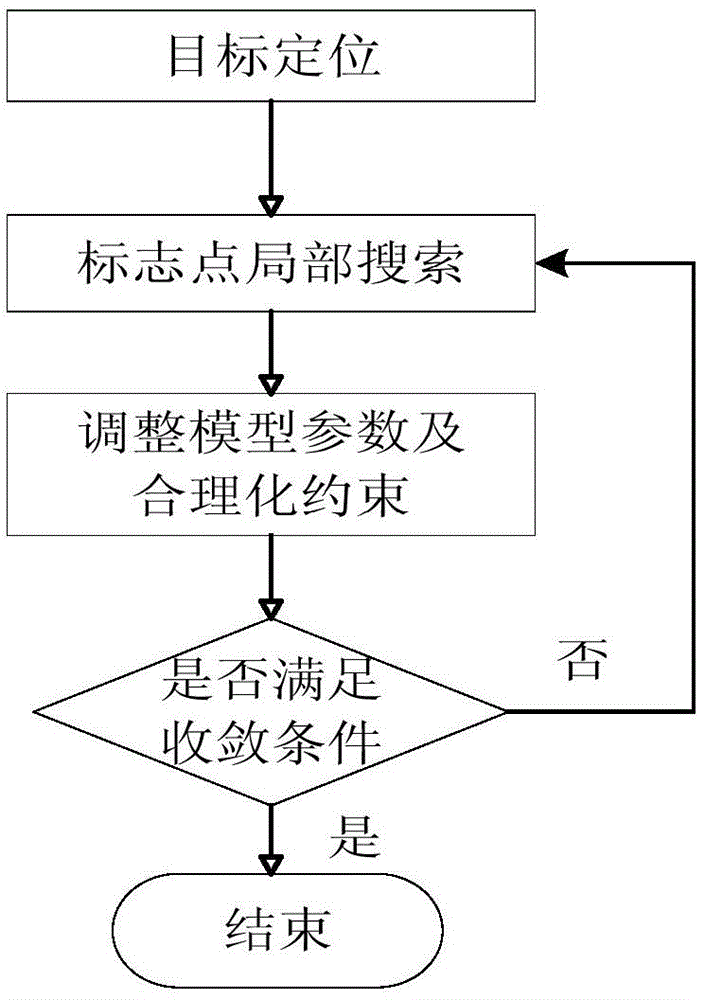
[0029] Such as figure 1 and 2 As shown, a kind of lane line detection method based on ASM of the present invention, specifically carries out according to the following steps:

[0030] 1. Sample calibration

[0031] Sample calibration is to calibrate the feature points of each sample in the sample set. The feature point set is required to describe the shape of the object as accurately as possible. The basis for selecting feature points is: points with special application significance on the target contour or points with certain geometric characteristics, such as connection points of line segments, extreme points of angle and curvature.

[0032] The calibration work is done manually and the number, order and corresponding position of the selected feature points on each shape must be the same. Let for each sample X i Taking n feature points, the sample can be expressed as a 2n-dimensional coordinate vector:

[0033] x i =(x i1 ,x i2 ,...x in ,y i1 ,y i2 ,...y in ) T...