
Neural network equalization method used for indoor visible light communication system
A visible light communication and neural network technology, applied in the field of visible light wireless communication, can solve problems in the research stage and achieve the effects of reducing system complexity, reducing bit error rate, and shortening training time
- Summary
- Abstract
- Description
- Claims
- Application Information
AI Technical Summary
Problems solved by technology
Method used
Image

Examples
Embodiment Construction
[0035] Below in conjunction with accompanying drawing, the present invention will be further described:
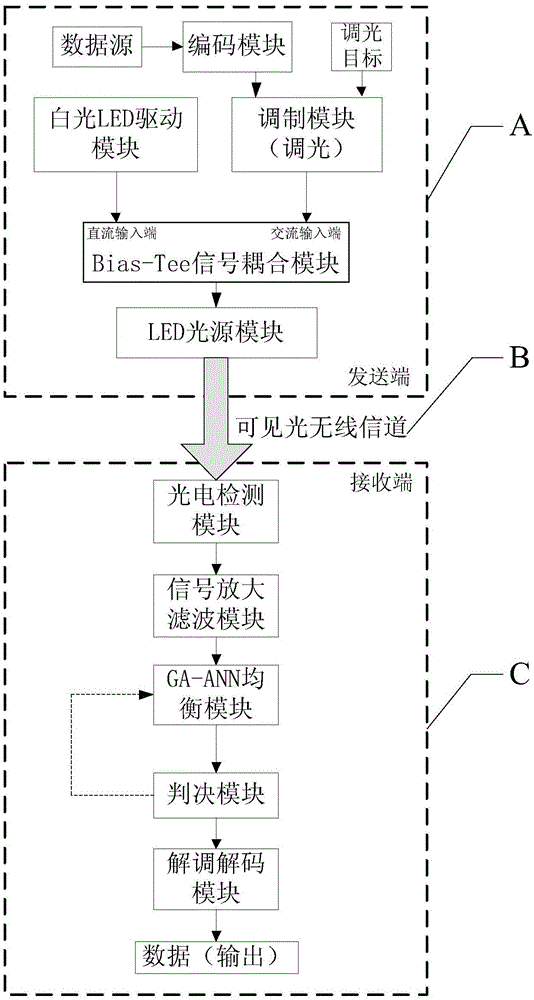
[0036] figure 1 It is a system block diagram of the method of the present invention. As shown in the figure, the visible light communication system includes a signal sending end A, an optical wireless communication channel B, and a signal receiving end C.
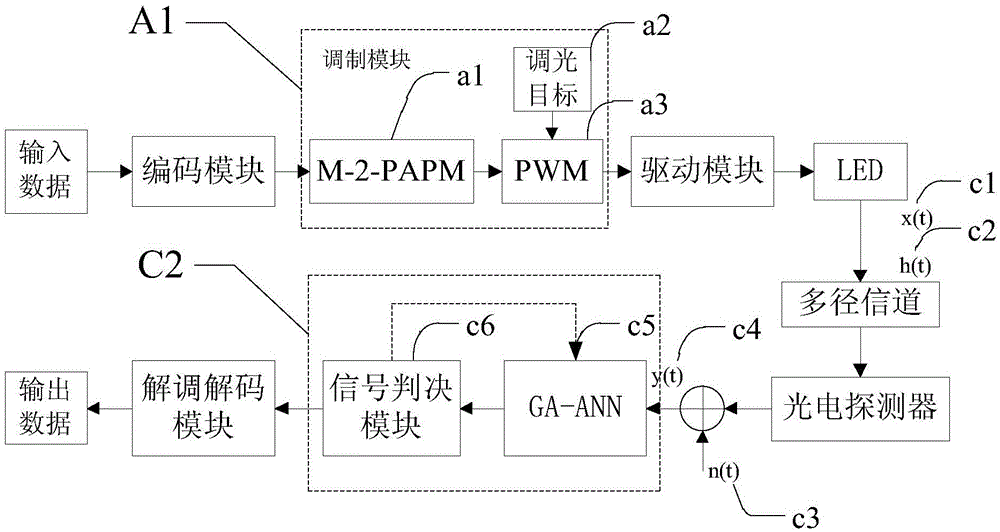
[0037]Signal sending end A is composed of encoding module, modulation module, LED driver module, Bias-Tee signal coupling module and LED light source module. At the signal sending end, the output end of the white LED driver module is connected to the DC input end of the Bias-Tee signal coupling module, and the output end of the signal modulation module A2 is connected to the AC input end of the Bias-Tee signal coupling module. First, the input data is passed through the encoding module and then output. The coding module may include source coding and channel coding, or only channel coding, depending on specific require...
PUM
 Login to View More
 Abstract
Description
Claims
Application Information
 Login to View More