Health-service robot capable of achieving electrocardiograph detection

A service robot and electrical detection technology, applied in the field of service robots, can solve the problems of difficult remote interaction between users and doctors, unfavorable long-term wearing, and difficult promotion, etc., to improve mobile portability and interactivity, and facilitate unloaded medical detection, The effect of simplifying computer vision algorithms

CN105310686AActive Publication Date: 2016-02-10广州迅合医疗科技有限公司
8 Cites 10 Cited by

Patent Information

Authority / Receiving Office
CN · China
Patent Type
Applications(China)
Current Assignee / Owner
Publication Date
2016-02-10

Smart Images

  • Figure 1
    Figure 1
  • Figure 2
    Figure 2
  • Figure 3
    Figure 3
Patent Text Reader

Abstract

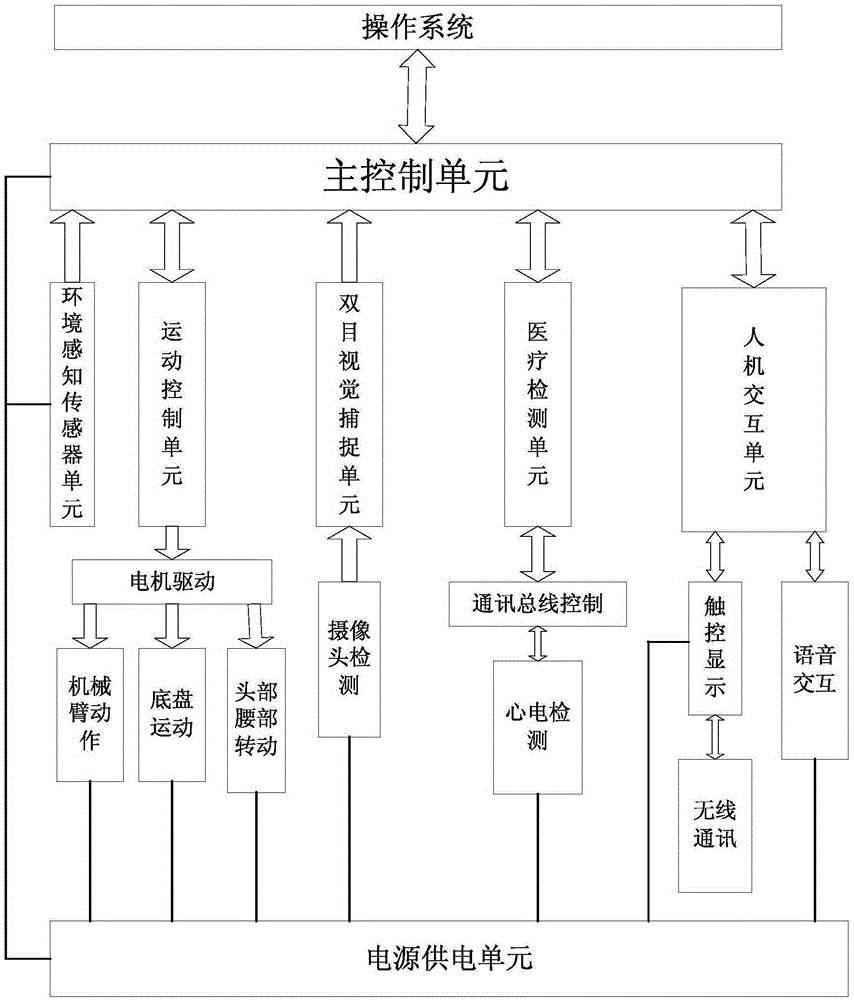
The invention discloses a health-service robot capable of achieving electrocardiograph detection. The health-service robot comprises a robot body, a main control unit, a motion control unit, a binocular vision capturing unit, a man-machine interaction unit, an environmental perception sensor unit, a medical detection unit and a power supply unit, wherein the medical detection unit comprises an electrocardiograph detection device, the electrocardiograph detection device is provided with two electrocardiograph sensors, and the two electrocardiograph sensors are respectively located on the left palm center and the right palm center of the robot body; the main control unit is respectively connected with the motion control unit, the binocular vision capturing unit, the man-machine interaction unit, the environmental perception sensor unit and the medical detection unit through a bus communication protocol and a serial communication protocol; the power supply unit is used for supplying power for the other units. The health-service robot has the advantages that the robot combines the robot moving technology and the medical detection technology and is good in man-machine interaction, convenient to move and use and long in service time.
Need to check novelty before this filing date? Find Prior Art

Description

technical field

[0001] The invention relates to a service robot, in particular to a health service robot capable of detecting electrocardiogram, and belongs to the technical field of service robot and vital sign parameter detection. Background technique

[0002] At present, cardiovascular disease has become the number one cause of death in the world. According to statistics, the number of people who die from cardiovascular disease is more than any other cause of death every year. Therefore, the prevention and diagnosis of cardiovascular disease are particularly important. At present, the electrocardiogram is the best method to measure and diagnose abnormal heart rhythm. The electrocardiogram can diagnose the abnormal rhythm of the heart when the electrical conduction tissue is damaged and the change of the heart rhythm caused by the imbalance of electrolyte balance. However, in traditional ECG monitors, the hardware devices are mainly connected by communication cables, and t...

Examples

Embodiment 1

[0040] The present invention will be further described in detail below in conjunction with the embodiments and the accompanying drawings, but the embodiments of the present invention are not limited thereto.

[0041] Such as figure 1 As shown, the health service robot of this embodiment includes a robot body, a main control unit, a motion control unit, a binocular vision capture unit, a human-computer interaction unit, an environment perception sensor unit, a medical detection unit and a power supply unit; the main control unit Unit, motion control unit, binocular vision capture unit, human-computer interaction unit, environmental perception sensor unit and medical detection unit are arranged on the robot body; the medical detection unit includes an electrocardiogram detection device, which has two One ECG sensor, two ECG sensors are placed on the front of the left and right palms of the robot body respectively; The unit, the environment perception sensor unit and the medical...