
Multipoint pulse wave detection method and device
A detection method and pulse wave technology, which are applied in the field of medical vital signs detection, can solve the problems of limited assessment of the cardiovascular physiological state of the human body, little information on the cardiovascular system, and difficulty in eliminating motion artifacts of pulse wave signals, so as to eliminate motion Artifacts, convenient and comfortable to wear
- Summary
- Abstract
- Description
- Claims
- Application Information
AI Technical Summary
Problems solved by technology
Method used
Image


Examples
Embodiment Construction
[0029] The present invention will be further described in detail below in conjunction with the accompanying drawings.
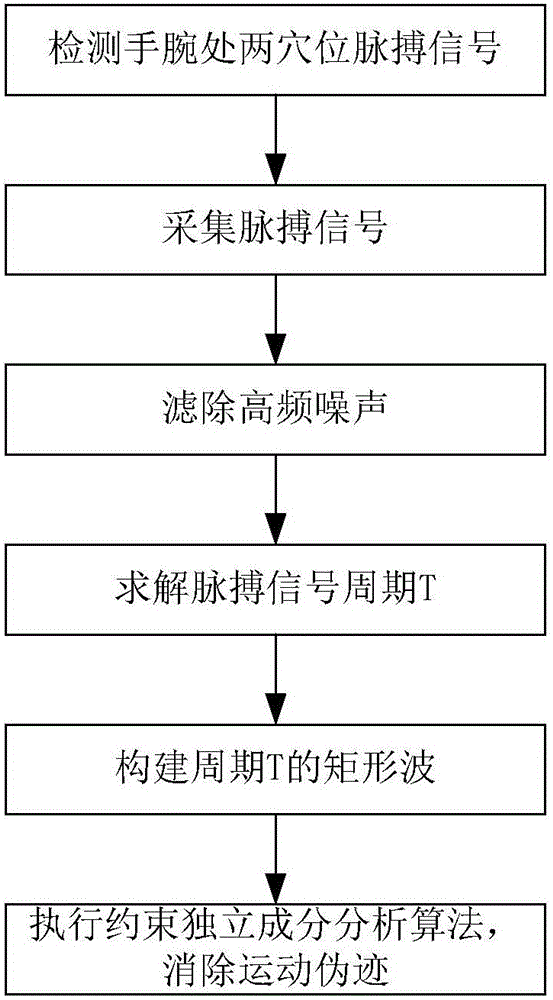
[0030] The multi-point pulse wave detection method of the present invention, as figure 1 As shown, it is realized through the following steps:
[0031] Step 1: Obtain a total of two pulse wave signals at Cunkou and Shenmen points on the wrist of the human body.
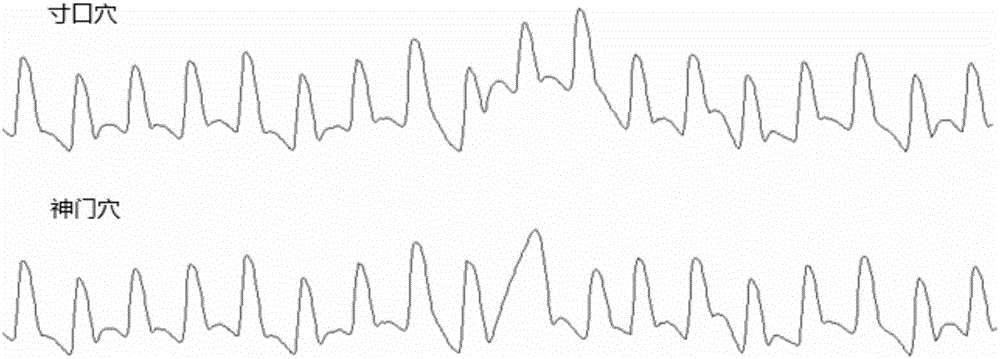
[0032] Step 2: Collect two pulse wave signals, but if figure 2 As shown, the continuous acquisition of the subject's pulse wave signal during the exercise process is obviously disturbed by motion artifacts.
[0033] Step 3: Perform low-pass filtering on the two pulse wave signals to filter out high-frequency noise.
[0034] Step 4: Since the periods of the two pulse wave signals are the same, the autocorrelation function of one of the pulse wave signals is solved to obtain the period T of the pulse wave signal.
[0035] Step 5: According to the period T of the pulse wave signal obtained in step ...
PUM
 Login to View More
 Abstract
Description
Claims
Application Information
 Login to View More