
Application of simulated fasting diet in the prevention and treatment of Parkinson's disease
A Parkinson's disease, heat technology, applied in the field of medical neurology, can solve the problems of PD mice with no therapeutic effect, worsening dysfunction, and low operability, and achieve the increase in the number of tyrosine hydroxylase-positive neuron cells , Improve the symptoms of slow movement, improve the effect of dopamine content
- Summary
- Abstract
- Description
- Claims
- Application Information
AI Technical Summary
Problems solved by technology
Method used
Image

Examples
Embodiment 1
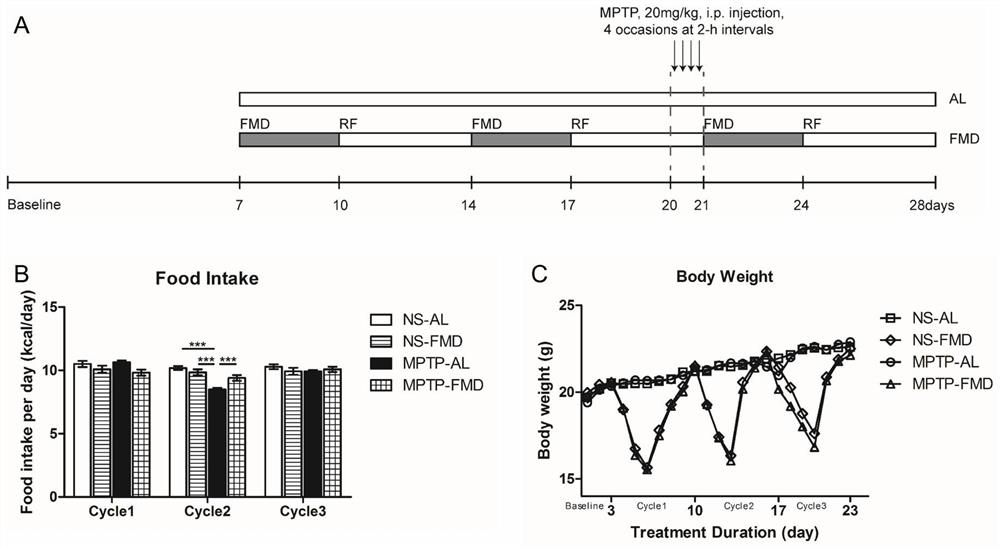
[0032] Example 1: Establishment and grouping of animal models
[0033] Body weight 20-25g, 7-week-old, male C57BL / 6J mice were randomly divided into blank control group (NS-AL group, ad libitum and intraperitoneal injection of normal saline), blank diet group (NS-FMD group, simulated fasting diet and Intraperitoneal injection of normal saline), model group (MPTP-AL group, free feeding and intraperitoneal injection of MPTP), treatment group (MPTP-FMD group, simulated fasting diet and intraperitoneal injection of MPTP), 20 animals in each group. The animals were placed at 23±2°C, and the lighting time was 12 hours / day, and the animals were acclimated to the environment for one week before dietary intervention. The NS-FMD group and the MPTP-FMD group were given FMD diet for three consecutive weeks, and on the last day of the second week, 0.9% saline or MPTP were injected intraperitoneally with MPTP (20 mg / kg) for four consecutive times, each time interval 2 hours. Both the NS-AL...
PUM
 Login to View More
 Abstract
Description
Claims
Application Information
 Login to View More