
Electronic beam cured paper packaging gloss oil and curing method of printed coating
An electron beam curing and printing coating technology, applied in coatings, polyester coatings, polyether coatings, etc., can solve problems such as containing and affecting human health.
- Summary
- Abstract
- Description
- Claims
- Application Information
AI Technical Summary
Problems solved by technology
Method used
Image

Examples
Embodiment 1
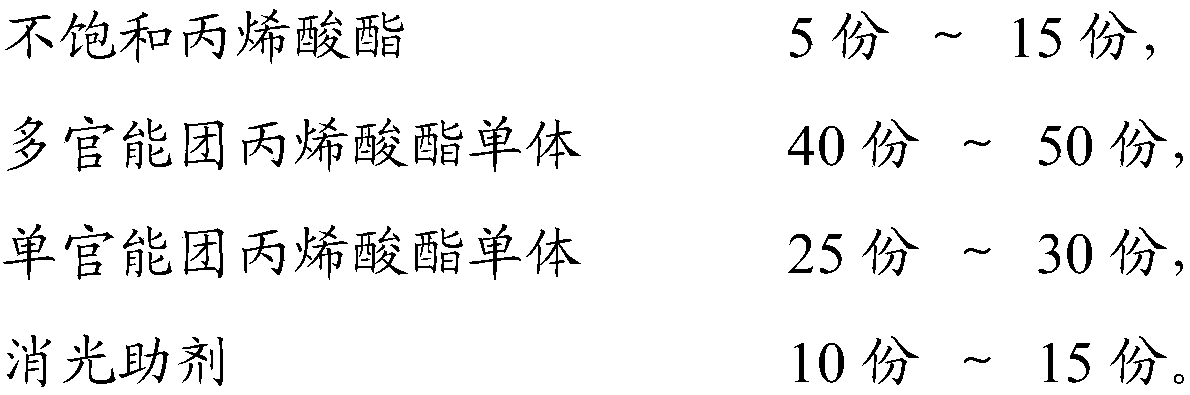
[0024] First, the parts by weight are respectively 5 parts of epoxy acrylate, 40 parts of dipropylene glycol diacrylate (DPGDA), 25 parts of hydroxyethyl acrylate (HEA), and 10 parts of matting aids are mixed uniformly to obtain electron beam curable varnish ; Secondly, the water-based ink is printed on the substrate, and the ultraviolet light is applied to irradiate and cure the ink to obtain a cured ink layer. The cured ink layer is not completely cured due to the influence of ultraviolet light reflection and refraction, and a layer of transparent coating is required. layer to protect the cured ink layer; finally, a layer of electron beam cured varnish is coated on the cured ink layer of the substrate, and an electron accelerator is used to irradiate the printed substrate with an oxygen concentration range of 0.5 to 1000ppm. layer, to obtain a cured printing coating, and to prepare a printed proof of the substrate. The control of the oxygen concentration is realized by passi...
Embodiment 2
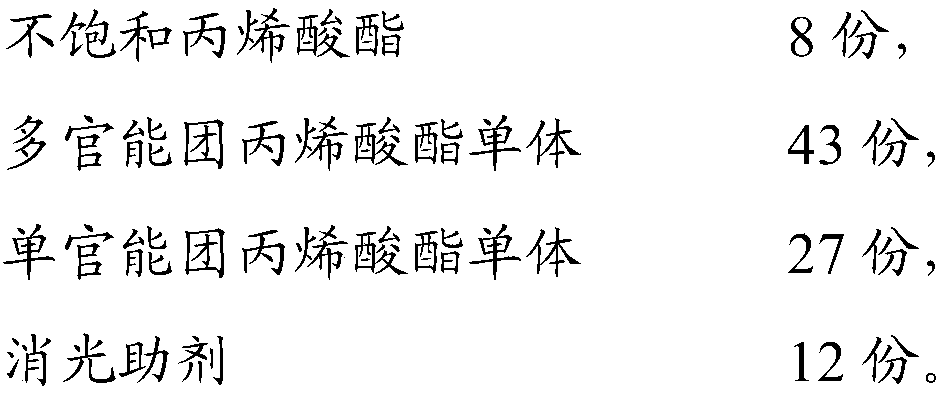
[0030] First, mix 8 parts by weight of epoxy acrylate, 43 parts of dipropylene glycol diacrylate (DPGDA), 27 parts of hydroxyethyl acrylate (HEA), and 12 parts of matting aids to obtain electron beam curable varnish ; Secondly, the water-based ink is printed on the substrate, and the ultraviolet light is applied to irradiate and cure the ink to obtain a cured ink layer. The cured ink layer is not completely cured due to the influence of ultraviolet light reflection and refraction, and a layer of transparent coating is required. layer to protect the cured ink layer; finally, a layer of electron beam cured varnish is coated on the cured ink layer of the substrate, and an electron accelerator is used to irradiate the printed substrate with an oxygen concentration range of 0.5 to 1000ppm. layer, to obtain a cured printing coating, and to prepare a printed proof of the substrate. The control of the oxygen concentration is realized by passing high-purity nitrogen gas into the electr...
Embodiment 3
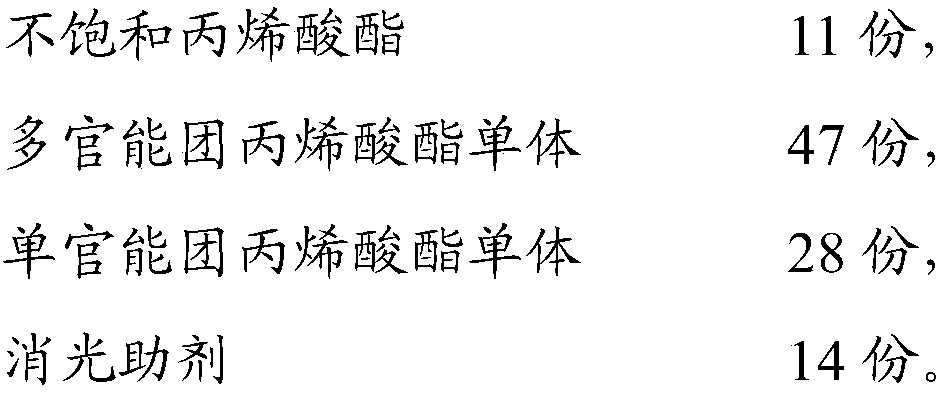
[0032] First, mix 11 parts by weight of epoxy acrylate, 47 parts of dipropylene glycol diacrylate (DPGDA), 28 parts of hydroxyethyl acrylate (HEA), and 14 parts of matting aids to obtain electron beam curable varnish ; Secondly, the water-based ink is printed on the substrate, and the ultraviolet light is applied to irradiate and cure the ink to obtain a cured ink layer. The cured ink layer is not completely cured due to the influence of ultraviolet light reflection and refraction, and a layer of transparent coating is required. layer to protect the cured ink layer; finally, a layer of electron beam cured varnish is coated on the cured ink layer of the substrate, and an electron accelerator is used to irradiate the printed substrate with an oxygen concentration range of 0.5 to 1000ppm. layer, to obtain a cured printing coating, and to prepare a printed proof of the substrate. The control of the oxygen concentration is realized by passing high-purity nitrogen gas into the elect...
PUM
| Property | Measurement | Unit |
|---|---|---|
| width | aaaaa | aaaaa |
Abstract
Description
Claims
Application Information
 Login to View More