
Tiger frog breeding method
A tiger frog and breeding box technology, which is applied in animal husbandry and other fields, can solve problems such as the difficulty in producing high-quality young frogs efficiently, affecting the market economic benefits of tiger frog breeding work, and the lack of fine varieties artificially selected to achieve design Reasonable, growth-promoting effect
- Summary
- Abstract
- Description
- Claims
- Application Information
AI Technical Summary
Problems solved by technology
Method used
Image

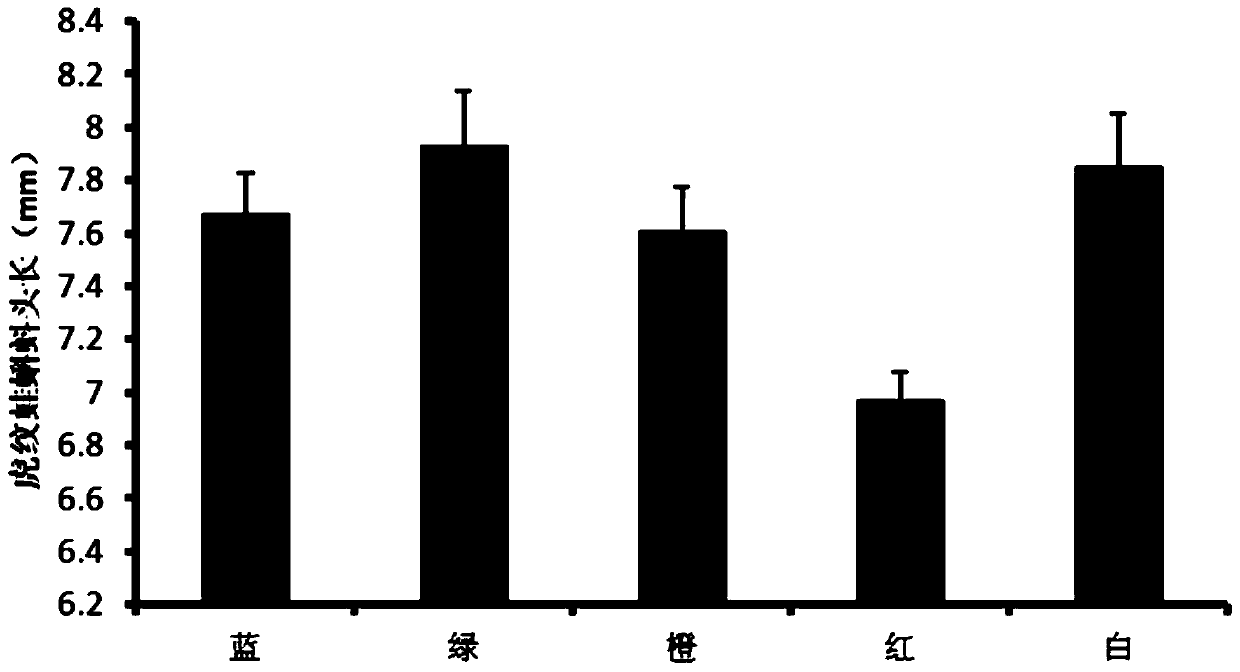
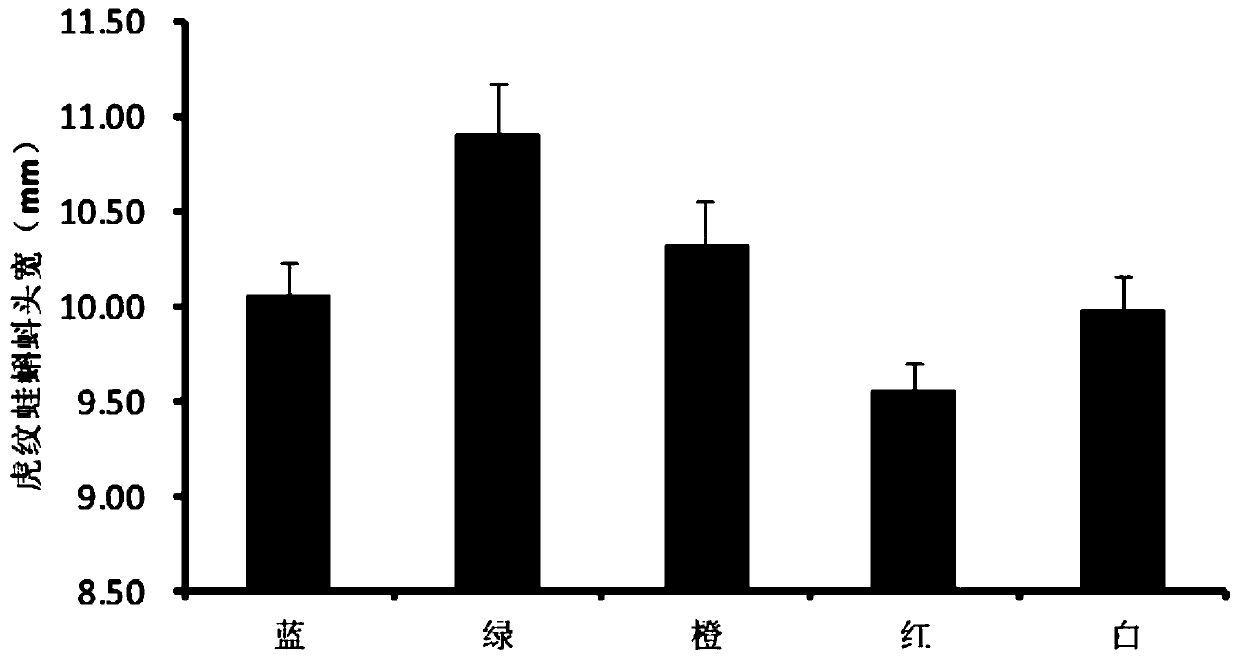
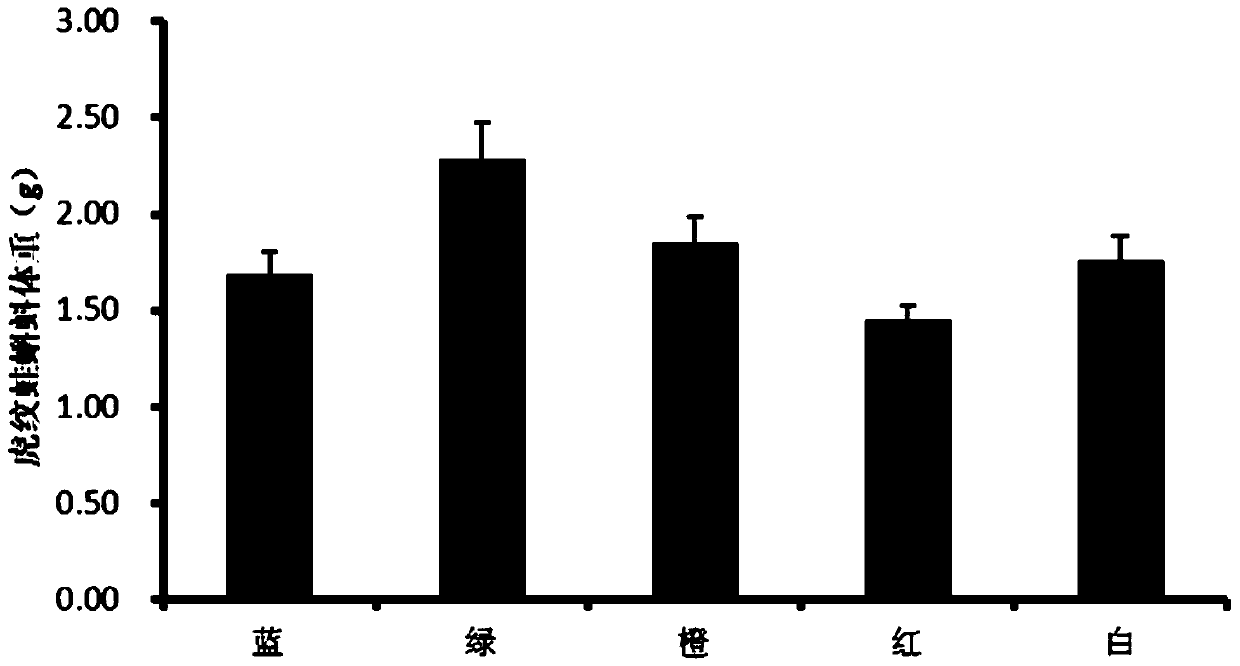
Examples
Embodiment 1
[0023] Embodiment 1. The method for tiger frog cultivation.
[0024] 1) Take an opaque plastic basket with a size of (50*40*40cm 3 ), filled with 40L of aeration water with a water depth of 20cm, and heated with a heating device to keep the water temperature stable at 29°C, and the fluctuation of the water temperature does not exceed 1°C. Collect the newly hatched tiger frog tadpoles, get 80 tails and place them in the above-mentioned plastic baskets for testing, and feed them with saturated food every day. The oxygen content in the aerated water in the plastic box is 6.5ppm; pH is 6.8; 63.5μS / cm; the chlorine content is less than 0.3mg / L; the feed for feeding is No. 0 bullfrog feed produced by Ningbo Tianbang Co., Ltd. (moisture ≤ 12.0, crude protein ≥ 42.0, crude fat ≥ 3.0, crude fiber ≤4.0, crude ash ≤18.0, calcium ≥1.5, total phosphorus ≥1.0, salt ≤3.0).
[0025] 2) During the tadpole rearing period, in a light-tight box, irradiate with LED green light with a peak wavele...
Embodiment 2
[0026] Embodiment 2. The method for tiger frog cultivation.
[0027] 1) Take an opaque plastic basket with a size of (50*40*40cm 3 ), filled with 40L of aeration water with a water depth of 20cm, and heated with a heating device to keep the water temperature stable at 29°C, and the fluctuation of the water temperature does not exceed 1°C. Collect the newly hatched tiger frog tadpoles, get 80 tails and place them in the above-mentioned plastic baskets for testing, and feed them with saturated food every day. The oxygen content in the aerated water in the plastic box is 6.47ppm; pH is 7.0; 63.1μS / cm; the chlorine content is less than 0.3mg / L; the feed for feeding is No. 0 bullfrog feed produced by Ningbo Tianbang Co., Ltd. (moisture ≤ 12.0, crude protein ≥ 42.0, crude fat ≥ 3.0, crude fiber ≤4.0, crude ash ≤18.0, calcium ≥1.5, total phosphorus ≥1.0, salt ≤3.0).
[0028] 2) During the tadpole rearing period, in a light-tight box, irradiate with LED green light with a peak wavel...
Embodiment 3
[0029] Embodiment 3. the method for tiger frog breeding.
[0030] 1) Take an opaque plastic basket with a size of (50*40*40cm 3 ), filled with 40L of aeration water with a water depth of 20cm, and heated with a heating device to keep the water temperature stable at 29°C, and the fluctuation of the water temperature does not exceed 1°C. Collect the newly hatched tiger frog tadpoles, get 80 tails and place them in the above-mentioned plastic baskets for testing, and feed them with saturated food every day. The oxygen content in the aerated water in the plastic box is 6.62ppm; pH is 7.0; 63.9μS / cm; the chlorine content is less than 0.3mg / L; the feed for feeding is No. 0 bullfrog feed produced by Ningbo Tianbang Co., Ltd. (moisture ≤ 12.0, crude protein ≥ 42.0, crude fat ≥ 3.0, crude fiber ≤4.0, crude ash ≤18.0, calcium ≥1.5, total phosphorus ≥1.0, salt ≤3.0).
[0031] 2) During the tadpole rearing period, in a light-tight box, irradiate with LED green light with a peak waveleng...
PUM
| Property | Measurement | Unit |
|---|---|---|
| Conductivity | aaaaa | aaaaa |
| Peak wavelength | aaaaa | aaaaa |
| Half wave width | aaaaa | aaaaa |
Abstract
Description
Claims
Application Information
 Login to View More