Controllable built-in electromagnetic waste gas bypass turbocharger

A turbocharger, electromagnetic technology, applied in the direction of machines/engines, internal combustion piston engines, engine components, etc., can solve the problems of limited space layout of the turbocharger, vibration and wear parts, easy to generate noise, etc., to achieve assembly The effect of reducing technology and procedures, avoiding vibration and wear, and improving low-speed performance

CN114320577APending Publication Date: 2022-04-12HUNAN TYEN MACHINERY
0 Cites 0 Cited by

Patent Information

Authority / Receiving Office
CN · China
Patent Type
Applications(China)
Current Assignee / Owner
Publication Date
2022-04-12

Smart Images

  • Figure 1
    Figure 1
  • Figure 2
    Figure 2
  • Figure 3
    Figure 3
Patent Text Reader

Abstract

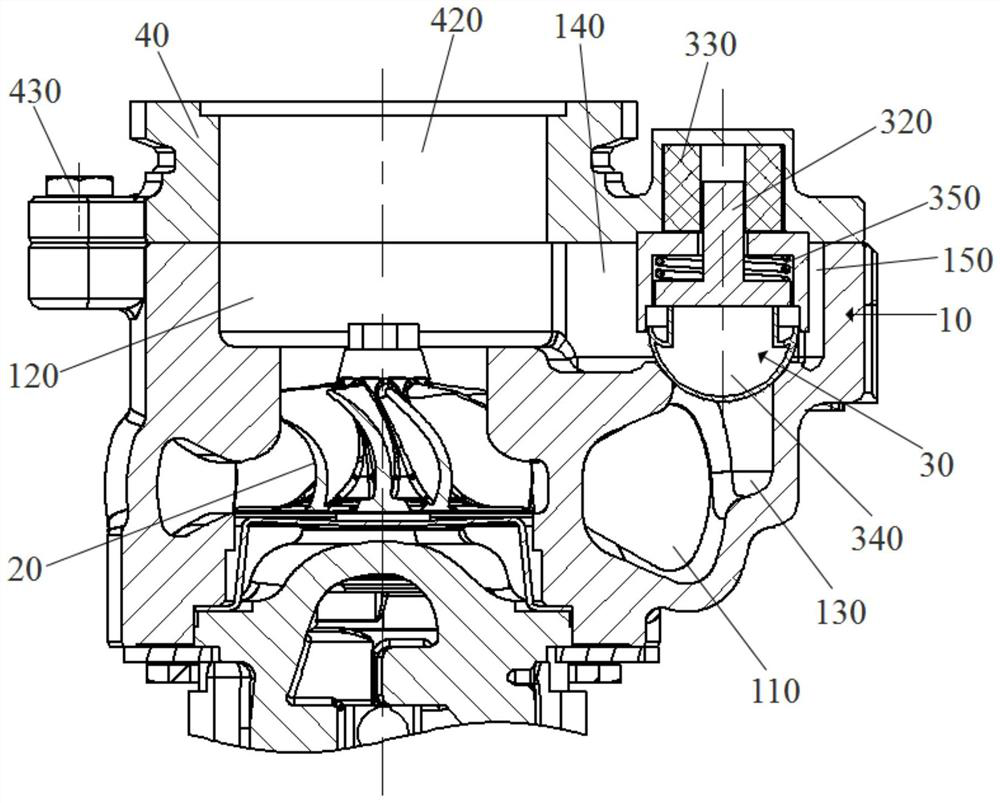
The invention provides a controllable built-in electromagnetic waste gas bypass turbocharger which comprises a turbine box, an end cover fixed to the turbine box and a bypass mechanism arranged in the turbine box, the bypass mechanism comprises a valve base, a movable iron core and a deflation valve, and a first through hole allowing the movable iron core to penetrate through is formed in the valve base; the movable iron core comprises a guide rod part and a connecting part which are oppositely arranged, the guide rod part is sleeved with an electromagnetic iron ring, the movable iron core is movably arranged in the axis direction of the first through hole, the deflation valve comprises a contact part and a guide part which are oppositely arranged, and a compression spring is arranged between the connecting part and the valve base. The bypass mechanism is arranged in the turbine box, opening and closing of the deflation valve are controlled through cooperation of the electromagnet ring, the movable iron core and the compression spring, and along with change of the working condition of an engine, as the magnetic force of the electromagnet is in direct proportion to the current, the bypass mechanism is arranged in the turbine box. Therefore, the opening stroke and the waste gas bypass amount of the deflation valve are controlled by controlling the current of the traction electromagnet.
Need to check novelty before this filing date? Find Prior Art

Description

technical field

[0001] The invention relates to the technical field of turbocharging, in particular to a controllable built-in electromagnetic wastegate turbocharger. Background technique

[0002] The turbocharger is a mechanical device that uses the exhaust gas energy discharged from the engine to further boost the pressure. It uses the exhaust gas energy of the engine to drive the turbine in the turbine box to rotate. The turbine drives the coaxial compressor impeller to work. The fresh air is filtered by the air. The cleaner enters the compressor, and the impeller of the compressor rotates to compress the fresh air to achieve the effect of supercharging. Therefore, the turbocharger can effectively recycle the exhaust gas energy, increase the air volume in the cylinder with the same displacement, optimize the combustion process, and improve the working efficiency of the internal combustion engine. Turbocharger is an essential part of modern engines to increase power, redu...

Examples

Embodiment Construction

[0041] It should be understood that the specific embodiments described here are only used to explain the present invention, not to limit the present invention.

[0042] The following will clearly and completely describe the technical solutions in the embodiments of the present invention with reference to the accompanying drawings in the embodiments of the present invention. Obviously, the described embodiments are only part of the embodiments of the present invention, not all of them. Based on the embodiments of the present invention, all other embodiments obtained by persons of ordinary skill in the art without creative efforts fall within the protection scope of the present invention.

[0043] It should be noted that all directional indications (such as up, down, left, right, front, back...) in the embodiments of the present invention are only used to explain the relationship between the components in a certain posture (as shown in the accompanying drawings). Relative position...