
Bonding objects together
a technology of objects and bonding, applied in the field of mechanical engineering and construction, can solve problems such as substantial forces/deformation, and achieve the effects of strong heating, high energy absorption, and potentially very fast processing
- Summary
- Abstract
- Description
- Claims
- Application Information
AI Technical Summary
Benefits of technology
Problems solved by technology
Method used
Image

Examples
Embodiment Construction
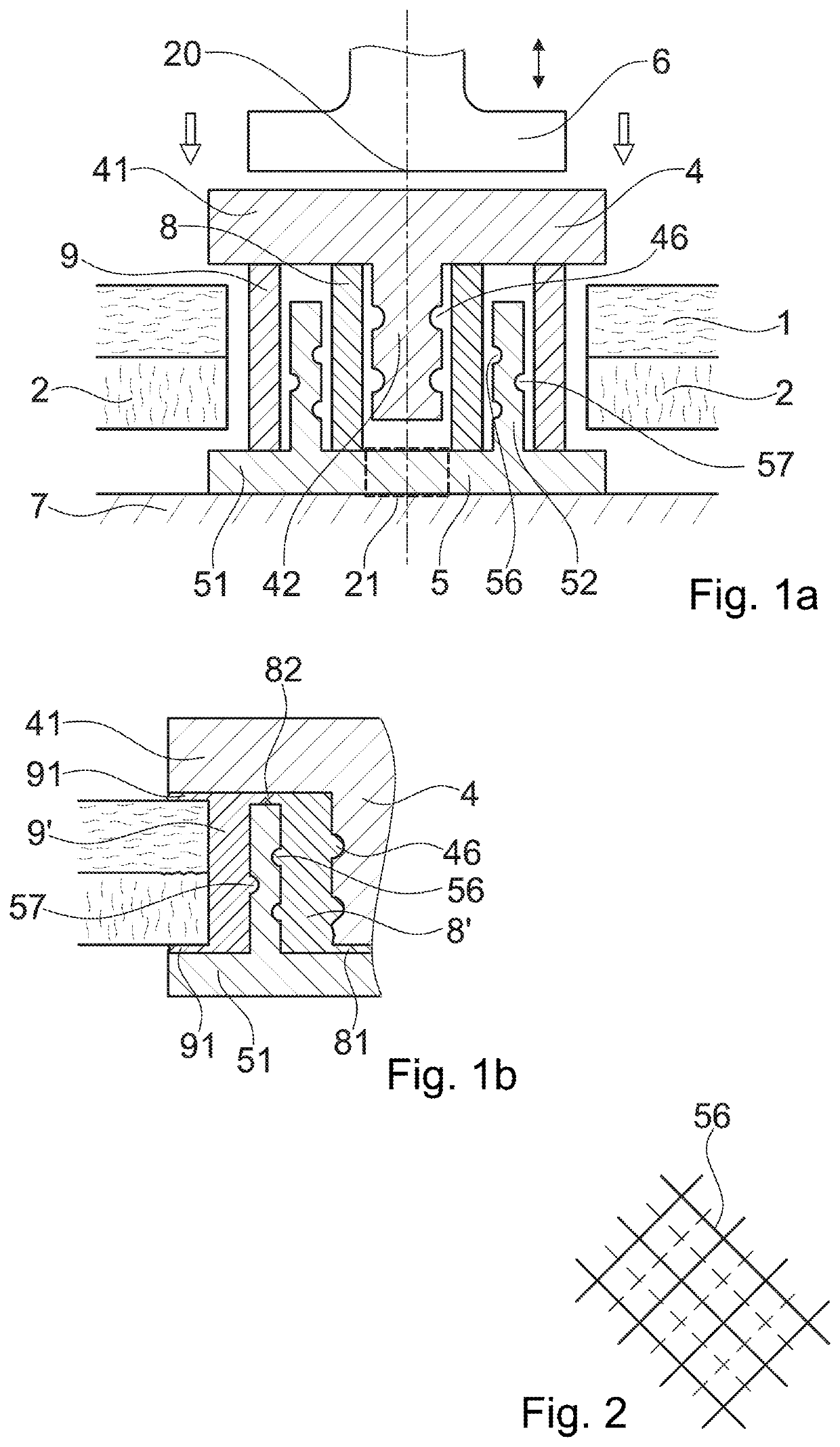
[0121]FIG. 1a depicts a basic set-up of embodiments of the invention. In the depicted embodiment, in addition to a first object 1, the connector is also to be connected to a second object 2 and to thereby connect the first and second objects 1, 2 to each other in a rivet-like manner.
[0122]The first and the second objects 1, 2 each have a through opening, the through openings being aligned with each other.
[0123]The first object 1 and the second object 2 may each, for example, be boards or sheets, for example of a metal or of a fiber reinforced composite or of foam filed carbon fiber reinforced sandwich element material. The second object may be of the same material composition as the first object or of a different material than the first object.
[0124]The first connector element 4 is of a metal, such as aluminum or an aluminum alloy or of steel. It is one-piece and has a proximal head portion 41 and a shaft portion 42.
[0125]The second connector element 5 is also of a metal, for exampl...
PUM
| Property | Measurement | Unit |
|---|---|---|
| frequency | aaaaa | aaaaa |
| frequency | aaaaa | aaaaa |
| frequency | aaaaa | aaaaa |
Abstract
Description
Claims
Application Information
 Login to View More