Check patentability & draft patents in minutes with Patsnap Eureka AI!

Method and apparatus for high denier hollow spiral fiber

a spiral fiber, high denier technology, applied in the field of apparatus and method for forming hollow fiber, can solve the problems of affecting the subsequent processing, affecting the application, and directly reflecting the molecular structure, and affecting the quality of spiral fibers

Inactive Publication Date: 2003-06-26
DAK AMERICAS MISSISSIPPI INC
View PDF31 Cites 6 Cited by
  • Summary
  • Abstract
  • Description
  • Claims
  • Application Information

AI Technical Summary

Benefits of technology

The solution effectively reduces filament breakages and enhances the production of self-texturing hollow fibers by managing strain rates and promoting coiling, even with recycled materials, thereby improving the quality and consistency of the final product.

Problems solved by technology

Both of these methods have various advantages and disadvantages in producing coiled yarns.
Nevertheless, the use of recycled polyester--the majority of which is from post-consumer beverage bottles--as feedstock for filament production poses numerous problems.
One problem associated with recycled feedstock (as opposed to virgin polymer) is the variation in the viscosity (which directly reflects the molecular weight) of the feedstock.
Another problem is the presence of unwanted contaminants.
Both of these problems disturb the flow of the melt through the spinneret, which in turn leads to disruptions in the subsequent processing of the filament of which the most troublesome are line breakages.
Changing size, of course, can limit certain end uses for the filaments.
The high stretch ratio for production of large denier hollow-fiber filament causes problems in the production of spiral filaments.
If the maximum strain rate is exceeded the filament breaks which interrupts production.
This rapid acceleration places a large amount of strain on the filament.
If the strain rate is higher than the polymer relaxation time the filament will likely break.
In short, current production methods for large denier hollow fiber are hindered by opposing but unavoidable production components: rapid quenching and high stretch ratios.

Method used

the structure of the environmentally friendly knitted fabric provided by the present invention; figure 2 Flow chart of the yarn wrapping machine for environmentally friendly knitted fabrics and storage devices; image 3 Is the parameter map of the yarn covering machine
View more

Image

Smart Image Click on the blue labels to locate them in the text.
Viewing Examples
Smart Image
  • Method and apparatus for high denier hollow spiral fiber
  • Method and apparatus for high denier hollow spiral fiber
  • Method and apparatus for high denier hollow spiral fiber

Examples

Experimental program
Comparison scheme
Effect test

Embodiment Construction

begins with a discussion of the apparatus embodiments of the invention.

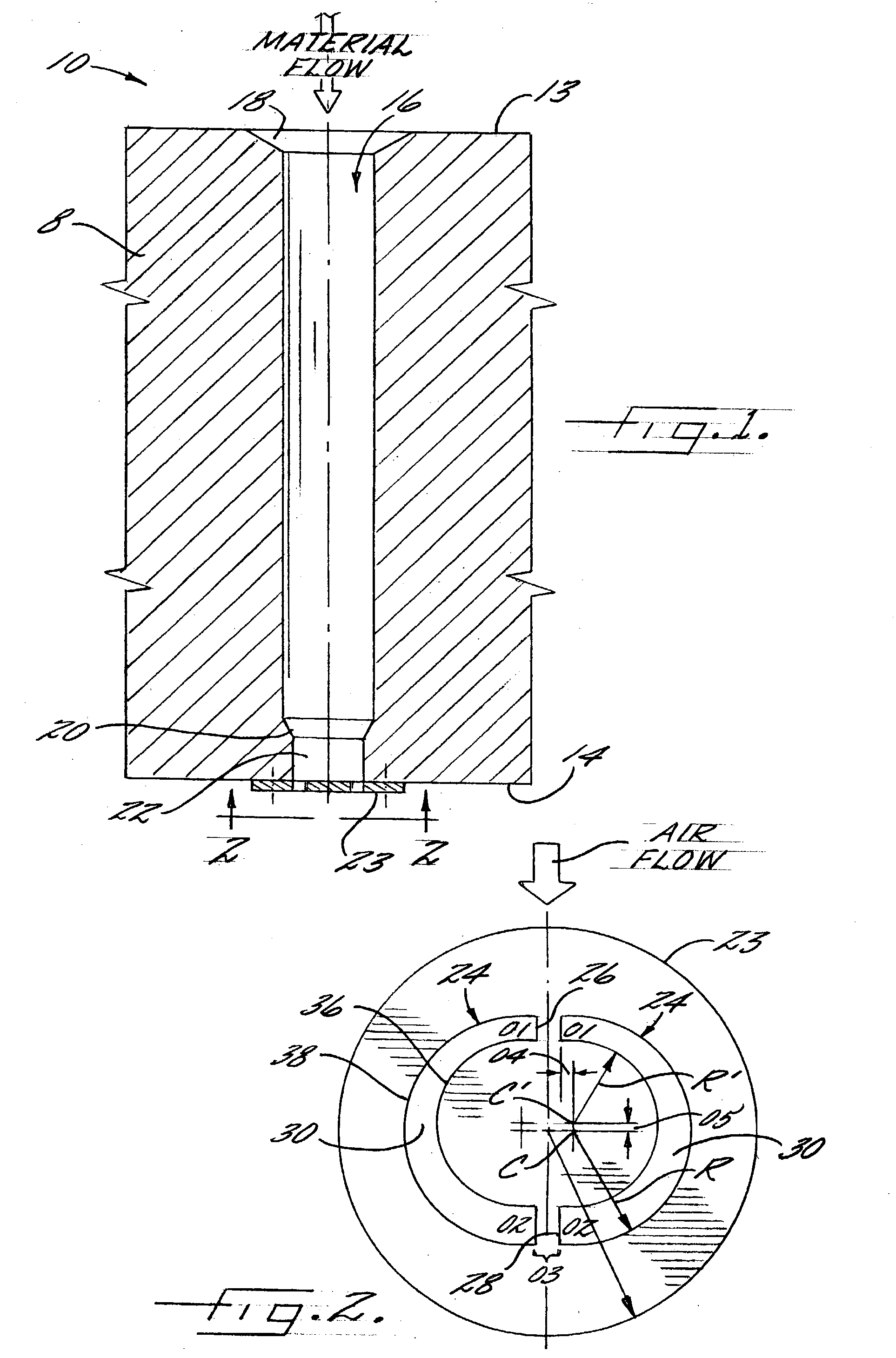
[0030] In general terms, the invention comprises extruding a liquid polymer through a spinneret comprising two non-linear slots. In preferred embodiments, the slots are C-shaped thereby forming two C-shaped polymer sections that are merged shortly after they are extruded to form a hollow filament. In preferred embodiments, the liquid polymer comprises polyester.

[0031] It will be understood by those familiar with the extrusion of filaments with various cross-sections that the phrase C-shaped is a general way of designating two shapes which when brought together would have a hollow space in between, including shapes that would very much resemble the letter "C". It will be further understood that the term C-shaped is utilized herein as an aid to reader in visualizing the invention and is not to be interpreted as limiting the scope of the invention.

[0032] Referring now to FIG. 1, a cross-section of a spinneret 10, in...

the structure of the environmentally friendly knitted fabric provided by the present invention; figure 2 Flow chart of the yarn wrapping machine for environmentally friendly knitted fabrics and storage devices; image 3 Is the parameter map of the yarn covering machine
Login to View More

PUM

PropertyMeasurementUnit
temperatureaaaaaaaaaa
Login to View More

Abstract

An apparatus and method for producing self-texturing hollow fiber that exhibits a desirable tendency to coil rather than to bend sharply or zig-zag. In one embodiment the invention is a spinneret for the production of hollow filament having first and second curved slots where each slot is defined by a first end having a first width and a second end having a second width and where the first and second ends are separated by an intermediate portion possessing a non-uniform width. In another embodiment the invention is a method for of producing generally cylindrical hollow filaments comprising extruding a polymer melt through a spinneret having first and second curved slots where each slot has a first end having a first width and a second end having a second width and where the first and second ends are separated by a intermediate portion possessing a non-uniform width along the continuum defined by the distance between the first end and the second end.

Description

[0001] The invention relates to an apparatus and method for producing filaments from a thermoplastic polymer, and in particular relates to a self-texturing filament formed from polyester that exhibits a desirable tendency to form helical coils when properly drawn and finished rather than remain straight and without texture. The apparatus and method are particularly well suited for forming spiraled high denier hollow filaments from recycled materials.[0002] Synthetic polymers are used in many textile applications to replace natural textile materials such as wool and cotton. Synthetic polymers are also used for other textile-related applications such as insulation layers in clothing, particularly clothing for outdoor use in colder weather, and for bulking properties in pillows and other such products in which these properties are alternatively provided by natural materials such as feathers or by synthetic foam materials.[0003] The starting product for almost all synthetic textile mate...

Claims

the structure of the environmentally friendly knitted fabric provided by the present invention; figure 2 Flow chart of the yarn wrapping machine for environmentally friendly knitted fabrics and storage devices; image 3 Is the parameter map of the yarn covering machine
Login to View More

Application Information

Patent Timeline
no application Login to View More
Patent Type & Authority Applications(United States)
IPC IPC(8): D01D5/24
CPCD01D5/24D01F6/62Y10T428/2969Y10T428/2929Y10T428/1369Y10T428/2935Y10T428/139Y10T428/2975Y10T428/2922Y10T428/2925Y10T428/2973Y10T428/2909Y10T428/2913Y10T442/2352Y10T442/30Y10T442/40Y10T442/60
Inventor TRAVELUTE, FREDERICK L.BASALIK, EVAN T.
Owner DAK AMERICAS MISSISSIPPI INC
Features
  • R&D
  • Intellectual Property
  • Life Sciences
  • Materials
  • Tech Scout
Why Patsnap Eureka
  • Unparalleled Data Quality
  • Higher Quality Content
  • 60% Fewer Hallucinations
Social media
Patsnap Eureka Blog
Learn More