

Can end
a can end and end technology, applied in the field of can end, can solve the problems of eversion of the end profile, leakage of the contents of the can, and possible abuse conditions
- Summary
- Abstract
- Description
- Claims
- Application Information
AI Technical Summary
Benefits of technology
Problems solved by technology
Method used
Image

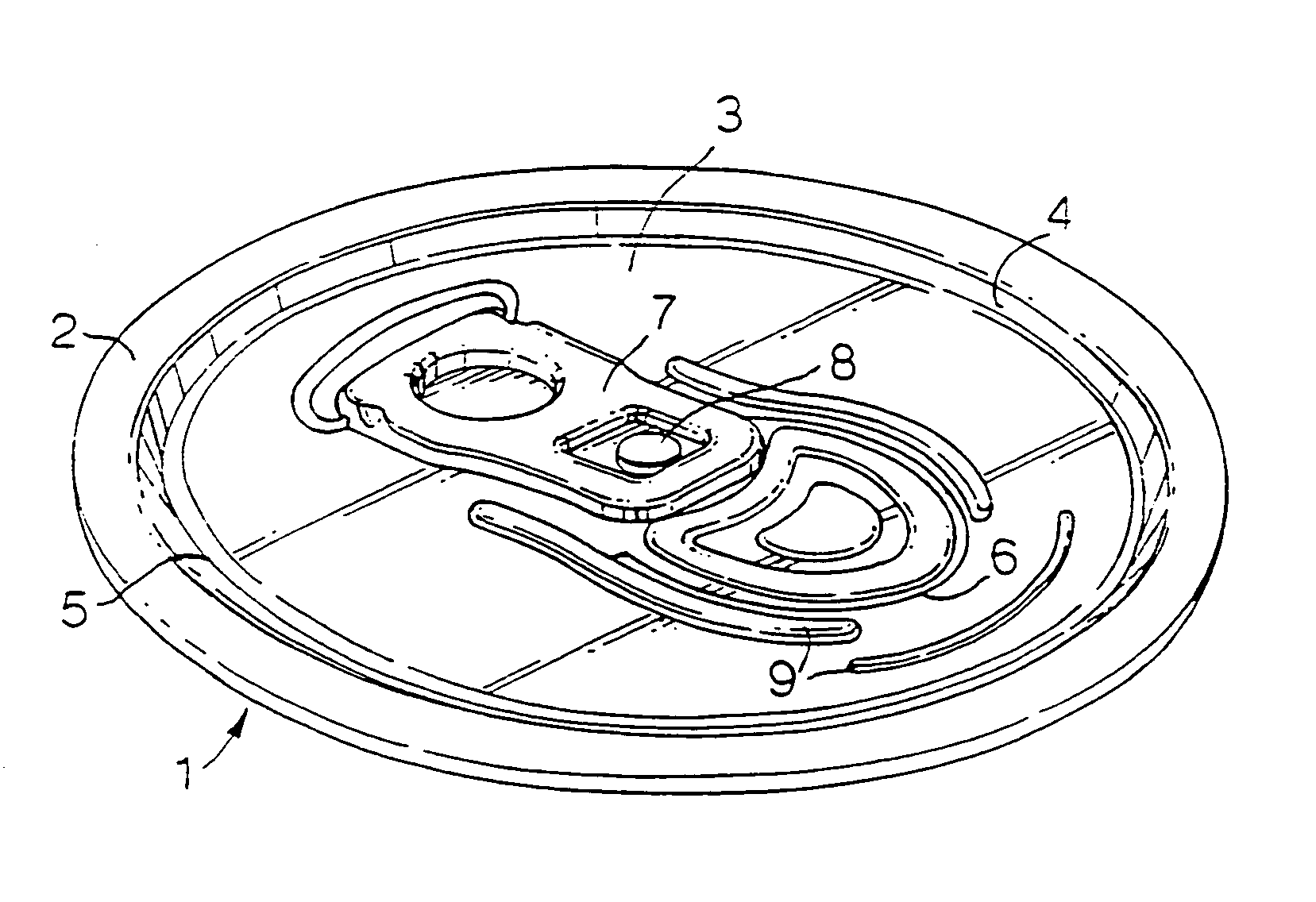
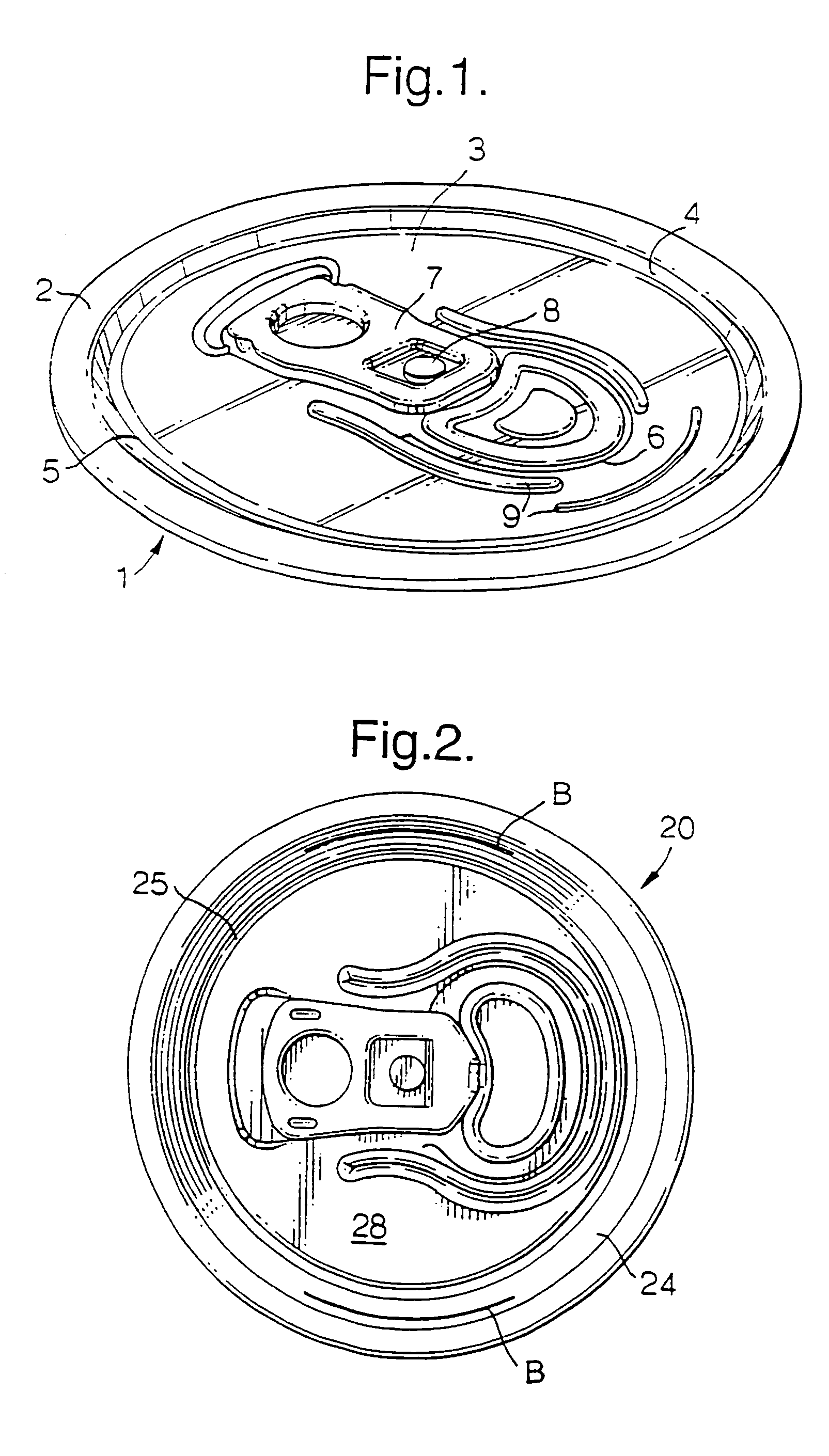
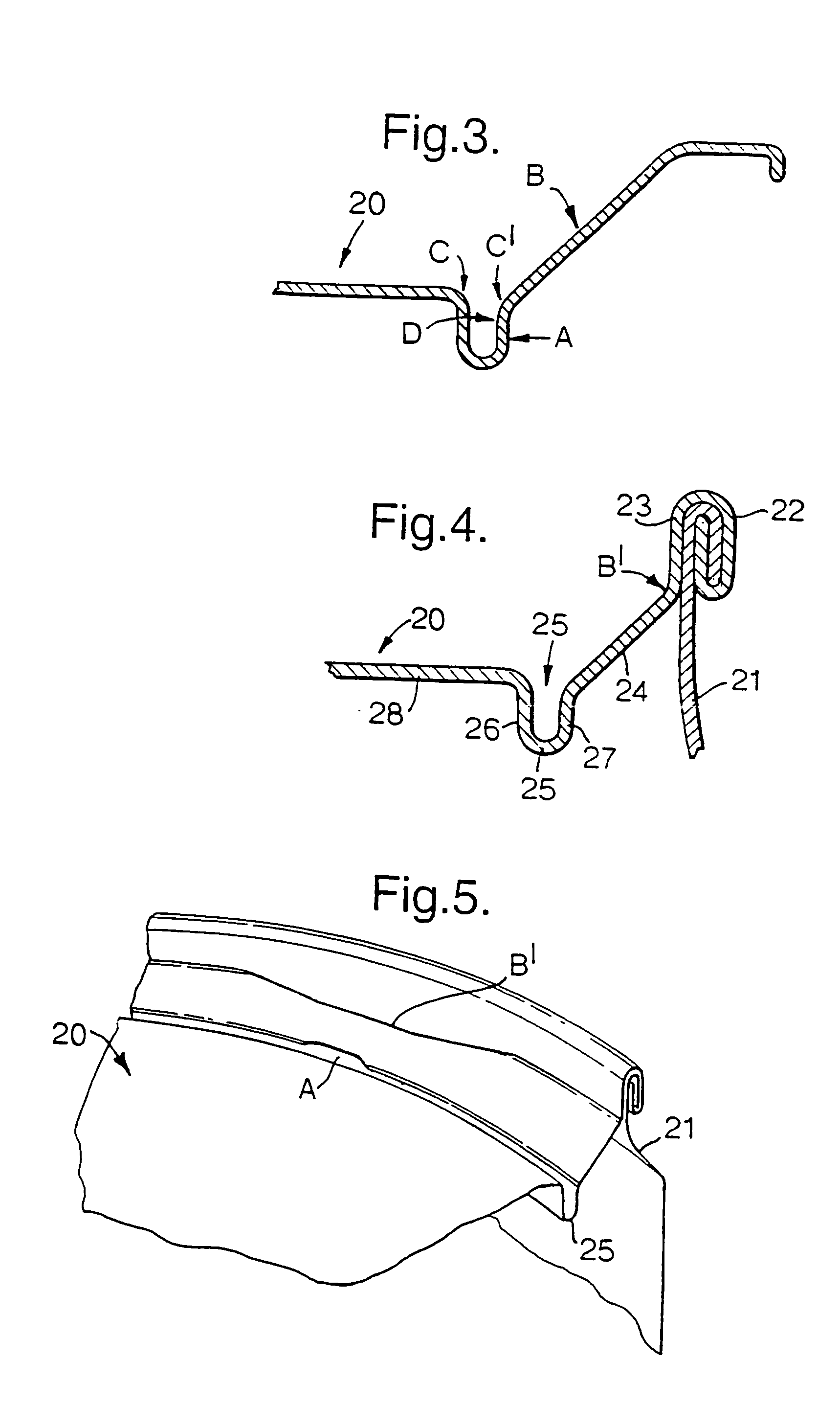
Examples
example 1
[0050] Can ends were modified in the conversion press by expanding the countersink bead over a 60° arc at positions ±90° of the tab heel. These ends were then seamed onto filled cans and dropped vertically, tab end down, onto a steel plate, the sheet steel being inclined at 30°. This extreme test is non-standard and tested the cans for severe abuse performance. The tests used the Bruceton staircase analysis and results are set out in table 1, where P=standard peak and PS=peak and score burst.
[0051] All cans tested peaked at the control feature without splitting. As with preliminary bench testing, the position of peaking was focussed on the indentation site.
[0052] Can ends modified in this way were also tested by pressurising a can to which the end was seamed (“seamed end test”). These results are shown in table 2. Whilst the cans all peaked on the indentation site and were still openable after peaking, only 25% survived testing without leaking on the peak location.
TABLE 1(Brucet...
example 2
[0054] Further can ends were then modified in the conversion press both by expanding the countersink bead over a 60° arc at positions ±90° of the tab heel, and also by providing a indentation over a 50° arc at positions ±90° in the upper chuck wall. These ends were then seamed onto filled cans and drop tested by dropping vertically, tab end down, onto a steel plate, the sheet steel being inclined at 30°. The results of the second tests are given in table 3, where again P=standard peak and PS=peak and score burst.
[0055] The combination of a countersink bead expansion and indentation in the chuck wall increases the average height at which peaking occurs. The countersink bead expansion was found to act as a trigger and this combination of a trigger and chuck wall indentation controls the peaking better than a countersink bead expansion alone (example 1).
[0056] Can ends modified in this way were also tested by pressurising a can to which the end was seamed (“seamed end test”). These r...
example 3
[0059] Can ends having an indentation in the upper chuck wall only (i.e. not in the countersink) were seamed to can bodies and then pressurised. Runs 1 to 8 had a single indentation behind the tab over an arc of about 40° to 50°. Runs 1-1 to 8-8 had indentations at ±90° and over a 50° arc. Mean results are given throughout. Peak location indicates the incidence of a peak on the control feature. The spacer details explain the degree of indentation in the chuck wall.
TABLE 5(SET test)Reversal% peak onRadial spacerIndentRUNpressure (psi)control featureSurvivalOpenable(mm)spacer199.03100%25%100%0.58.752101.7 75%50%100%08.75392.48100%75% 75%09.25491.3100%25% 75%0.59.255101.83100%75%100%0.510.756103.2100%100% 100%010.75794.65100%50%100%011.25893.45100%75%100%0.511.251-1101.45100%75% 75%0.58.752-2101.83 75%75%100%08.753-392.35100%75%100%09.254-489.6100%25%100%0.59.255-5102.0100%75%100%0.510.756-6103.95 75%50%100%010.757-794.98100%75%100%011.258-895.8100%75%100%0.511.25CONTROL105.98N / A25%1...
PUM
 Login to View More
 Abstract
Description
Claims
Application Information
 Login to View More