Noise suppression based on Bark band weiner filtering and modified doblinger noise estimate

US20050240401A1Active Publication Date: 2005-10-27CIRRUS LOGIC INC
14 Cites 241 Cited by

Patent Information

Authority / Receiving Office
US · United States
Current Assignee / Owner
Publication Date
2005-10-27

Smart Images

  • Figure 1
    Figure 1
  • Figure 2
    Figure 2
  • Figure 3
    Figure 3
Patent Text Reader

Abstract

In a noise suppresser, an input signal is converted to frequency domain by discrete Fourier analysis and divided into Bark bands. Noise is estimated for each band. The circuit for estimating noise includes a smoothing filter having a slower time constant for updating the noise estimate during noise than during speech. The noise suppresser further includes a circuit to adjust a noise suppression factor inversely proportional to the signal to noise ratio of each frame of the input signal. A noise estimate is subtracted from the signal in each band. A discrete inverse Fourier transform converts the signals back to the time domain and overlapping and combined windows eliminate artifacts that may have been produced during processing.
Need to check novelty before this filing date? Find Prior Art

Description

BACKGROUND OF THE INVENTION

[0001] This invention relates to audio signal processing and, in particular, to a circuit that uses spectral subtraction for reducing noise.

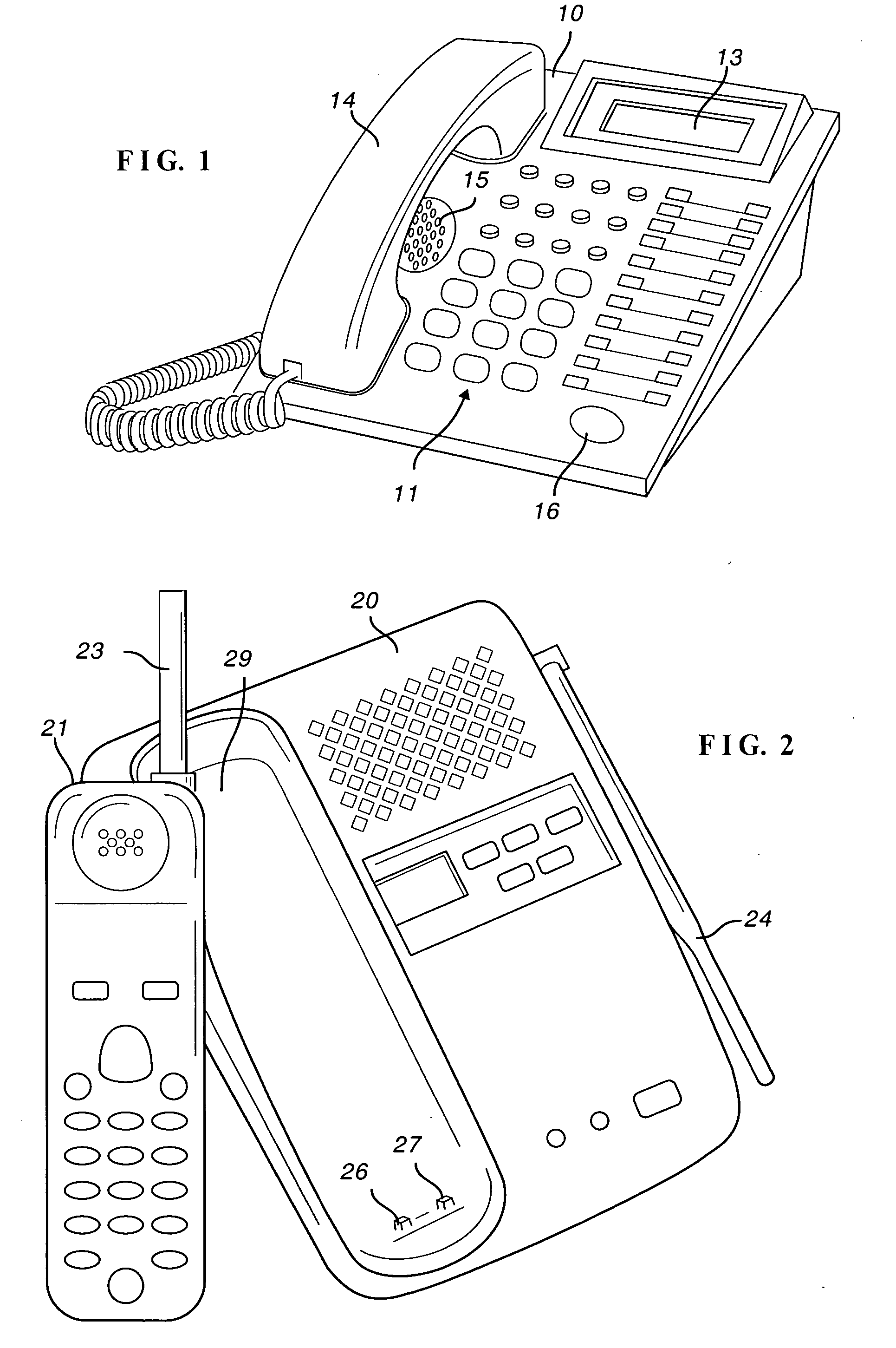
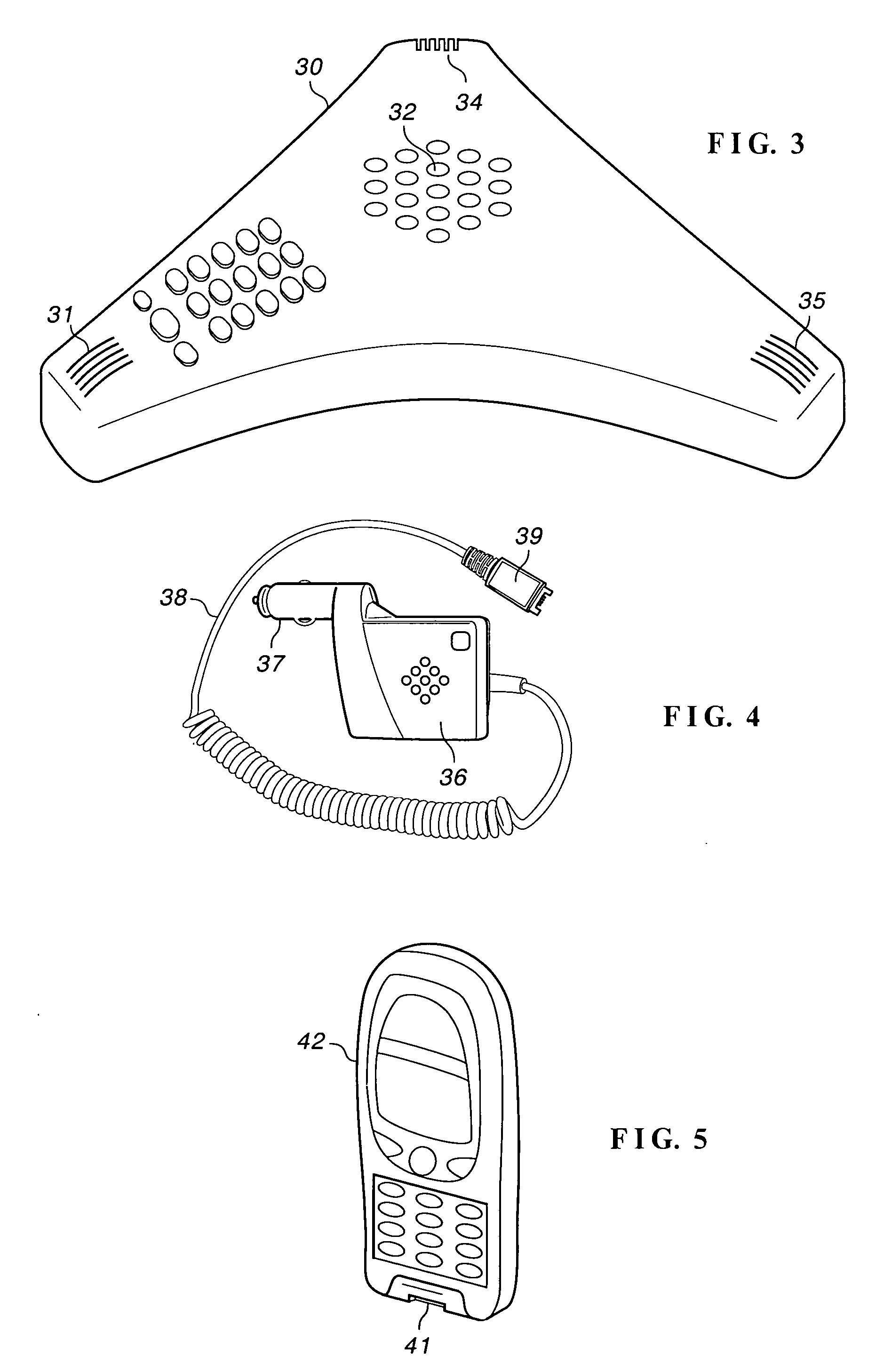
[0002] As used herein, “telephone” is a generic term for a communication device that utilizes, directly or indirectly, a dial tone from a licensed service provider. As such, “telephone” includes desk telephones (see FIG. 1), cordless telephones (see FIG. 2), speaker phones (see FIG. 3), hands free kits (see FIG. 4), and cellular telephones (see FIG. 5), among others. For the sake of simplicity, the invention is described in the context of telephones but has broader utility; e.g. communication devices that do not utilize a dial tone, such as radio frequency transceivers or intercoms.

[0003] There are many sources of noise in a telephone system. Some noise is acoustic in origin while the source of other noise is electronic, the telephone network, for example. As used herein, “noise” refers to any unwanted sound, whethe...

Examples

Embodiment Construction

[0026] This invention finds use in many applications where the internal electronics is essentially the same but the external appearance of the device is different. FIG. 1 illustrates a desk telephone including base 10, keypad 11, display 13 and handset 14. As illustrated in FIG. 1, the telephone has speaker phone capability including speaker 15 and microphone 16. The cordless telephone illustrated in FIG. 2 is similar except that base 20 and handset 21 are coupled by radio frequency signals, instead of a cord, through antennas 23 and 24. Power for handset 21 is supplied by internal batteries (not shown) charged through terminals 26 and 27 in base 20 when the handset rests in cradle 29.

[0027]FIG. 3 illustrates a conference phone or speaker phone such as found in business offices. Telephone 30 includes microphone 31 and speaker 32 in a sculptured case. Telephone 30 may include several microphones, such as microphones 34 and 35 to improve voice reception or to provide several inputs f...