Monitoring of atrial activation

a technology of atrial activation and monitoring, applied in the field of atrial activation monitoring, can solve the problem of av block detection and other problems

a technology of atrial activation and monitoring, applied in the field of atrial activation monitoring, can solve the problem of av block detection and other problems

US20060173369A1Active Publication Date: 2006-08-03GENERAL ELECTRIC CO

Image

Smart Image Click on the blue labels to locate them in the text.
Viewing Examples
Smart Image
  • Monitoring of atrial activation
  • Monitoring of atrial activation
  • Monitoring of atrial activation

Examples

Experimental program
Comparison scheme
Effect test

Embodiment Construction

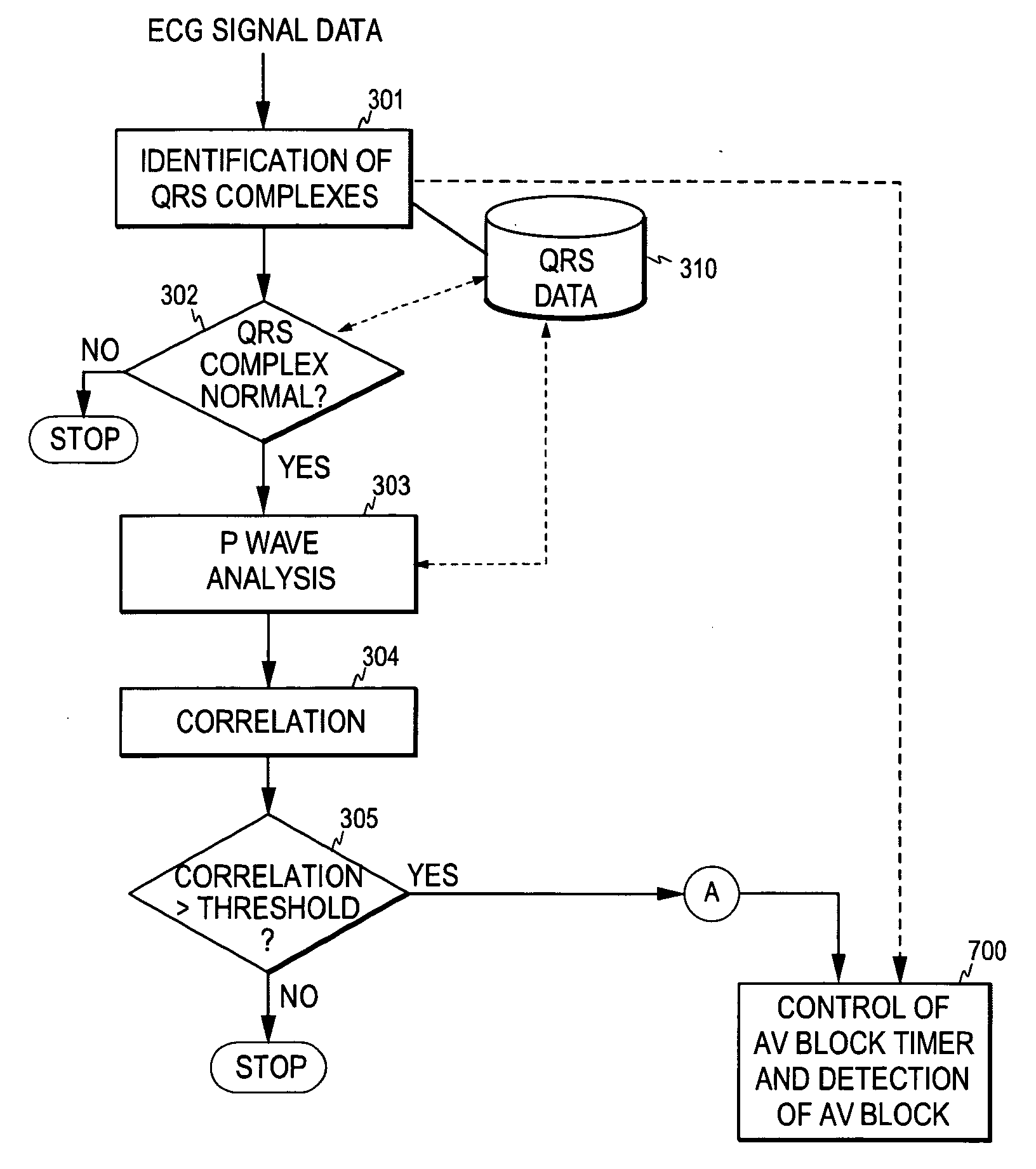
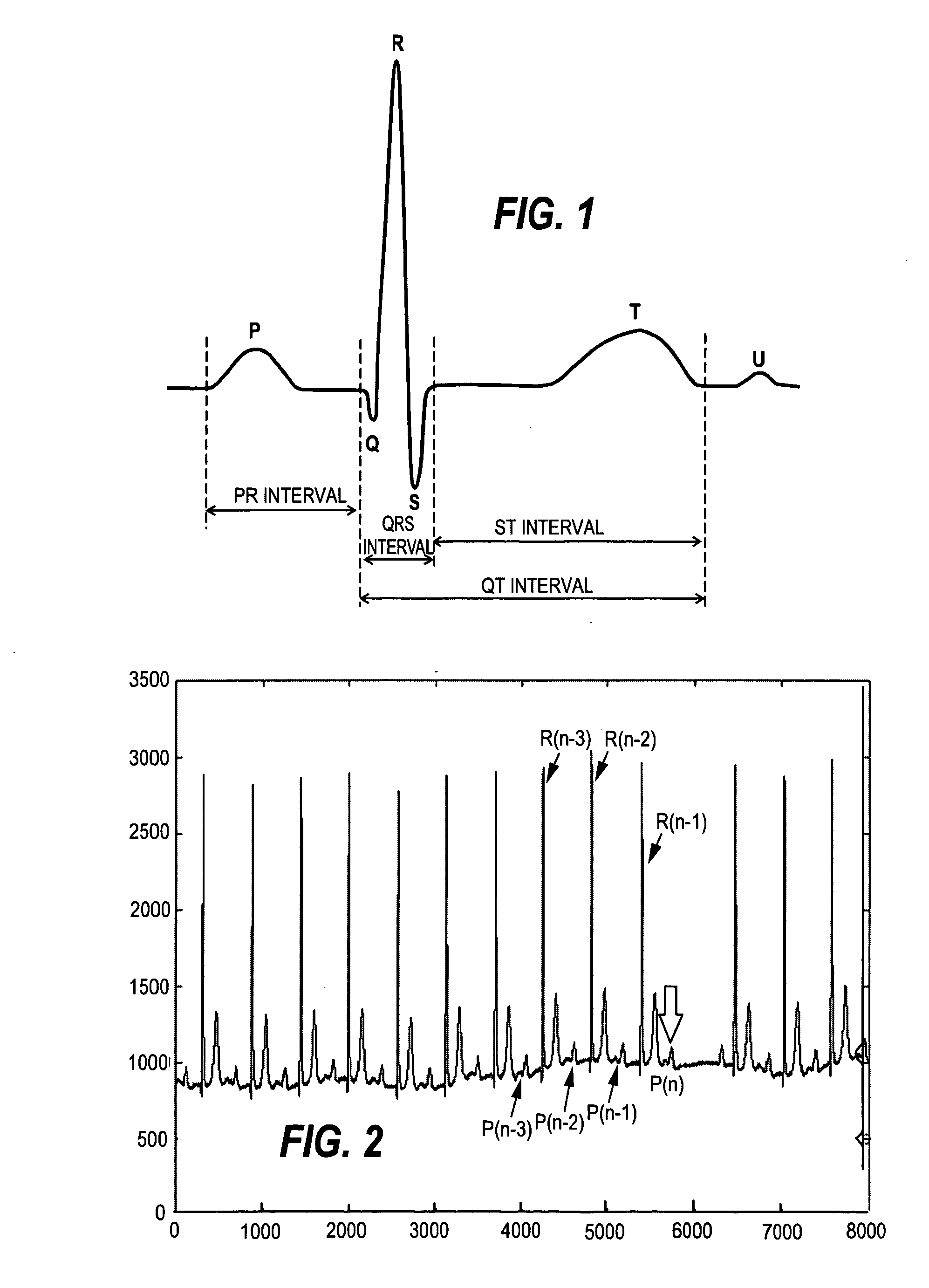
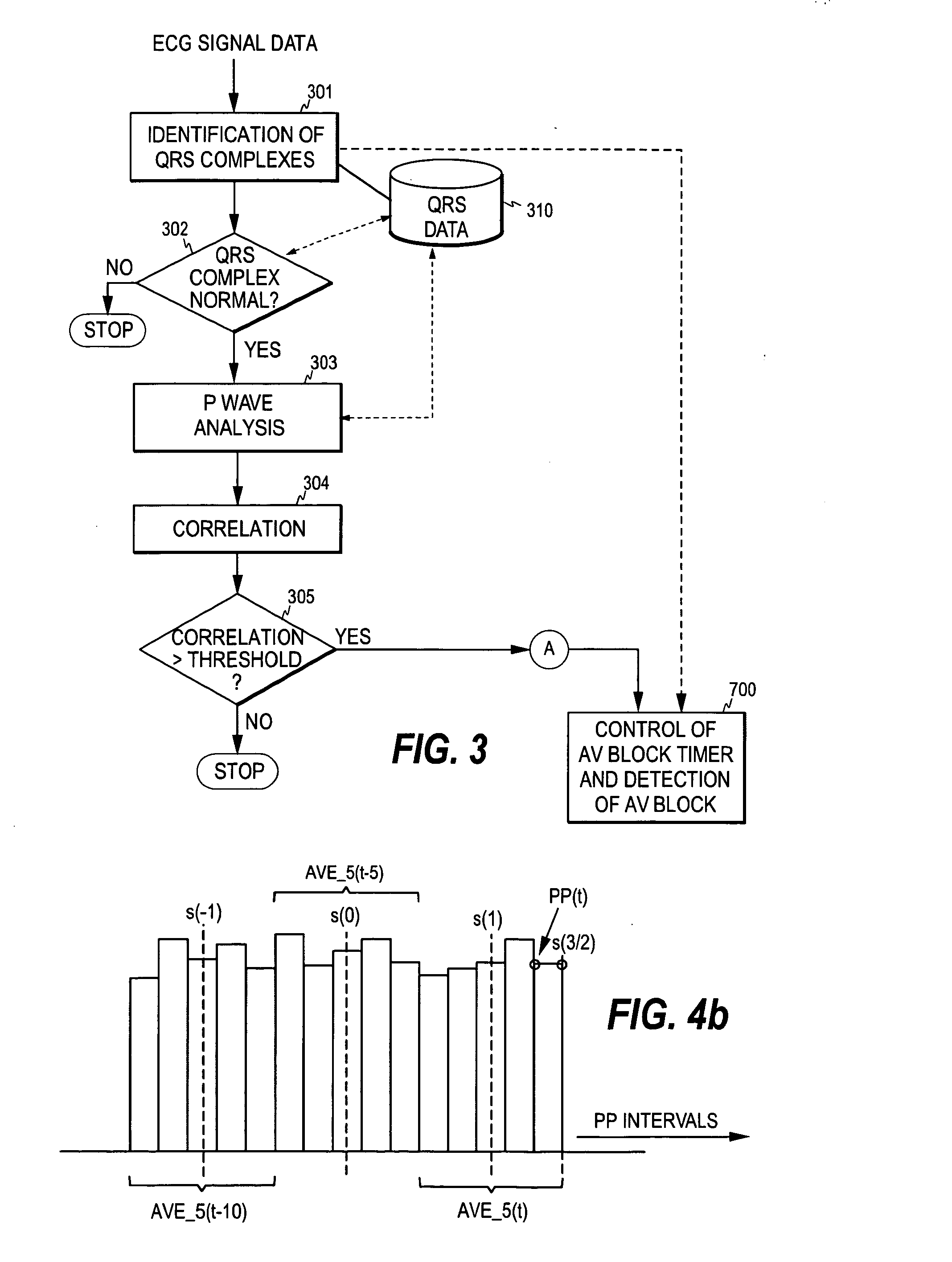
[0029] As discussed above, during a normal sinus rhythm the P waves are conducted to the ventricles, i.e. each P wave P(i) is followed by a QRS complex R(i). Therefore, a P wave can normally be detected by first detecting the subsequent QRS. However, since in the case of an AV block a P wave may not be followed by a QRS complex, the relevant P wave cannot be detected based on QRS detection. In the following, the said relevant P wave is denoted P(n). Therefore, in order to detect an AV block, the relevant P wave needs to be detected independently of the detection of the QRS complex in the same cardiac cycle.

[0030] In the present invention, the above facts are utilized by storing information about the P waves detected during normal sinus rhythm. This information is used to predict the moment of occurrence and the morphology of the relevant P wave P(n). Here, morphology refers to the shape and magnitude of the P wave. Since information about a certain number K of previous P waves (P(n...

the structure of the environmentally friendly knitted fabric provided by the present invention; figure 2 Flow chart of the yarn wrapping machine for environmentally friendly knitted fabrics and storage devices; image 3 Is the parameter map of the yarn covering machine
Login to View More

PUM

No PUM Login to View More

Abstract

The invention relates to a method and system for monitoring atrial activation in a patient. In the method, a moment of occurrence and a wave form are predicted for a subsequent P wave based on a sequence of P waves already received in ECG signal data obtained from the patient. The process of the invention then checks whether the said subsequent P wave really occurs in the ECG signal data within a first time window around the predicted moment of occurrence. If this is the case, the process further monitors whether the said P wave is followed by a QRS complex in the ECG signal data.

Description

FIELD OF THE INVENTION [0001] The present invention relates generally to the monitoring of atrial activation, especially to the detection of atrioventricular (AV) blocks. BACKGROUND OF THE INVENTION [0002] The normal cardiac cycle includes contractions of the atrial muscles, which are activated by the autonomic sinoatrial node (SA node), also called the sinus node. The electrophysiologic (EP) signal generated by the SA node spreads in the right and left atrium leading to their contraction. The EP signal further reaches the atrioventricular node (AV node) situated between the atria and the ventricles. The AV node delays the EP signal, giving the atria time to contract completely before the ventricles are stimulated. After the delay in the AV node the EP signal spreads to the ventricles via the fibers of the His-Purkinje system leading to the contraction of the ventricles. After the contraction the atria are relaxed and filled by blood coming from venous return. The entire cardiac cyc...

Claims

the structure of the environmentally friendly knitted fabric provided by the present invention; figure 2 Flow chart of the yarn wrapping machine for environmentally friendly knitted fabrics and storage devices; image 3 Is the parameter map of the yarn covering machine
Login to View More

Application Information

Patent Timeline
03 Aug 2006
Publication
US20060173369A1
IPC
A61B5/04; A61B5/366
CPC
A61B5/0472; A61B5/366
Inventors
KASKI, MIKKO