Check patentability & draft patents in minutes with Patsnap Eureka AI!

Antibody against a mast cell surface antigen

a cell surface antigen and antibody technology, applied in the field of mast cell surface antigens, can solve the problem that there is no cell surface antigen specific to mast cells, and achieve the effect of reducing the number of mast cell antigens

Inactive Publication Date: 2006-12-07
KAWAI MAKOTO +4
View PDF3 Cites 0 Cited by
  • Summary
  • Abstract
  • Description
  • Claims
  • Application Information

AI Technical Summary

Benefits of technology

The antibody allows for the specific identification and elimination of mast cells, clarifying their role in allergic diseases and providing a treatment option for these conditions.

Problems solved by technology

However, heretofore, no cell surface antigen specific to the mast cells has been known.

Method used

the structure of the environmentally friendly knitted fabric provided by the present invention; figure 2 Flow chart of the yarn wrapping machine for environmentally friendly knitted fabrics and storage devices; image 3 Is the parameter map of the yarn covering machine
View more

Image

Smart Image Click on the blue labels to locate them in the text.
Viewing Examples
Smart Image
  • Antibody against a mast cell surface antigen
  • Antibody against a mast cell surface antigen
  • Antibody against a mast cell surface antigen

Examples

Experimental program
Comparison scheme
Effect test

Embodiment Construction

[0013] [1] Culture of MC-TC

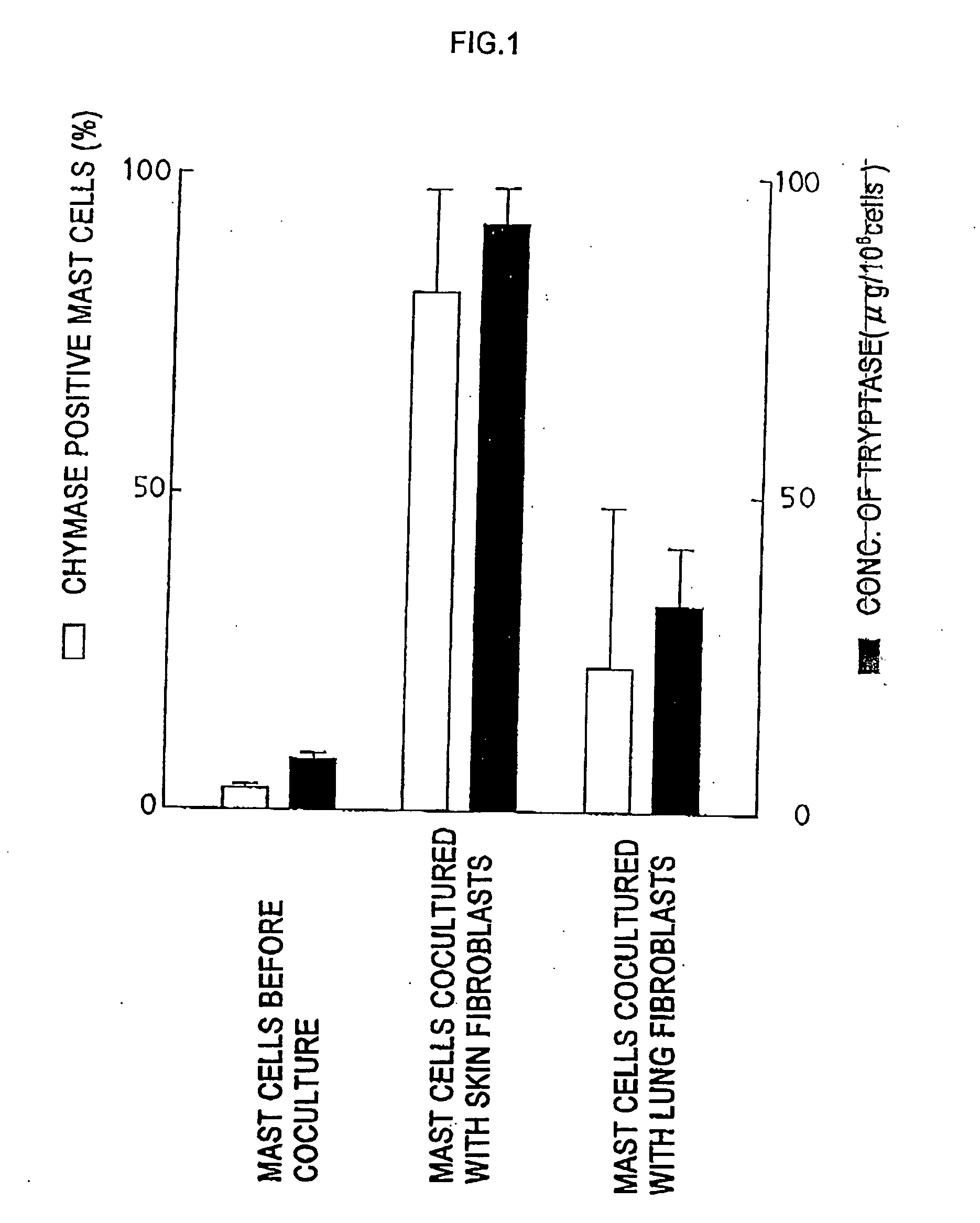
[0014] Cord blood treated with heparin was layered over the Ficoll Hypaque solution (specific gravity: 1.077, Sigma Inc.), centrifuged at 300×g for 30 minutes at room temperature to separate the mononuclear cells, which were then suspended in RPMI1640 medium (Nissui Seiyaku) containing 10% of FBS (Gibco BRL), 50ìM of 2-mercaptoethanol, 4 mM of L-glutamine, 100 U / ml of penicillin and 50ìg / ml of streptomycin. The concentration of the mononuclear cells in the suspension was adjusted to 5×10⁶ / ml, and the suspension was poured into a collagen coated culture dish (Iwaki Glass) having a diameter of 10 cm, and, added with SCF (100 ng / ml, PeproTech Inc.) and IL-6 (50 ng / ml, PeproTech Inc.), cultured for 2 weeks to obtain two-week cultured cells containing neutrophils, lymphocytes, macrophages, basophils and precursor cells of mast cell. SCF is a factor participating in differentiation and proliferation of mast cells expressed on fibroblasts. It is an abbreviation ...

the structure of the environmentally friendly knitted fabric provided by the present invention; figure 2 Flow chart of the yarn wrapping machine for environmentally friendly knitted fabrics and storage devices; image 3 Is the parameter map of the yarn covering machine
Login to View More

PUM

PropertyMeasurementUnit
diameteraaaaaaaaaa
adhesionaaaaaaaaaa
cell surfaceaaaaaaaaaa
Login to View More

Abstract

A mast cell surface antigen, DNA thereof and an antibody against the antigen are provided. The amino acid sequence of this mast cell surface antigen is the translation of the coding region of its DNA. The base sequence of this DNA has been clarified in the following manner. Namely, mast cells obtained by incubating cord blood monocular cells are co-incubated with primary culture of fibroblasts to give connective tissue type mast cells (MC-TC). Then mRNA is extracted from this MC-TC cell extraction and a cDNA library is constructed therefrom. Immunological screening is carried out with the use of anti-MC-TC antiserum and the base sequence of the positive clone thus obtained is identified. Owing to the clarification of the amino acid sequence of this mast cell antigen, it becomes possible to reveal the role of mast cells in the pathology of allergic diseases and thus an antibody against mast cells can be easily obtained.

Description

[0001] This application is a divisional application of Ser. No. 10 / 250,644 filed Jan. 4, 2001, now U.S. Pat. No. 7,045,597, which is a national stage completion of PCT / JP01 / 00005 filed Jul. 3, 2001 which is a continuation-in-part of Ser. No. 09 / 229,932 filed Jan. 13, 1999, now U.S. Pat. No. 6,255,107.TECHNICAL FIELD OF THE INVENTION [0002] This invention relates to a mast cell surface antigen, DNA thereof, and antibody against the antigen. BACKGROUND OF THE INVENTION [0003] Allergic diseases, such as bronchial asthma or allergic rhinitis, are induced as follows: firstly, antigen-specific IgE production is induced, and then, from mast cells, basophils and the like, activated by the induced IgE, various chemical mediators such as histamine, eosinophil chemotactic factor in allergy (ECF-A), leukotrienes, platelet-activating factor (PAF) and thromboxane are produced and released. Specifically in tissues, the mast cells release these chemical mediators, and therefore play an important ro...

Claims

the structure of the environmentally friendly knitted fabric provided by the present invention; figure 2 Flow chart of the yarn wrapping machine for environmentally friendly knitted fabrics and storage devices; image 3 Is the parameter map of the yarn covering machine
Login to View More

Application Information

Patent Timeline
no application Login to View More
Patent Type & Authority Applications(United States)
IPC IPC(8): C07K14/74C07K16/28C07H21/04C07K14/705
CPCC07K16/28C07K14/705
Inventor KAWAI, MAKOTOOKADA, TADASHIATSUMI, FUKIKOSHIBATA, MASAOKUHARA, MOTOKI
Owner KAWAI MAKOTO
Features
  • R&D
  • Intellectual Property
  • Life Sciences
  • Materials
  • Tech Scout
Why Patsnap Eureka
  • Unparalleled Data Quality
  • Higher Quality Content
  • 60% Fewer Hallucinations
Social media
Patsnap Eureka Blog
Learn More