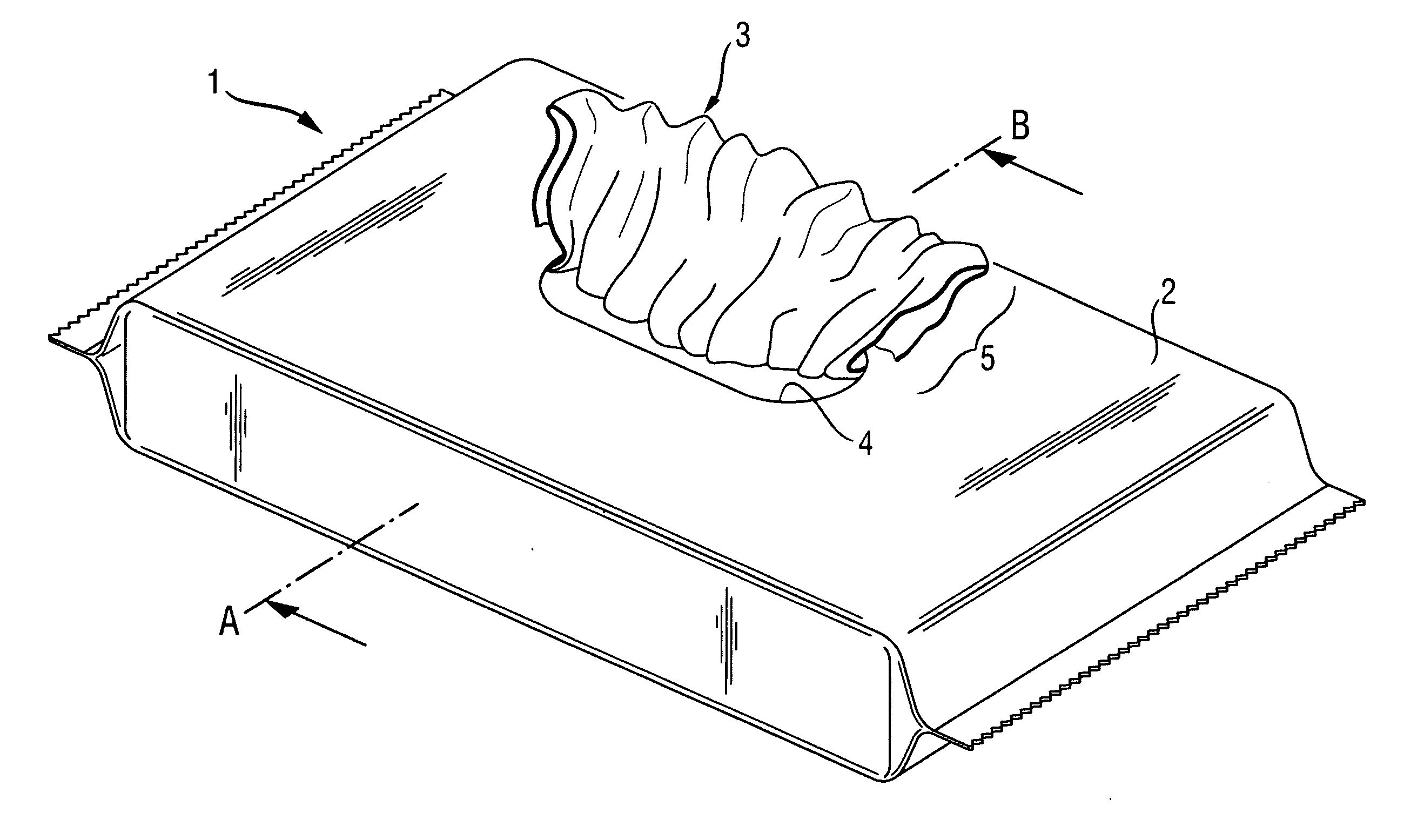
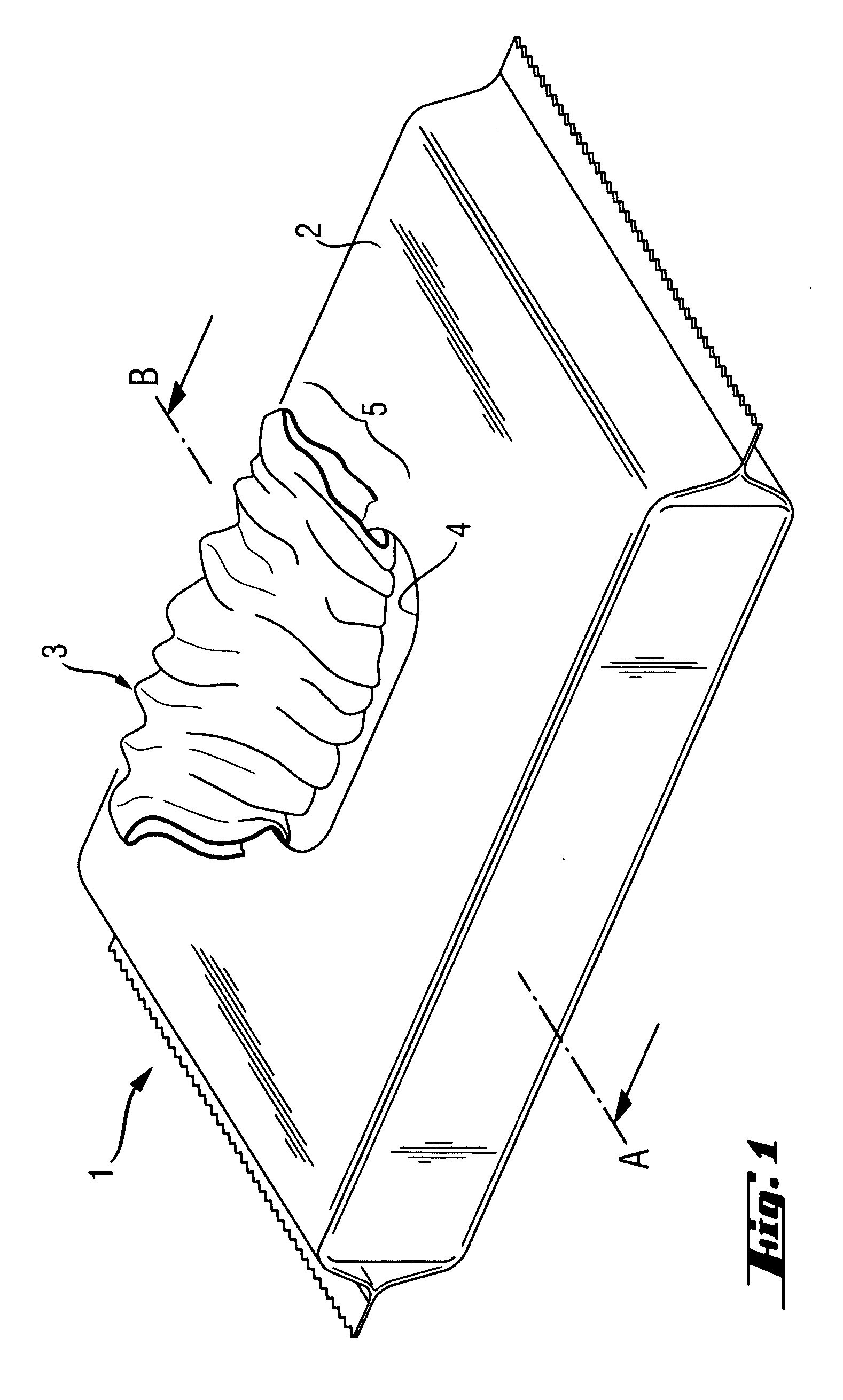
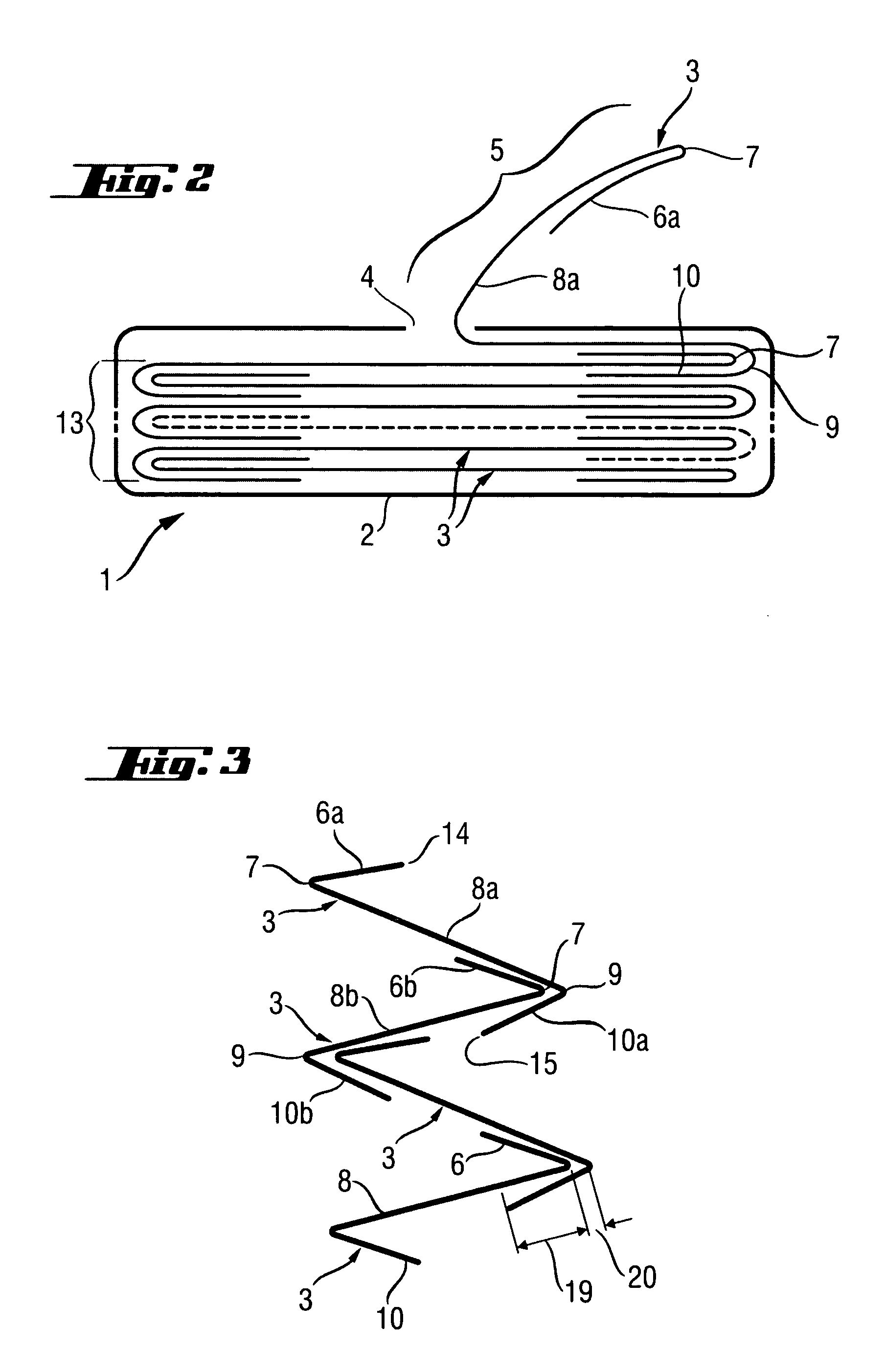
[0026] On the contrary, in the prior art pack of wipes (e.g. illustrated in FIG. 11), the exposed leading portion 5 is not a dual-layer but a single layer, and i.e. it is substantially or completely unfolded. In the pack of wipes of the invention, thus, the leading fold 7 is also partially protruding through the dispensing orifice 4. The exposed leading portion 5 of the pack of wipes of the invention can comprise a partial
dual layer of material (portions of leading and central panels contacting each other). The
dual layer exposed leading portion of the invention (e.g. 5 in FIGS. 2 and 8), may constitute a more rigid
assembly in comparison to a conventional single layer exposed leading portion (e.g. 5 in FIG. 11). The exposed leading portion of the wipe may then be easier to grip and induce a more convenient dispensing of the wipes. Such a better grip allows for a relatively smaller length of the exposed portion (smaller length of material exposed). A shorter exposed portion can reduce the
drying out effect of the pack of wipes, as illustrated in Tables 1a and 1b. Without being bound by the theory, it is believed that the beneficial effect of the invention is based on the fact that a relatively short and rigid
dual layer exposed leading portion induces less dry-out than a relatively long and floppy single layer exposed leading portion, while preserving an adequate grip of the first wipe.
[0027] Table 1a describes the frequency of the various lengths in mm of the exposed leading portions 5 in a typical pack of wipes of the invention. The normalized
frequency of occurrence for each length range of the exposed leading portion is reported (measured from the edge of the dispensing orifice to the highest point of the fold 7). The data reported are frequencies over the measurement of 5 packs of 48 dispensed wipes. The packs of wipes of the invention measured are those described in table 2a (with a round dispensing orifice 33 mm in
diameter). The prior art wipes have a material compositions as described in table 2b. However, they have a folding configuration as in FIG. 11 (prior art). Their folding has a center panel of about 80 mm, a leading panel of about 25 mm, and a corner gap of about 12 mm. While prior art shows frequency peak around about 50 mm (average about 47 mm over one pack), the wipes of the invention show an average of about 18 mm with the highest
population around about 16 mm. This illustrates the short exposed leading portions created by the packs of the present invention. TABLE 1aBin (lengthin mm ofexposedleadingportionmeasured asPrior ArtInventiondescribed)(frequency)(frequency)00.0064940.014184100400800.056738120.0021650.2056741600.262411200.0129870.170213240.0129870.120567280.0281390.078014320.0735930.014184400.2380950.014184500.283550.056738600.2121210.007092700.0562770800.0346320900.0238101000.00865801250.00432901500.0021650Average47 mm18 mm
[0028] The
mass loss over time of the exposed leading portions of wipes was recorded and is shown in Table 1b. For this purpose, about 27 mm of the double layered
leading edge were
cut off after the given
drying time (t) over the
full width of the wipe. The packs of wipes are the same as those used for Table 1a.
[0029] Table 1b shows that after t=240 mins the
mass-loss of the invention remains stable while prior art samples dry-out to a much higher extent. This illustrates the reduced dry-out of the invention versus prior art wipes. TABLE 1bDrying time%
mass loss(min)Prior ArtInvention00.0%0.0%7.51.8%5.5%151.4%4.8%305.3%6.7%347.9%364.3%455.9%603.0%5.7%1209.0%6.4%1309.8%1359.0%12.5%24013.0%12.3%24215.8%9.9%48016.9%9.1%50013.3%50520.4%144023.5%14.3%288040.0%15.3%290528.9%14.5%432038.5%14.5%433738.1%576054.9%738066.6%13.1%
[0030] In one embodiment of the present invention, the length 11 of the dispensing orifice is between about 5 mm and about 120 mm or between about 20 mm and about 100 mm. The length 11 can alternatively be between about 30 mm and about 75 mm. In one embodiment, the length 11 of the dispensing orifice is about 75 mm and the width 17 of the wipes is about 110 mm.
[0031] In one embodiment of the invention the width 17 of the wipes is between about 50 mm and about 150 mm, alternatively between about 60 mm and about 130 mm or between about 80 mm and about 120 mm. In an embodiment the width 17 of the wipes is about 110 mm.


 Login to View More
  Login to View More