
Sequential decoding method and apparatus thereof
a decoding method and sequence technology, applied in the field of decoding methods, can solve the problems that the large quantity of calculation cannot be reduced in parallel viterbi decoding, and achieve the effect of reducing the quantity of calculation, the complexity of decoding, and the decoding tim
- Summary
- Abstract
- Description
- Claims
- Application Information
AI Technical Summary
Benefits of technology
Problems solved by technology
Method used
Image

Examples
Embodiment Construction
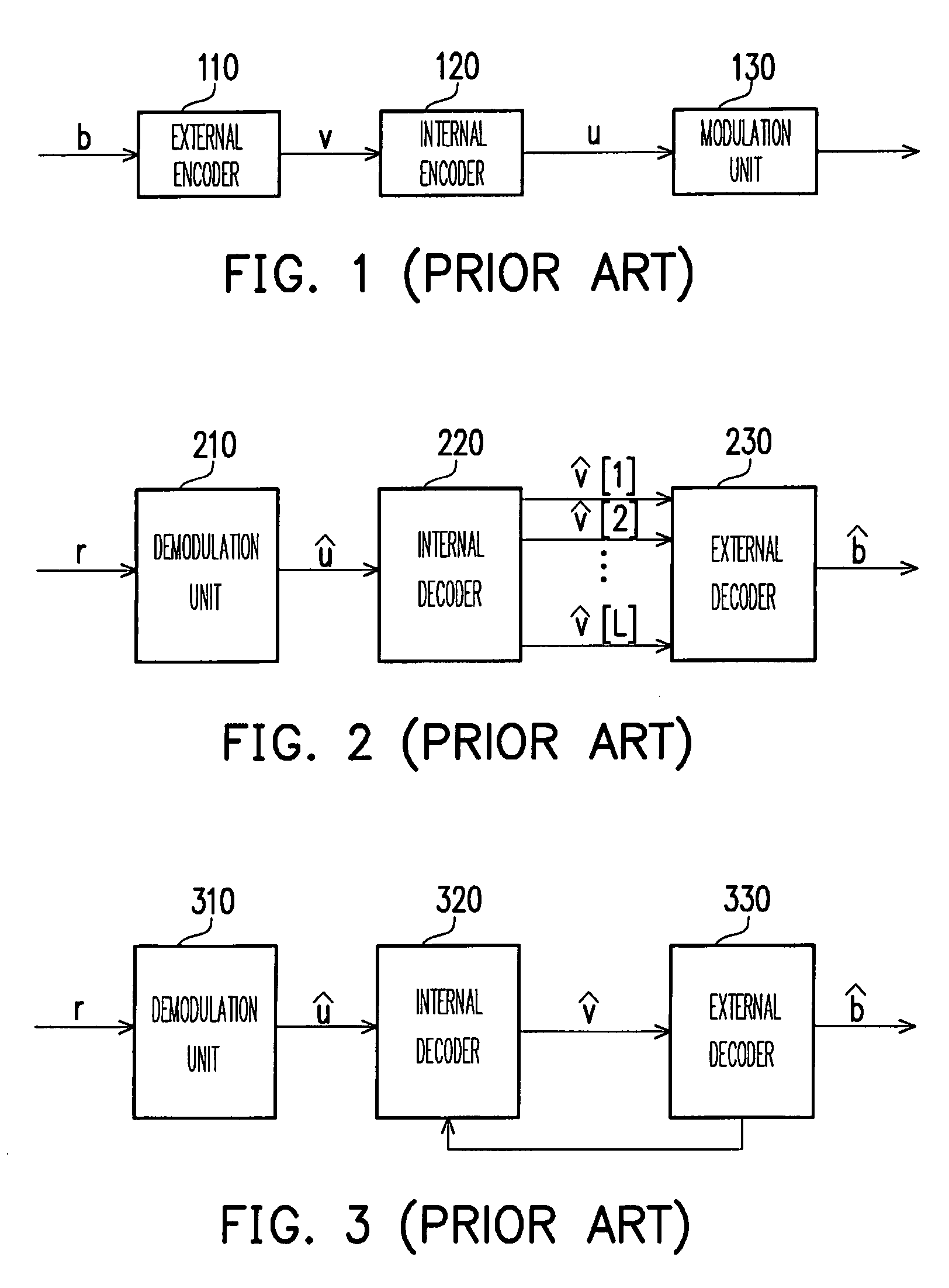
[0045]In a typical communication system, if a signal is encoded at least twice at the transmitter, the signal received at the receiver will be decoded at least twice. FIG. 1 is a block diagram illustrating the channel coding at a transmitter according to a conventional technique. The external encoder in FIG. 1 may be implemented with an error detection code, and the error detection code may be a cyclic redundancy check (CRC) code or a parity check code. The internal encoder may be implemented with an error correction code, wherein the error correction code may include trellis code, and the commonest trellis code is convolution code.
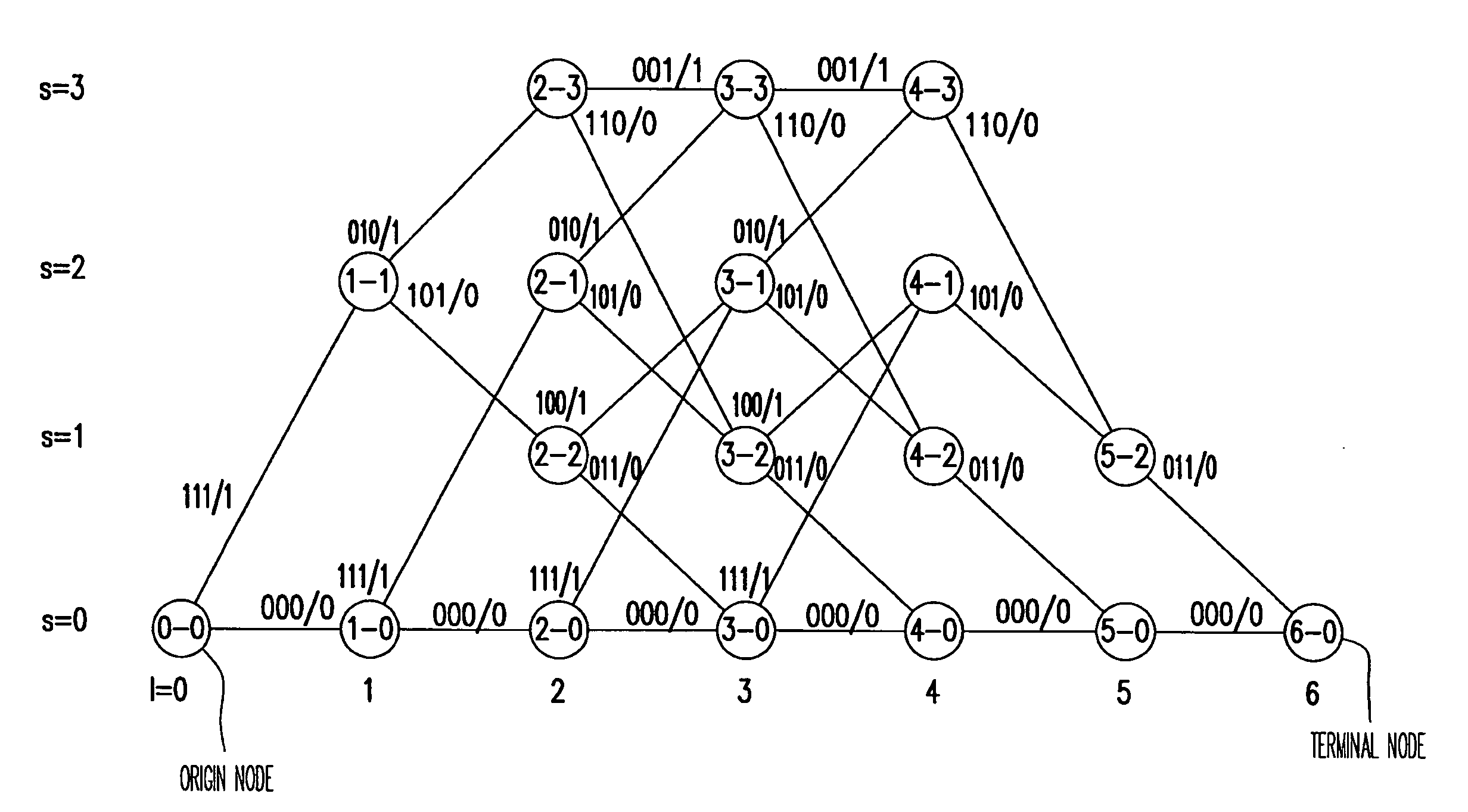
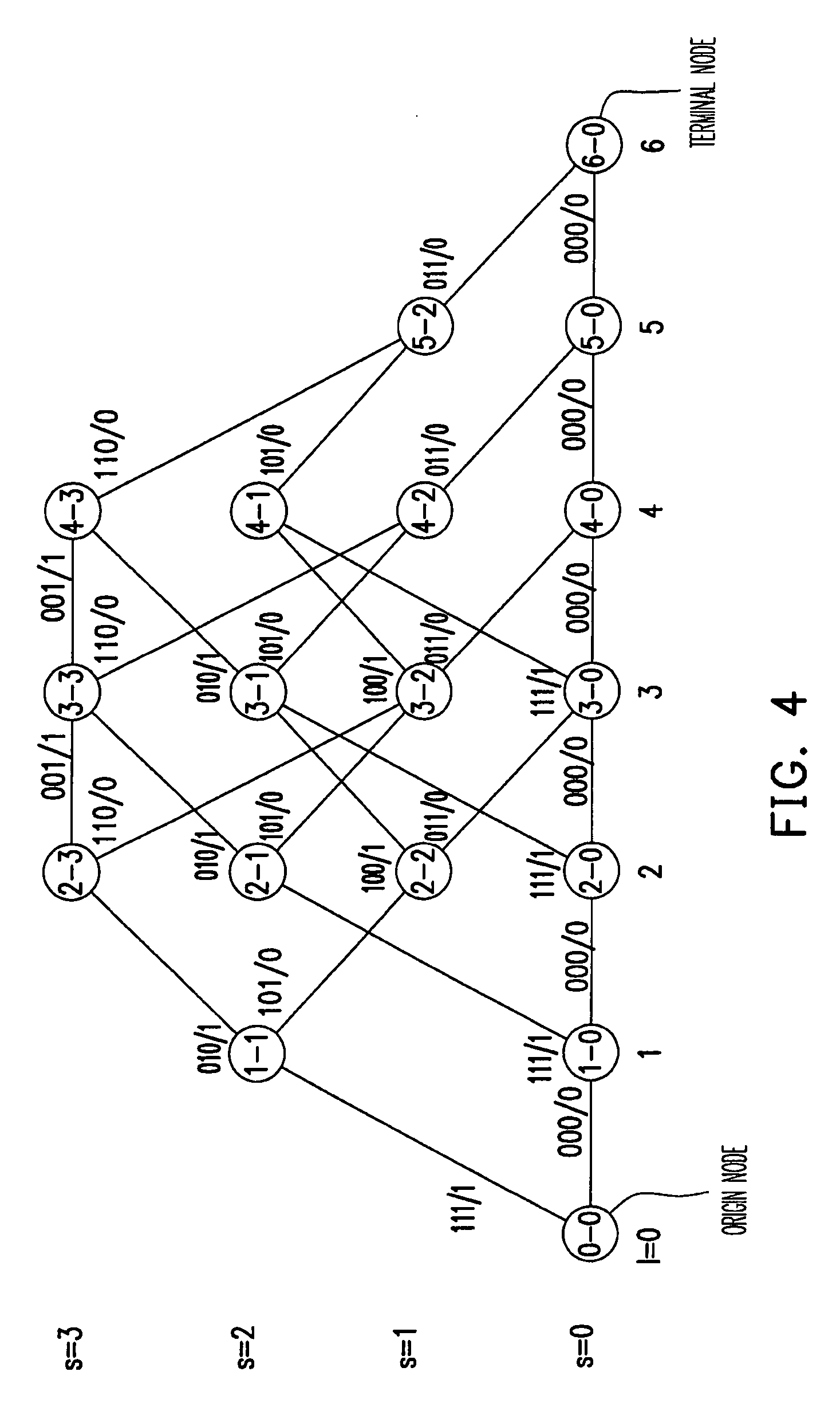
[0046]For the convenience of descripting the embodiment, assuming a parity check code (x+1,x) is used for implementing the external encoder, and the length of a message sequence b is assumed to be 3 (i.e. assuming x=3), thus, a redundant bit v3 is added to the 3-bit message sequence b=(b0,b1,b2) to become a first codeword V=(b0, b1, b2,v3), wherein b0, b1...
PUM
 Login to View More
 Abstract
Description
Claims
Application Information
 Login to View More