

Seam welding
a seam welding and multi-pass technology, applied in the field of seam welding, can solve the problems of high surface heating (expulsion), brittle and weak welds, and high welding parameters, and achieve the effect of high strength
Active Publication Date: 2009-06-04
CLEVELAND CLIFFS STEEL TECH INC
View PDF27 Cites 8 Cited by
- Summary
- Abstract
- Description
- Claims
- Application Information
AI Technical Summary
Benefits of technology
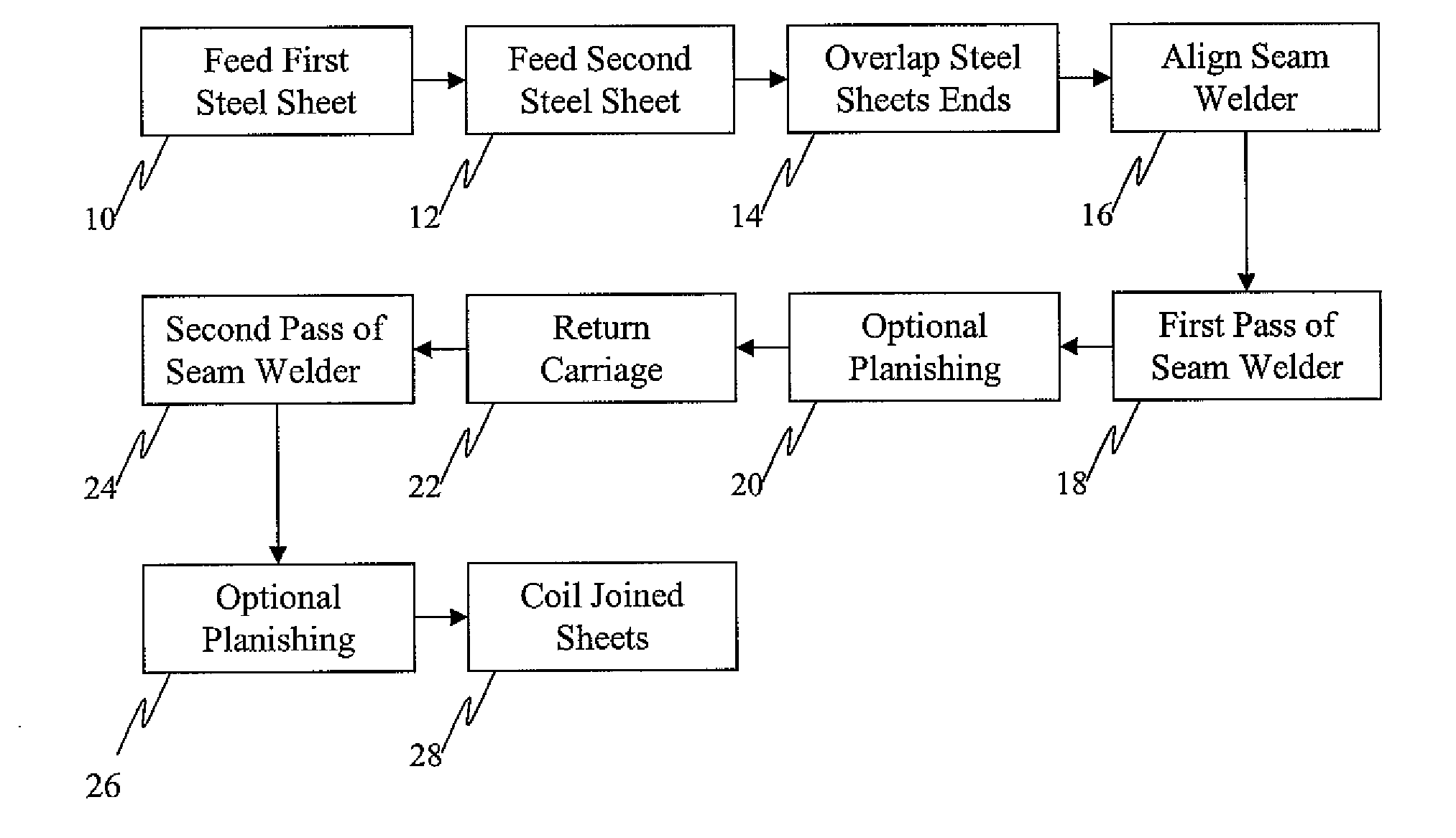
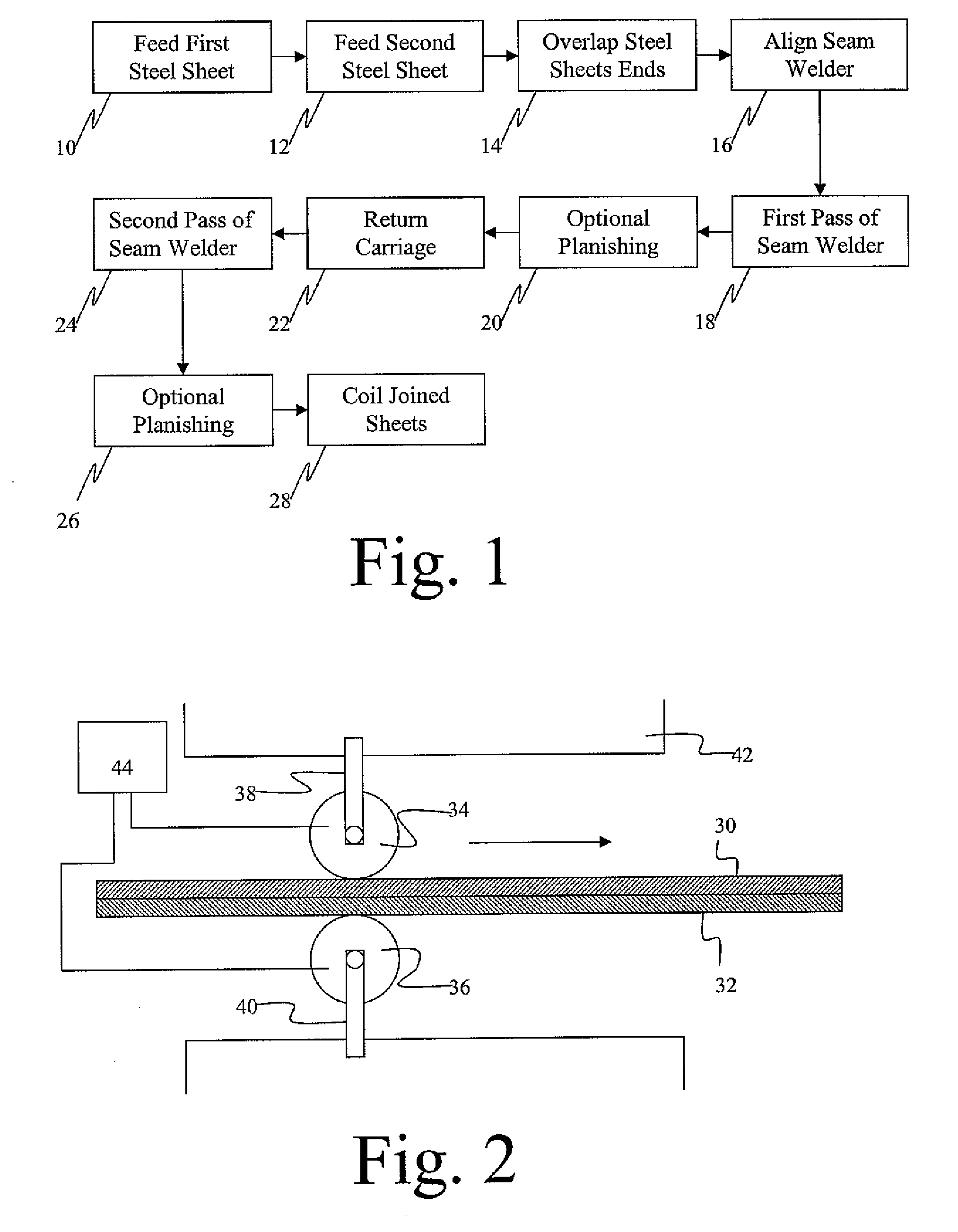
[0008]According to a first aspect of the invention, a process is provided for seam welding advanced high strength steel sheets together. Respective end portions of first and second advanced high strength steel sheets are placed in overlapping contact with one another. The overlapping contact end portions arc subjected to a first weld pass of a seam welder including weld electrodes operating at a first-pass applied current and a first-pass pressure and moving relative to the overlapping end portions at a first-pass carriage speed. The first weld pass establishes a weld seam containing a weld nugget having a martensite phase. The weld seam is subjected to a second weld pass of the seam welder in which the weld electrodes operate at a second-pass applied current and a second-pass pressure, and are moved relative to the weld seam at a second-pass carriage speed selected to fuse microcracks, lap openings, and porosity in the weld seam, relieve joint stress, and temper the martensite phase of the weld nugget and thereby establish a reliable weld joint suited for continuous processing.
[0011]A fourth aspect of the invention resides in a method of continuously processing joined advanced high strength steel sheets. The method comprises placing respective end portions of first and second advanced high strength steel sheets in overlapping contact with one another, and subjecting the overlapping contact end portions to a first weld pass of a seam welder including weld electrodes operating at a first-pass applied current and a first-pass pressure and moving relative to the overlapping end portions at a first-pass carriage speed. The first weld pass establishes a weld seam containing a weld nugget having a martensite phase. The weld seam is subjected to a second weld pass of the seam welder in which the weld electrodes operate at a second-pass applied current and a second-pass pressure, and are moved relative to the weld seam at a second-pass carriage speed selected to fuse microcracks, lap openings, and porosity in the weld seam, relieve joint stress, and temper the martensite phase of the weld nugget and thereby establish a reliable weld joint suited for continuous processing. The joined steel sheets are then subjected to a continuous processing step.
Problems solved by technology
However, the application of conventional welding apparatus and operations, such as single-pass lap seam welding process, to galvanized TRansformation Induced Plasticity (TRIP) grade AHSS results in a brittle and weak weld due to martensite and oxide formation.
Further, very high alloy content (high carbon equivalent) and high resistivity of AHSS makes these grades ultra-sensitive to welding parameters.
Microstructure studies have shown that AHSS grade welds often undergo excessive surface heating (expulsion) and generate hot micro-cracks, porosity, and inadequate fusion when subjected to the single weld pass employed for HSLA.
Performance criteria required for safe and reliable processing through the mill are generally not satisfied by the brittle welds created by conventional single-pass lap seam welding practices.
Failure of the weld during mill processing may cause shut down of the line for relatively short (e.g., 1 hour) or extended (e.g., 1 day) periods, depending on the location and severity of the weld break.
The additional labor and materials required for implementation of this remedy reduces overall productivity and increases expenses.
Other costs include quality defects due to unstable processing conditions, and greater equipment wear and tear.
This alternative solution requires the installation of an induction heating unit or separate station requiring capital investment and significant additional processing time to cool down the weld.
Method used
the structure of the environmentally friendly knitted fabric provided by the present invention; figure 2 Flow chart of the yarn wrapping machine for environmentally friendly knitted fabrics and storage devices; image 3 Is the parameter map of the yarn covering machine
View moreImage
Smart Image Click on the blue labels to locate them in the text.
Smart ImageViewing Examples

Examples
Experimental program
Comparison scheme
Effect test
examples 1-6
[0042]Table 1 sets forth parameters for exemplary double-pass welding operations carried out on various gauges of AHSS galvanized TRIP grade steel (780 MPa tensile strength) according to embodiments of the present invention.
TABLE 1First Weld PassSecond Weld Pass1st Coil2nd CoilCurrentCurretGaugeGauge(PrimarySpeedPressure(PrimarySpeedPressureEx.(inch)(inch)Amps)(imp)(psi)Amps)(ipm)(psi)10.0390.039760120803503008020.0470.047760120803503008030.0550.05576090854003009040.0630.06376090854003009050.0710.07176080904003009060.0790.079760809040030090
the structure of the environmentally friendly knitted fabric provided by the present invention; figure 2 Flow chart of the yarn wrapping machine for environmentally friendly knitted fabrics and storage devices; image 3 Is the parameter map of the yarn covering machine
Login to View More PUM
| Property | Measurement | Unit |
|---|---|---|
| Fraction | aaaaa | aaaaa |
| Fraction | aaaaa | aaaaa |
| Fraction | aaaaa | aaaaa |
Login to View More
Abstract
A process is provided for scam welding advanced high strength steel sheets together. Respective end portions of first and second advanced high strength steel sheets are placed in overlapping contact with one another, and subjected to first and second weld passes. In the first weld pass, a seam welder including weld electrodes operate at a first-pass applied current and a first-pass pressure and are moved relative to the overlapping end portions at a first-pass carriage speed to establish a weld seam containing a weld nugget with a martensite phase. In the second weld pass, the weld electrodes operate at a second-pass applied current and a second-pass pressure and move relative to the weld seam at a second-pass carriage speed selected to fuse microcracks, lap openings, and porosity in the seam, relieve the residual stress in the joint, and temper the martensite phase of the weld nugget, and thereby form a weld joint.
Description
CROSS-REFERENCE TO RELATED APPLICATION(S)[0001]This application claims the benefit of priority of U.S. provisional application Ser. No. 60 / 991,044 filed Nov. 29, 2007, the complete disclosure of which is incorporated herein by reference.FIELD OF THE INVENTION[0002]The present invention relates to a multiple-pass operation of seam welding steel sheets, especially high strength steel sheets.BACKGROUND OF THE INVENTION[0003]Steel sheets are processed continuously in continuous galvanizing, continuous annealing, and tin mill lines of steel cold mills. In order to optimize the efficiency of the mills, the steel sheets are joined end to end via lap-seam welding. Specifically, the tail or trailing end of a preceding (first) coil and the head end of an incoming (second) coil are joined together at the entry end of the mill, thereby creating a continuous joined sheet that may be processed continuously in the mill at a much higher efficiency than would be realized if the sheets were individua...
Claims
the structure of the environmentally friendly knitted fabric provided by the present invention; figure 2 Flow chart of the yarn wrapping machine for environmentally friendly knitted fabrics and storage devices; image 3 Is the parameter map of the yarn covering machine
Login to View More Application Information
Patent Timeline
 Login to View More
 IPC IPC(8): B23K11/00
CPCB21B15/0085B23K11/061Y10T403/478B23K11/087B23K11/16B23K2203/04B23K2101/006B23K2103/04
InventorAGASHE, SOUMITRA V.
OwnerCLEVELAND CLIFFS STEEL TECH INC