
Blind Channel Estimation for PSK and D-PSK Modulated Multicarrier Communication Systems
a communication system and multi-carrier technology, applied in phase-modulated carrier systems, multi-frequency code systems, digital transmission, etc., can solve problems such as providing sufficient pilots, and achieve the effect of moderate complexity
- Summary
- Abstract
- Description
- Claims
- Application Information
AI Technical Summary
Benefits of technology
Problems solved by technology
Method used
Image

Examples
Embodiment Construction
[0023]While the present invention is described herein with reference to illustrative embodiments for particular applications, it should be understood that the invention is not limited thereto. Those skilled in the art with access to the teachings provided herein will recognize additional modifications, applications, and embodiments within the scope thereof and additional fields in which the invention would be of significant utility.
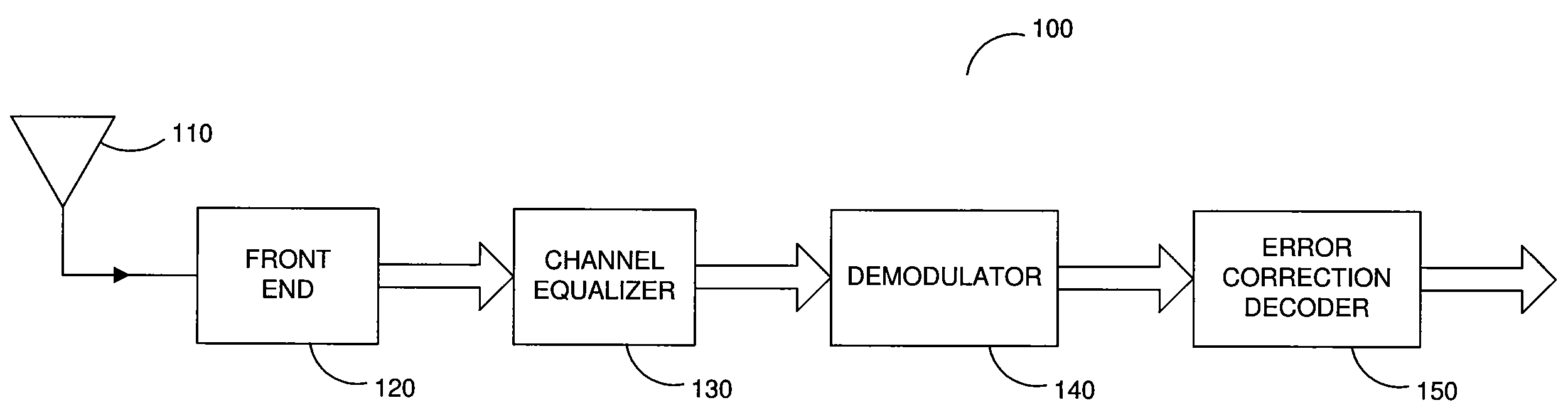
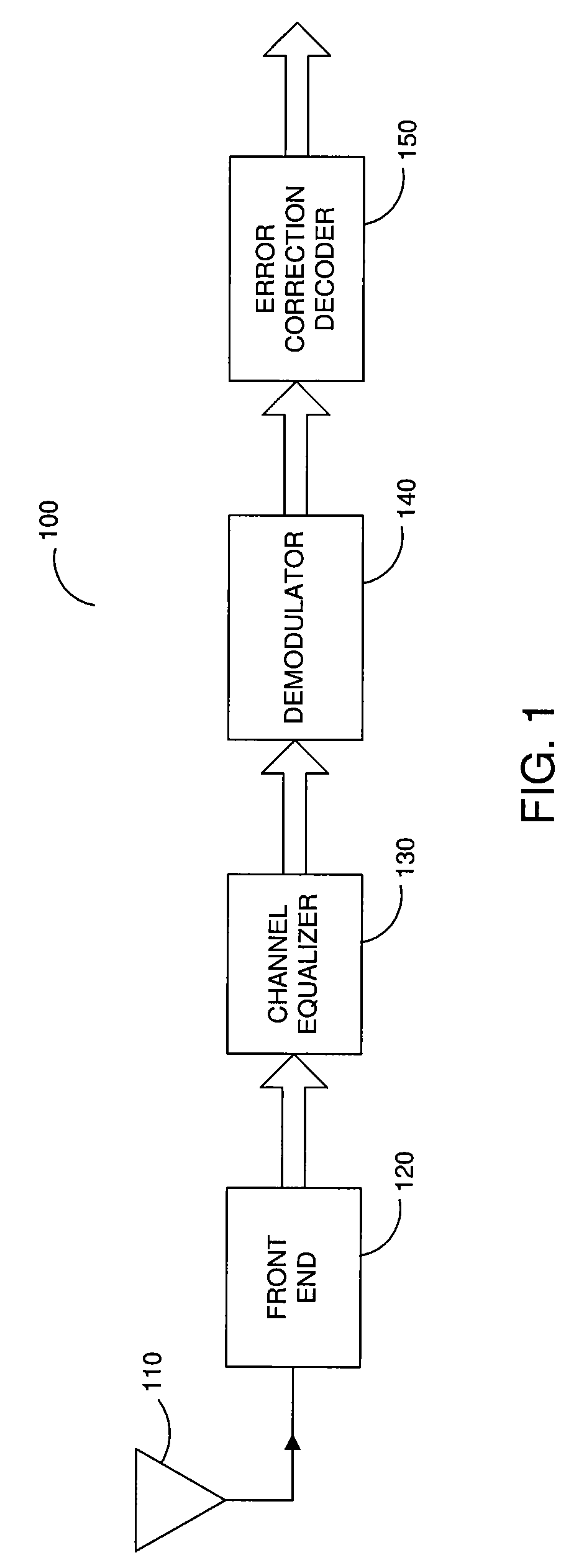
[0024]FIG. 1 is an illustration of a receiver in a communication system to which embodiments of the current invention may be employed. A typical communications receiver 100 comprises an antenna 110, a front end 120, a channel equalizer 130, a demodulator 140, and an error correction decoder 150. A communications signal that has passed through a communications channel from transmitter to receiver is captured by the antenna 110, and is turn coupled to the receiver's front-end 120. The front-end 120 provides one or more of the following functionalities: gain...
PUM
 Login to View More
 Abstract
Description
Claims
Application Information
 Login to View More