Method for interference-minimizing resource block-size selection at a macrocell, a microcell and a femtocell

a microcell and resource block technology, applied in the field of wireless communication, can solve the problems of poor customer experience, low voice quality and cost of mobile telephone networks in indoor environments, and the inability of mobile telephone subscribers to truly be the only telephone they need, so as to avoid interference and waste spectrum resources

a microcell and resource block technology, applied in the field of wireless communication, can solve the problems of poor customer experience, low voice quality and cost of mobile telephone networks in indoor environments, and the inability of mobile telephone subscribers to truly be the only telephone they need, so as to avoid interference and waste spectrum resources

US20100056167A1Active Publication Date: 2010-03-04NTT DOCOMO INC

Image

Smart Image Click on the blue labels to locate them in the text.
Viewing Examples
Smart Image
  • Method for interference-minimizing resource block-size selection at a macrocell, a microcell and a femtocell
  • Method for interference-minimizing resource block-size selection at a macrocell, a microcell and a femtocell
  • Method for interference-minimizing resource block-size selection at a macrocell, a microcell and a femtocell

Examples

Experimental program
Comparison scheme
Effect test

Embodiment Construction

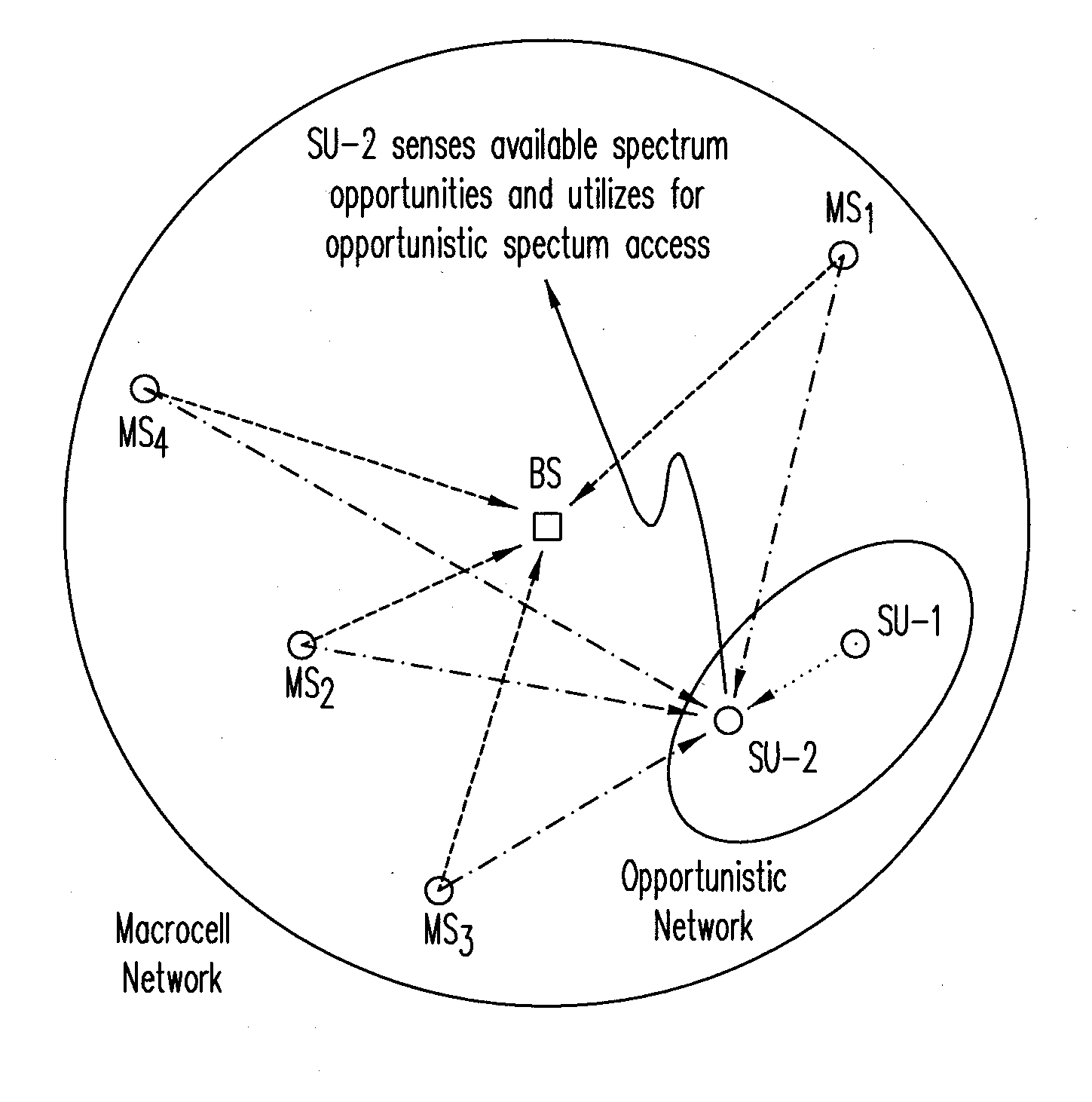
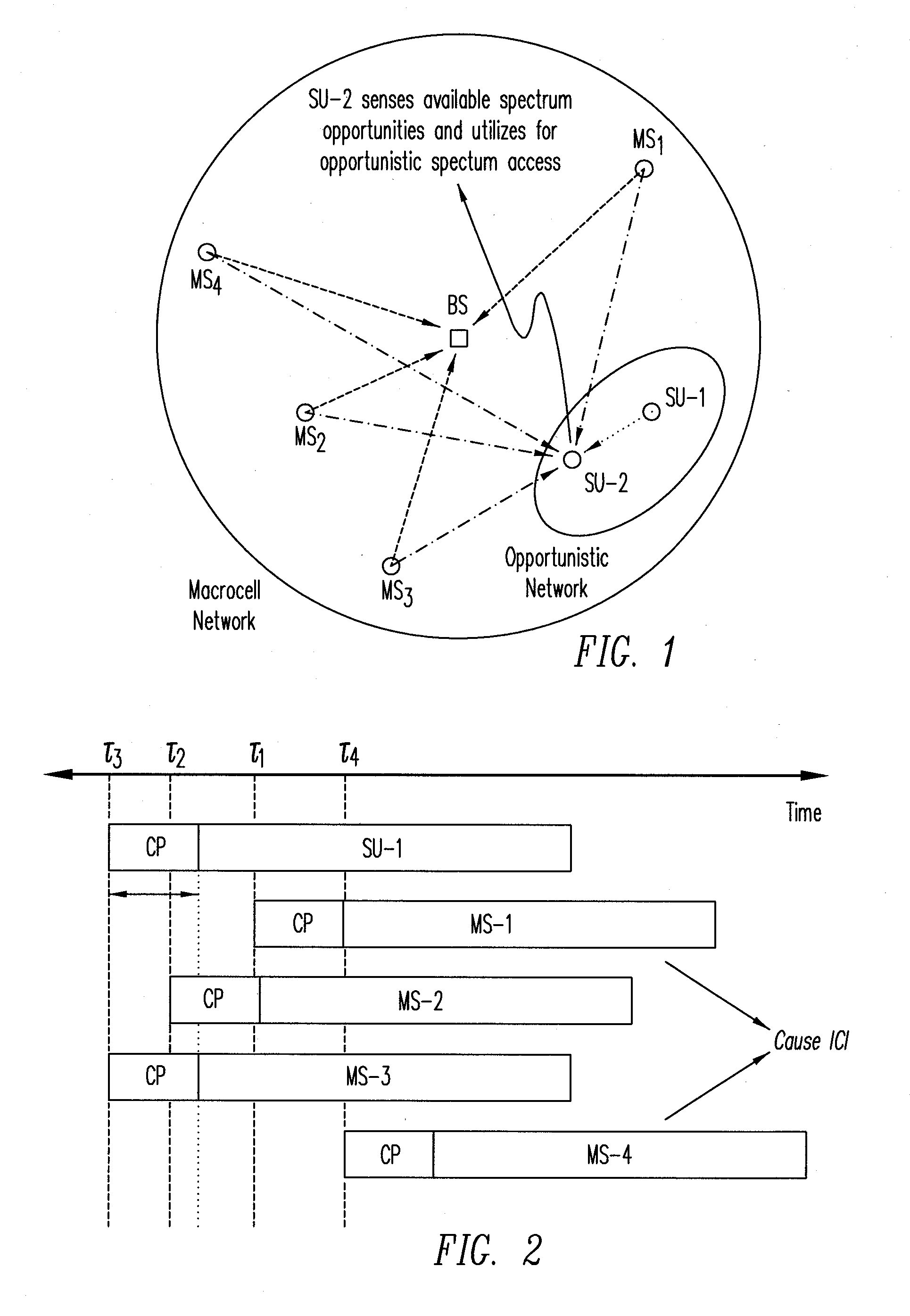
[0034]One potential problem in wireless systems is the crowding of the radio spectrum. The increasing number of different wireless technologies that may be used render the coexistence among systems in the same spectrum complex. Cognitive radio is a possible solution to the potential problem of radio spectrum crowding. At any given time, in conjunction with the OFDMA technology, a cognitive radio system can opportunistically utilize a spectrum (i.e., a range of subcarriers) that is not used by other users in the network. Such opportunistic use of unused spectrum requires either a priori knowledge of spectrum utilization, or the ability to reliably sense spectrum utilization. Failure to reliably sense spectrum utilization may lead to significant probabilities of false alarms (PFA) and misdetections (PMD). FIG. 1 shows a pnmary network (e.g., a macrocell network) having coverage area 100, in which one or more users SU-1 and SU-2 of opportunistic network 101—a secondary network—may accu...

the structure of the environmentally friendly knitted fabric provided by the present invention; figure 2 Flow chart of the yarn wrapping machine for environmentally friendly knitted fabrics and storage devices; image 3 Is the parameter map of the yarn covering machine
Login to View More

PUM

No PUM Login to View More

Abstract

A method for an opportunistic network within a coverage area of a primary network includes (a) spectrum-sensing signals from users in the primary network to identify unused spectrum resources in a spectrum shared between the opportunistic network and the primary network; and (b) based on the spectrum resources identified, assigning the identified spectrum resources to be used among the users of the opportunistic network in one or more block sizes determined from expected interference from the users of the primary network. The method is applicable to a primary network whether or not spectrum resources are assigned to its users using a block-wise subcarrier assignment scheme or a randomized allocation scheme. The identified unused spectrum resources that are to be assigned to the users of the opportunistic network exclude un-used subcarriers adjacent to subcarriers used by the users of the primary network to avoid interference. The opportunistic network may assign the identified unused spectrum resources using a scheme that selects a block size for an adaptive modulation and coding scheme or for avoidance of waste of spectrum resources.

Description

CROSS REFERENCE TO RELATED APPLICATIONS[0001]The present application is related to and claims priority of U.S. provisional patent applications (“Copending Provisional Applications”): (a) Ser. No. 61 / 151,121, entitled “Method for Interference-Minimizing Resource Block-size Selection at a Macrocell, a Microcell and a Femtocell,” filed on Feb. 9, 2009; and (b) Ser. No. 61 / 093,206, entitled “Method for Jointly Utilizing Spectrum Sensing and Scheduling Information for FemtoCell,” filed on Aug. 29, 2008. The disclosures of the Copending Provisional Patent Applications are hereby incorporated by reference in their entireties. The present application is also a continuation-in-part patent application of U.S. Patent Application (“Copending Non-Provisional Application”), entitled “OFDMA-Based Co-channel Femtocell,” Ser. No. 12 / 333,138, filed on Dec. 11, 2008. The disclosure of the Copending Non-Provisional Patent Application is also hereby incorporated by reference in its entirety.BACKGROUND O...

Claims

the structure of the environmentally friendly knitted fabric provided by the present invention; figure 2 Flow chart of the yarn wrapping machine for environmentally friendly knitted fabrics and storage devices; image 3 Is the parameter map of the yarn covering machine
Login to View More

Application Information

Patent Timeline
04 Mar 2010
Publication
US20100056167A1
IPC
H04W72/04
CPC
H04L5/0007; H04L5/0033; H04L5/0037; H04L5/0044; H04L5/0062; H04W84/045; H04W16/14; H04W24/00
Inventors
GUVENC, ISMAIL