
Configuring state machines used to order and select matching operations for determining whether an input string matches any of at least one regular expression using lookahead finite automata based regular expression detection
a technology of finite automata and matching operations, applied in the direction of microcontrollers, program control, instruments, etc., can solve the problems of not exploring the potential benefits of reducing the number of operations and states using out-of-sequence detection methods, and achieve the effect of less memory and very small memory requirements
- Summary
- Abstract
- Description
- Claims
- Application Information
AI Technical Summary
Benefits of technology
Problems solved by technology
Method used
Image

Examples
case 1
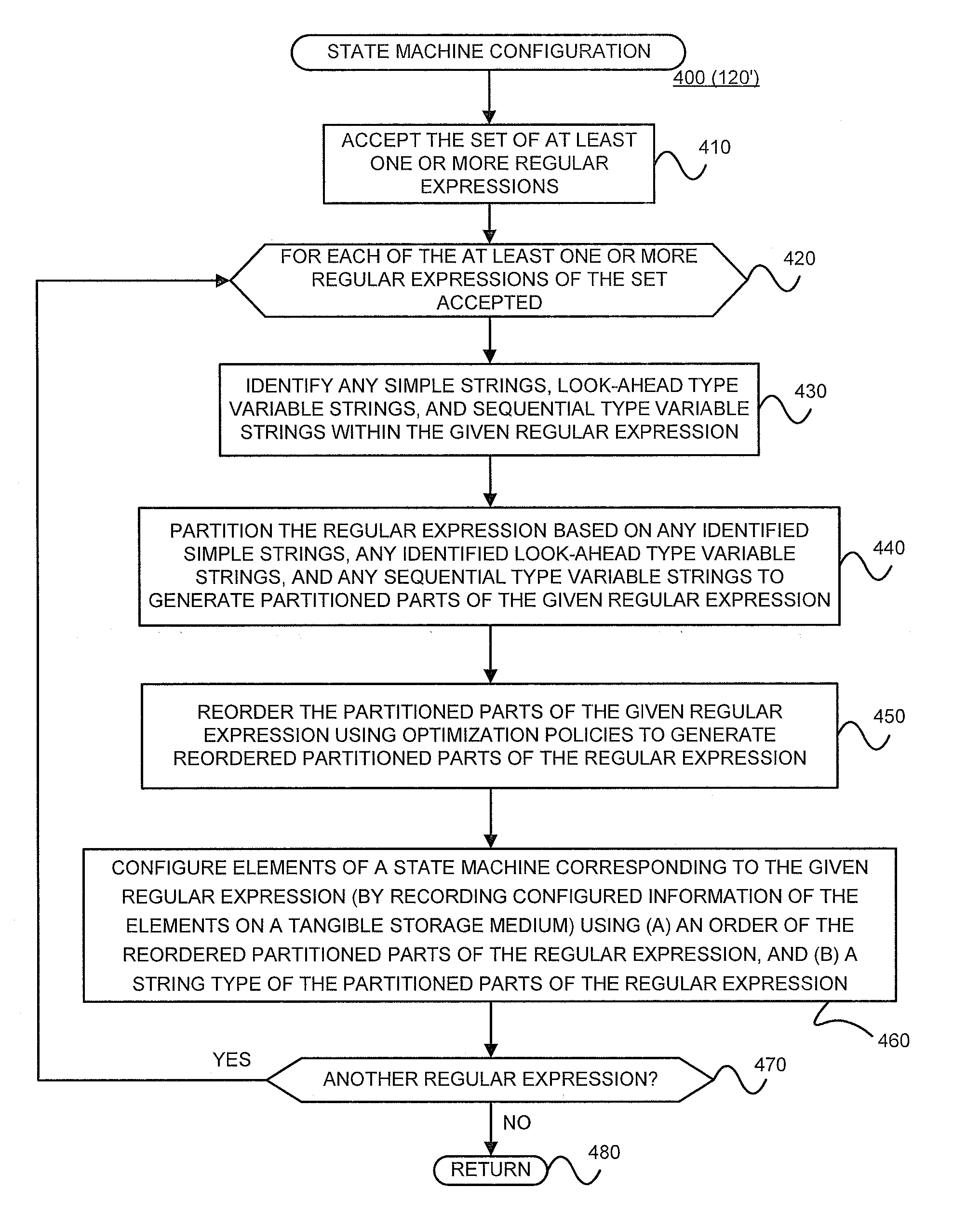
[0065]If a RegEx includes only simple strings S and look-ahead type variable string(s) V1a, then the rule for reordering is as follows. Examining each component and starting from the first component (leftmost component) of the RegEx and moving / scanning towards the right components, for every variable string V1a (or group of adjacent V1a only) that is directly followed by a simple string S, a swap in component positions between the encountered V1a (or group of adjacent V1a only) and the directly following simple string S shall be performed, resulting in a reordered RegEx.
[0066]As an example given for the above case 1, consider the regular expression: RegEx: abc[a-z]xyz[0-9]op→S1:abc, V1: [a-z], S2: xyz, V2 [0-9], S3: op→RegEx: S1 V1 S2 V2 S3. Note that V1 and V2 are look-ahead-type variable strings. Then, applying the reordering rule of case 1, discussed above, to the RegEx: S1 V1 S2 V2 S3→ results in the reordered RegEx: S1 S2 V1 S3 V2.
[0067]The information obtained from this reorde...
case 2
[0068]If a RegEx includes simple strings S and “sequential type” variable string(s) Vseq only, then the RegEx are not reordered. For example, the RegEx: abc[a-z]{3}op→S1: abc, V3: [a-z]{3}, S3: op→RegEx: S1 V3S3 should not be reordered since the V3 is a sequential type variable string Vseq. The information obtained directly from this RegEx (non-reordered) is used for configuring the LaFA state machine such as configuring the nodes and their information in the correlation block.
case 3
[0069]If a RegEx includes simple strings S and both look-ahead type variable string(s) V1a and sequential type variable string(s) Vseq, then the rule for reordering is as follows. Examining each component and starting from the first component (leftmost component) of the RegEx and moving / scanning towards the right components, for every variable string V1a (or group of adjacent V1a only) that is directly followed by a simple string S or variable string Vseq, a swap in component positions between the encountered V1a (or group of adjacent V1a only) and the directly following simple string S or variable string Vseq shall be performed, resulting in a reordered RegEx. Basically, case 3 is similar to case 1, with the variable string Vseq treated like another simple string S (while applying the rules of case 1).
[0070]As an example given for the above case 3, consider the regular expression: RegEx: abc[a-z][a-z]{3}[0-9]{2}op→S1: abc, V1: [a-z], V3: [a-z]{3}, V4: [0-9]{2}, S3: op→RegEx: S1 V1 ...
PUM
 Login to View More
 Abstract
Description
Claims
Application Information
 Login to View More