
Process for Manufacturing a Sweetener and Use Thereof
a technology of sweetener and process, which is applied in the field of process for manufacturing sweeteners, can solve the problems of large amount of toxic organic solvents, and use of artificial sweeteners such as dulcin, sodium cyclamate and saccharin
- Summary
- Abstract
- Description
- Claims
- Application Information
AI Technical Summary
Benefits of technology
Problems solved by technology
Method used
Image

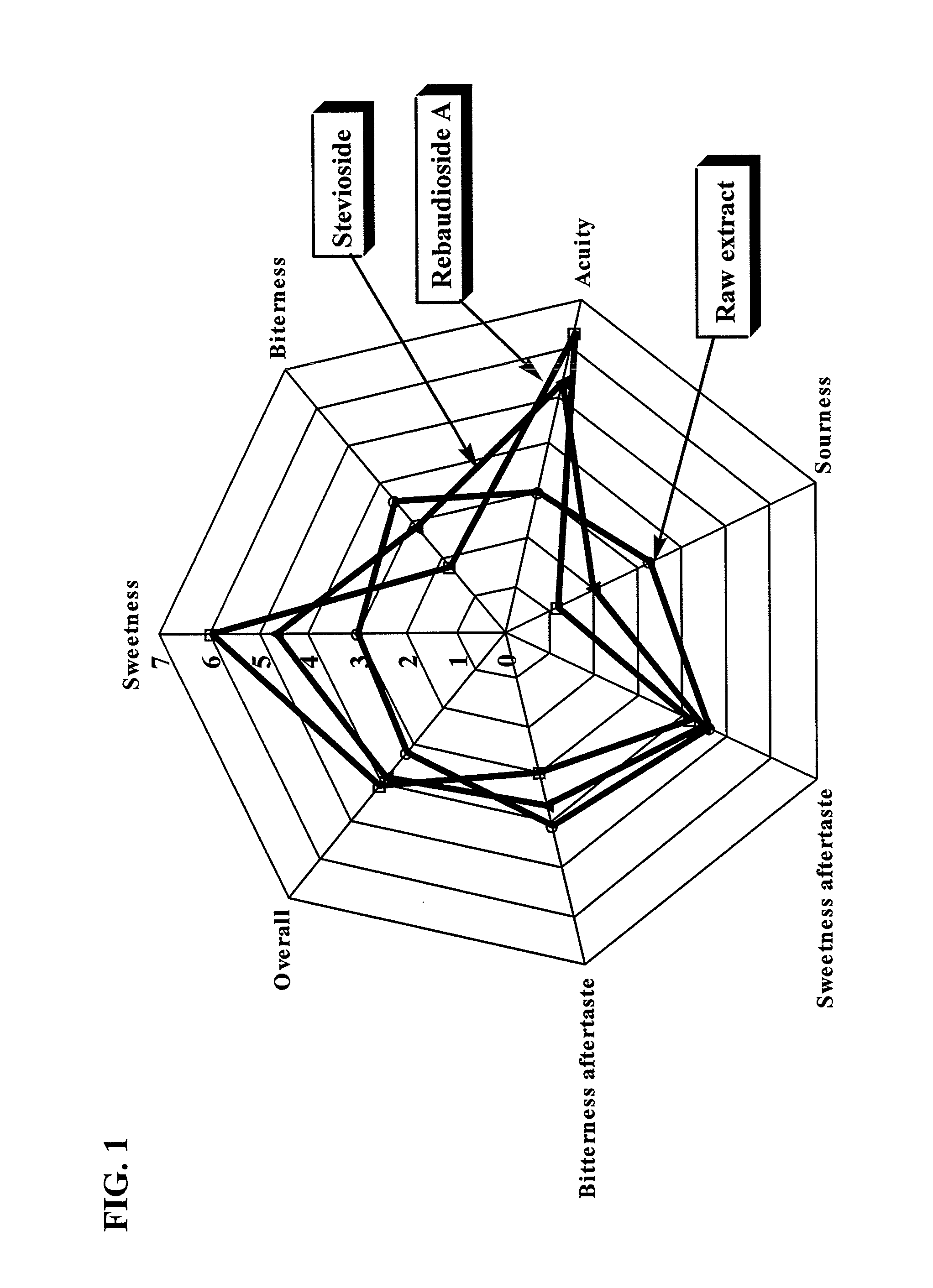
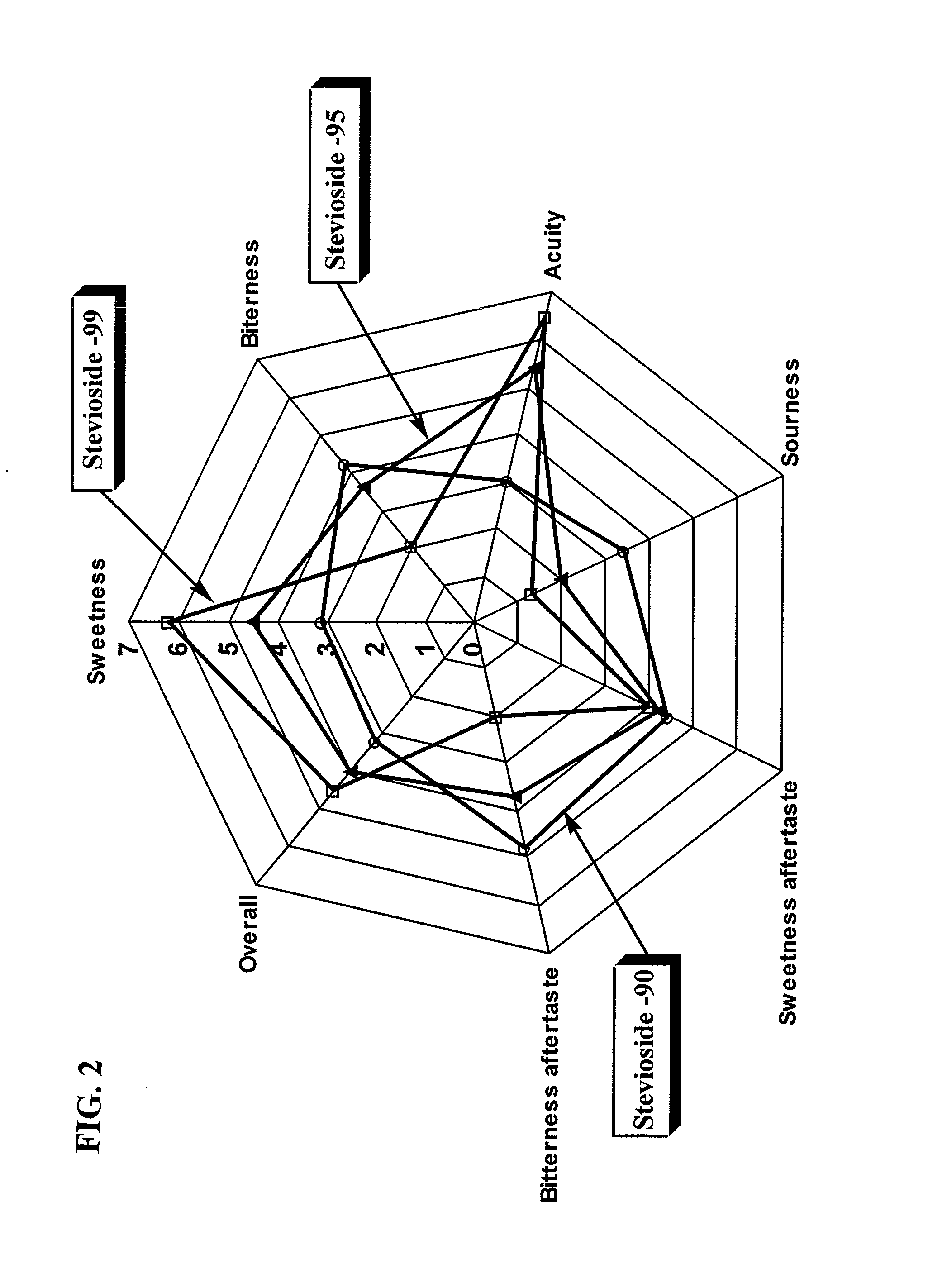
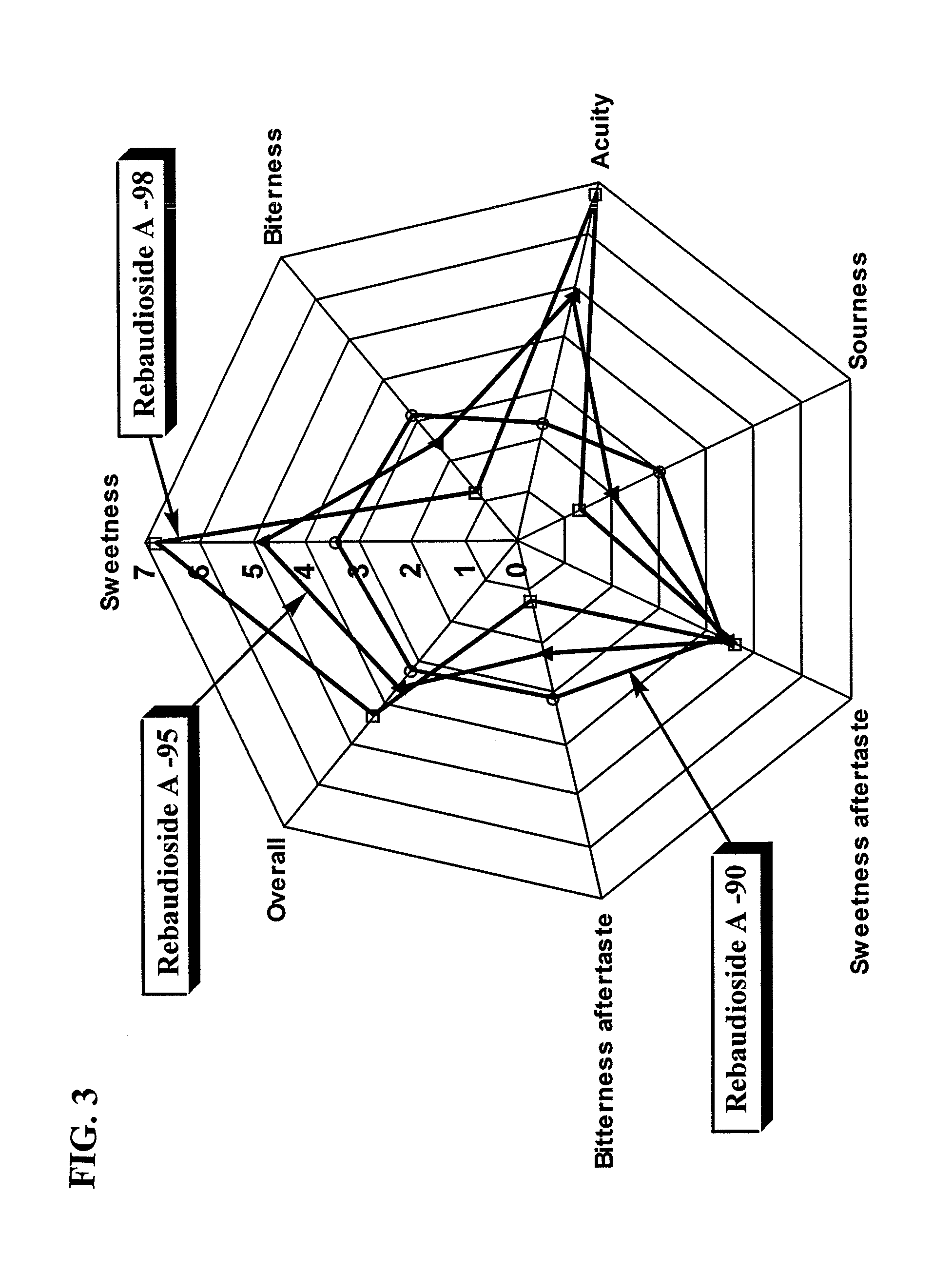
Examples
example 1
Extraction of Sweet Steviol Glycosides
[0041]The leaves of Stevia rebaudiana are dried at 55° C. for three hours in a vacuum oven and powdered (30 mesh). One kg of the obtained material was mixed with 10 liters of water (pH 6.5) and heated to 55° C. with slow agitation for 10 hours. The plant material was separated from the solution by filtration and the pH of the filtrate was adjusted to 10 with about 24 grams of calcium hydroxide and heated to 50° C. for 0.5 hours. The obtained mixture was cooled to ambient temperature and the pH was adjusted to about 7.0 by about 53 grams of FeCl3. After mixing for 15 minutes the precipitate was removed by filtration.
[0042]The slightly yellow filtrate was passed through the Celite, deionized, and decolorized by conventional manner on Amberlite FPC23H, Amberlite FPA51, and Amberlite FPA98Cl commercialized by ROHM & HAAS Co., Germany. The solution was concentrated and spray dried. The yield was 122 grams of powder with a content of sweet glycosides ...
example 2
Preparation of Stevioside
[0043]100 grams (on the base of dry material) of the sweet steviol glycoside powder obtained by the process of EXAMPLE 1 was mixed with 0.5 liters of methanol and maintained at 25° C. for 45 minutes with slow agitation. The precipitate Stevioside was filtered and dried. 61.2 grams of Stevioside with 90.6% purity was obtained.
[0044]For the further purification the powder was mixed with two parts of 90% of ethanol, and maintained at 10-12° C. for about 30 minutes with slow agitation. The precipitate was separated by filtration and dried under vacuum. The product weighed 58.8 grams and contained 99.3% Stevioside. In another embodiment, Stevioside with a purity of at least about 98% was obtained.
example 3
Preparation of Rebaudioside A
[0045]The remaining solutions after separation of Stevioside (EXAMPLE 2) were combined, and methanol was removed by evaporation. The syrup was diluted with water and passed through polysulfone based ultrafiltration membranes (with a filtering discrimination of 2.5 kDa) (Liumar Technologies, Ottawa, Canada) with diafiltration. The filtrate was concentrated and spray dried. 40.8 grams of powder with content of Rebaudioside A of around 60% were obtained. The powder was mixed with five volumes (w / v) of 96.2% ethanol and maintained at 50° C. for 30 minutes with slow agitation. The precipitate was filtered and dried. Rebaudioside A with 89.8% purity was obtained. The powder was mixed with two volumes of 92% of ethanol and maintained at 12° C. for 60 minutes with slow agitation. The crystals were filtered and dried. 23.6 grams of Rebaudioside A of 98.9% purity was obtained. In another embodiment, Rebaudioside A with a purity of at least about 98% was obtained.
PUM
 Login to View More
 Abstract
Description
Claims
Application Information
 Login to View More