Hierarchical ant clustering and foraging

a clustering algorithm and hierarchy technology, applied in the field of clustering algorithms, can solve the problems of limiting the degree of parallel execution, centralized constraint is a hindrance, and clustering algorithms cannot meet the requirements of clustering algorithms

Inactive Publication Date: 2012-11-08
PARUNAK HENRY VAN DIKE +4
View PDF2 Cites 4 Cited by
  • Summary
  • Abstract
  • Description
  • Claims
  • Application Information

AI Technical Summary

Benefits of technology

The method achieves a searchable hierarchy that adapts to changing data, supports efficient retrieval, and scales with nearly linear speed-up using parallel hardware, ensuring continuous and accurate clustering without the need for restarts.

Problems solved by technology

This class of application imposes several requirements on the process that classical clustering algorithms do not satisfy.
Decentralized.Because of the massive nature of the data, the centralized constraint is a hindrance.
Distributed implementations of centralized systems are possible, but the degree of parallel execution is severely limited by the need to maintain the central data structure as the clustering progresses.
Any-Time.Because the stream is continual, the batch orientation of conventional algorithms, and their need for a static set of data, is inappropriate.
Previous researchers have adapted this algorithm to practical applications, but (like the ant exemplar) these algorithms produce only a partitioning of the objects being clustered.
Computer scientists have developed a number of algorithms for sorting things, but no ant in the ant hill is executing a sorting algorithm.
The staged processing in these models has the undesirable consequence of removing them from the class of any-time algorithms and requiring that they be applied to a fixed collection of data.
In addition, some of these algorithms are multi-stage processes that cannot be applied to a dynamically changing collection of documents, and even those that could be applied to such a collection have not been analyzed in this context.
All of the previous ant clustering work produces a flat partition of documents, and thus does not offer the retrieval benefits of a hierarchical clustering.

Method used

the structure of the environmentally friendly knitted fabric provided by the present invention; figure 2 Flow chart of the yarn wrapping machine for environmentally friendly knitted fabrics and storage devices; image 3 Is the parameter map of the yarn covering machine
View more

Image

Smart Image Click on the blue labels to locate them in the text.
Viewing Examples
Smart Image
  • Hierarchical ant clustering and foraging
  • Hierarchical ant clustering and foraging
  • Hierarchical ant clustering and foraging

Examples

Experimental program
Comparison scheme
Effect test

Embodiment Construction

[0048]This section outlines the hierarchical ant clustering (HAC) algorithm, describes an ant-based searching algorithm that can run concurrently with the clustering process, and discusses the performance of the system.

Algorithm

[0049]We introduce the algorithm at an abstract level, then describe its components, and finally discuss alternative detailed implementations.

Abstract View

[0050]To frame the discussion, we first consider the nature of the data structure we want to achieve, and then propose some simple operations that can construct and maintain it.

Objective: A Well-Formed Hierarchy

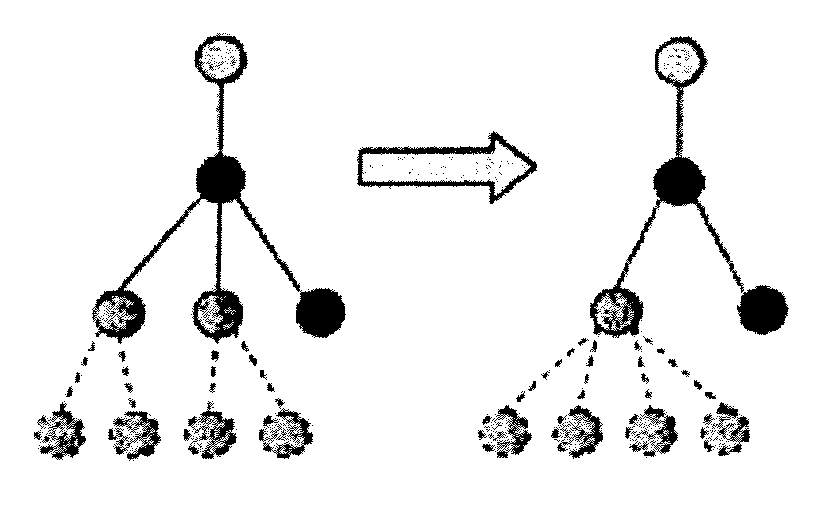
[0051]FIG. 3 is a schematic of a hierarchy. All data lives in the leaves. We constrain neither depth of the hierarchy, nor the branching factor of individual nodes. The set of all nodes N=R∪L∪I has three subclasses:[0052]1. The set of root nodes R has one member, the root, which is an ancestor of all the other nodes, and has no distinct parent, (For simplicity in describing the algorithm, it is conve...

the structure of the environmentally friendly knitted fabric provided by the present invention; figure 2 Flow chart of the yarn wrapping machine for environmentally friendly knitted fabrics and storage devices; image 3 Is the parameter map of the yarn covering machine
Login to View More

PUM

No PUM Login to View More

Abstract

A clustering method yields a searchable hierarchy to speed retrieval, and can function dynamically with a changing document population. Nodes of the hierarchy climb up and down the emerging hierarchy based on locally sensed information. Like previous ant clustering algorithms, the inventive process is dynamic, decentralized, and anytime. Unlike them, it yields a hierarchical structure. For simplicity, and reflecting our initial application in the domain of textual information, the items being clustered are documents, but the principles may be applied to any collection of data items.

Description

[0001]This application is a continuation of U.S. application Ser. No. 11 / 562,437, filed Nov. 22, 2006, which claims priority to U.S. Provisional App. No. 60 / 739,496, filed Nov. 23, 2005, and is entitled to those filing dates for priority. The complete specification and disclosures of U.S. application Ser. No. 11 / 562,437 and U.S. Provisional App. No. 60 / 739,496 are incorporated herein in their entireties by specific reference for all purposes.FIELD OF THE INVENTION[0002]This invention relates generally to clustering algorithms and, in particular, to a hierarchical clustering method that yields a searchable hierarchy to speed retrieval, and can function dynamically with changing data.BACKGROUND OF THE INVENTION[0003]Clustering is a powerful and widely used tool for discovering structure in data. Classical algorithms [9] are static, centralized, and batch. They are static because they assume that the data being clustered and the similarity function that guides the clustering do not cha...

Claims

the structure of the environmentally friendly knitted fabric provided by the present invention; figure 2 Flow chart of the yarn wrapping machine for environmentally friendly knitted fabrics and storage devices; image 3 Is the parameter map of the yarn covering machine
Login to View More

Application Information

Patent Timeline
no application Login to View More
Patent Type & AuthorityApplications(United States)
IPC IPC(8): G06F17/30
CPCG06F17/30705G06F16/35
InventorPARUNAK, HENRY VAN DYKEBELDING, THEODORE C.BRUECKNER, SVENCHIUSANO, PAULWEINSTEIN, PETER
OwnerPARUNAK HENRY VAN DIKE