This helps you quickly interpret patents by identifying the three key elements:
Problems solved by technology
Method used
Benefits of technology
Benefits of technology
The invention aims to provide a way to make composite materials using unidirectional fiber rovings that don't have the production disadvantages of current methods and can be directly processed to molded parts without needing a separate step after the textile structure is made.
Problems solved by technology
However, this procedure requires a high energy expense because the relatively viscous melt has to be pressed into the mat at pressures far above 1 bar.
The production of such fiber structures is quite complex and, moreover, the rovings are not sufficiently opened up during needling of the layers due to the tight binding of the rovings by the stitching threads so that they are only insufficiently and irregularly impregnated with the thermoplastic, whereby the mechanical properties of the molded article thus produced are negatively affected.
Method used
the structure of the environmentally friendly knitted fabric provided by the present invention; figure 2 Flow chart of the yarn wrapping machine for environmentally friendly knitted fabrics and storage devices; image 3 Is the parameter map of the yarn covering machine
View more
Image
Smart Image Click on the blue labels to locate them in the text.
Viewing Examples
Smart Image
Click on the blue label to locate the original text in one second.
Reading with bidirectional positioning of images and text.
Smart Image
Examples
Experimental program
Comparison scheme
Effect test
second embodiment
[0022]In a second embodiment, the fiber mat with randomly oriented fibers B consists of a thermoplastic oriented fiber layer with endless thermoplastic fibers which optionally can also contain endless reinforcing fibers. Preferred thermoplastic fibers are polypropylene fibers with a titer of 600 to 2,400 dtex, which can be finished with generally known stabilizers and adhesion promoters.
[0023]It is preferred for the composite material to comprise exclusively layers A and B, and optionally C, but no further layers of other type.
[0024]The composite material of the present invention preferably contains 30 to 80 wt.-%, particularly 50 to 70 wt.-% UD fibers. Its areal weight is preferably more than 400 to 4,000 g / m2, particularly 1,000 to 1,000 g / m2. In the non-consolidated state the thickness is preferably 5 to 15 mm.
[0025]The reinforcing fiber rovings are, for example, glass, carbon, aramide or basalt fibers with a titer of preferably 100 to 4,800 tex, particularly 200 to 3,000 tex. Pa...
first embodiment
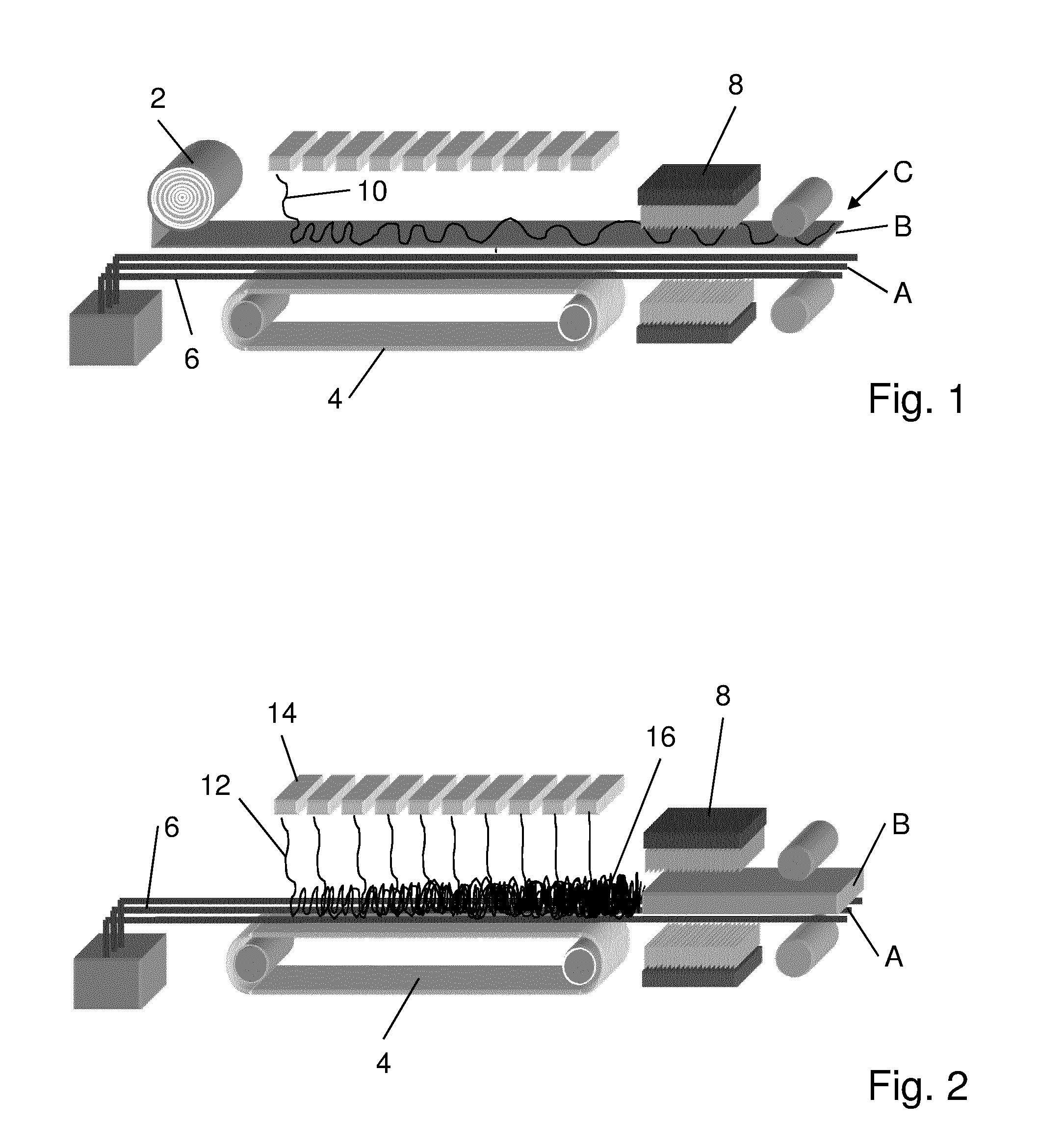
[0028]An implementation of the method for producing composite materials is shown in FIG. 1 as a perspective view. Initially, a fiber nonwoven layer is produced according to the carding or airlay method and needled to form a needle nonwoven 2. The UD fibers 6 are initially laid out next to each other on a circulating endless band (4), preferably as closely to each other as possible, thereby forming a layer A. Thereupon, the prefabricated needle nonwoven 2 is then continuously laid out to form a layer B, and the two layers A, B are then needled to each other in a needling device 8.
[0029]It is also possible to lay out a nonwoven produced according to the airlay or carding method directly onto the UD fibers without needling, and to needle thereafter only.
[0030]If the composite material shall contain further layers A or B, respectively, the corresponding webs can be additionally fed and needled.
[0031]If the composite material shall additionally contain a thin layer C, the randomly orien...
the structure of the environmentally friendly knitted fabric provided by the present invention; figure 2 Flow chart of the yarn wrapping machine for environmentally friendly knitted fabrics and storage devices; image 3 Is the parameter map of the yarn covering machine
Login to View More
PUM
Property
Measurement
Unit
Linear density
aaaaa
aaaaa
Temperature
aaaaa
aaaaa
Weight
aaaaa
aaaaa
Login to View More
Abstract
A planar composite material comprises an UD fiber layer A made of discrete reinforcing fiber rovings and a fiber nonwoven layer B made of a thermoplastic nonwoven which may contain reinforcing fibers, wherein the layers A and B are needled to each other.
Description
CROSS-REFERENCE TO RELATED APPLICATIONS[0001]This application is the U.S. National Phase of PCT Appln. No. PCT / EP2013 / 054844 filed Mar. 11, 2013 which claims priority to European Application No. EP 12158958.4 filed Mar. 9, 2012, the disclosures of which are incorporated in their entirety by reference herein.BACKGROUND OF THE INVENTION[0002]1. Field of the Invention[0003]The invention relates to a planar composite material having at least one layer A made of unidirectional reinforcing fiber rovings and at least one layer B made of a thermoplastic fiber nonwoven or a thermoplastic oriented fiber layer which can optionally contain reinforcing fibers, wherein the layers A and B are needled to each other.[0004]2. Description of the Related Art[0005]Thermoplastics are increasingly being used for producing components, particularly components for automobiles, due to their low weight. To provide them with a sufficient rigidity and strength they are usually compounded with reinforcing fibers....
Claims
the structure of the environmentally friendly knitted fabric provided by the present invention; figure 2 Flow chart of the yarn wrapping machine for environmentally friendly knitted fabrics and storage devices; image 3 Is the parameter map of the yarn covering machine
Login to View More
Application Information
Patent Timeline
Application Date:The date an application was filed.
Publication Date:The date a patent or application was officially published.
First Publication Date:The earliest publication date of a patent with the same application number.
Issue Date:Publication date of the patent grant document.
PCT Entry Date:The Entry date of PCT National Phase.
Estimated Expiry Date:The statutory expiry date of a patent right according to the Patent Law, and it is the longest term of protection that the patent right can achieve without the termination of the patent right due to other reasons(Term extension factor has been taken into account ).
Invalid Date:Actual expiry date is based on effective date or publication date of legal transaction data of invalid patent.


 Login to View More